
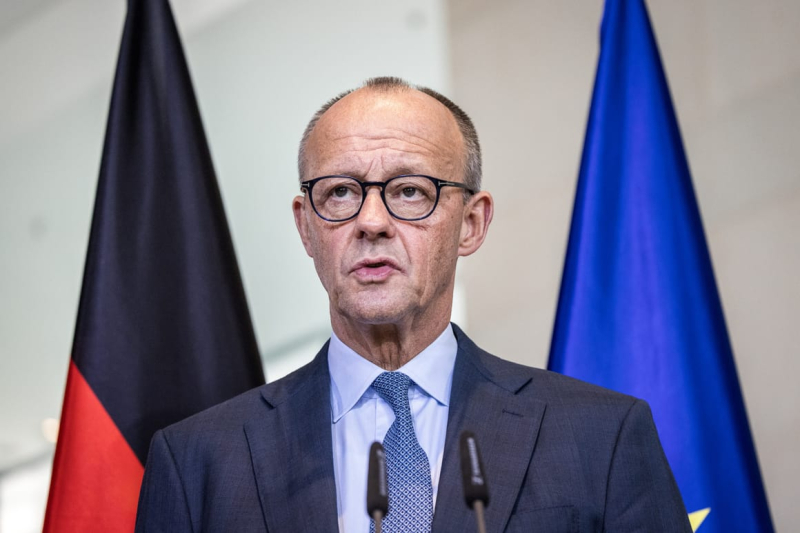

The Slovak prime minister lambasted the German chancellor’s proposal as “blackmail.”
BERLIN — German Chancellor Friedrich Merz on Tuesday reiterated his push to link the EU’s next budget to unanimous backing for a multibillion-euro Ukraine loan, despite Slovak Prime Minister Robert Fico labeling the demand “classic blackmail.”
Supporting Ukraine “is a shared European responsibility, not the responsibility of individual member states,” Merz told reporters at a press conference with Hungarian Prime Minister Péter Magyar. “That is why the question of how we will finance Ukraine in the coming years, if necessary, naturally belongs within the context of these budget negotiations.”
Merz’s demand, which he also laid out in a letter to European Council President António Costa on Friday, has triggered a backlash. “What the German chancellor is doing is classic blackmail, and I reject it,” Fico said Tuesday during a meeting with Czech Prime Minister Andrej Babiš in Bratislava, according to Slovak media.
The EU and partners are currently discussing a new €70 billion loan to support Ukraine in the next year against sustained Russian attacks. The EU plans to shoulder about €45 billion of the loan, while other allies like Britain, Canada and Japan are expected to stump up the remaining €25 billion.
Merz argued that he does not want to repeat last year’s approach, when a different €90 billion loan for Ukraine was agreed only with financial guarantees and liabilities from most EU countries, while three nations — Czechia, Hungary and Slovakia — secured an opt-out.
“In my view, continuing down this path is not a good option. We must fully incorporate Ukraine policy into the EU budget,” he said.
However, that view is not shared by Magyar, who came to Berlin with four ministers and a state secretary to discuss deeper cooperation, underlining the general rapprochement between Germany and Hungary after years of icy relations under Budapest’s previous leader Viktor Orbán.
“I would like to note here — diplomatically and with all due respect as the Hungarian prime minister — that I do not necessarily consider it the right approach for the European budget, which is actually intended for seven years and for Europe,” to be “linked to other matters,” Magyar said.