
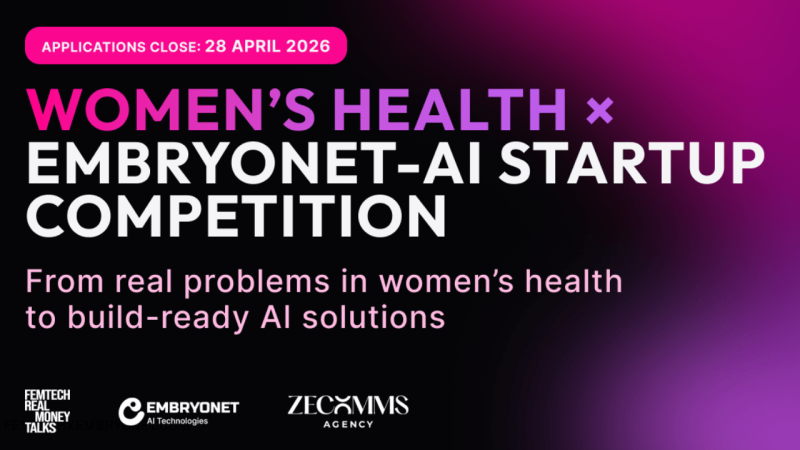

Targeting areas such as endometriosis, fertility, and gynaecological cancers, the competition aims to unlock new AI-driven insights from clinical and imaging data.
Portugal is hosting a first-of-its-kind competition for femtech startups and research labs this spring. It will bring together innovators working at the intersection of artificial intelligence and women’s health.
The initiative was launched by the scientific platform EmbryoNet-AI in partnership with FemTech Real Money Talks Media.
It aims to accelerate real-world breakthroughs by transforming early-stage ideas and clinical questions into working AI solutions.
Organisers have already launched an open call, which will remain open until 28 April 2026, with all submissions due by midnight CET.
The competition is open to Portuguese and international teams with a strong hypothesis and access to imaging or time-series data, and who are seeking to answer critical questions in women’s health using AI, whether in drug discovery, diagnostic support, or clinical research.
Early-stage startups in women’s health that do not yet have a product or MVP are also invited to apply.
According to Elena Lipilina, co-founder and CMO of Embryonet AI, women’s health has long been underfunded and under-researched.
“With this competition, we want to change that and bring light to talented teams that are moving this field forward.”
The contest specifically targets clinical and drug discovery challenges where AI has the potential to make a meaningful impact on women’s health. This includes projects that leverage time-series phenotyping to better understand drug response and disease mechanisms in areas such as gynaecological cancers, endometriosis, and fertility research.
Lipilina explained:
“We are also interested in teams that want to accelerate medical image pre-labelling for datasets derived from mammography, pelvic MRI, ultrasound, or pathology slides, as well as solutions that combine phenotypic and clinical data to support decision-making in clinical trials, biomarker discovery, and treatment stratification.”
Among the applications, organisers will select up to 10 companies based on their potential impact on women’s health, data readiness, alignment with EmbryoNet-AI’s capabilities, feasibility within the program timeframe, and the strength of their business case, alongside ethical and sustainability considerations.
The shortlisted teams will move into the next phase, a Mentor Sprint, taking place in early May 2026. During this period, participants will work closely with experts across technology, marketing, and clinical domains to refine their project scope and strengthen their approach.
The program will culminate in a Live Pitch Day in May 2026, where finalists will present their solutions to a panel of investors and experts in women’s health, AI, and biotech. The winning team will then enter an 8 to 10-week build period, running from May to July 2026, during which EmbryoNet-AI will deliver a fully developed, services-first pilot at no cost.
According to Lipilina, this will allow the team to save between €65,000 and €100,000—the typical cost of developing an MVP, depending on the product’s complexity.
The winner will also gain direct access to investors active in women’s health and AI-driven biotech, as well as enhanced public credibility through investor-ready materials, including pitch decks, and media exposure.