
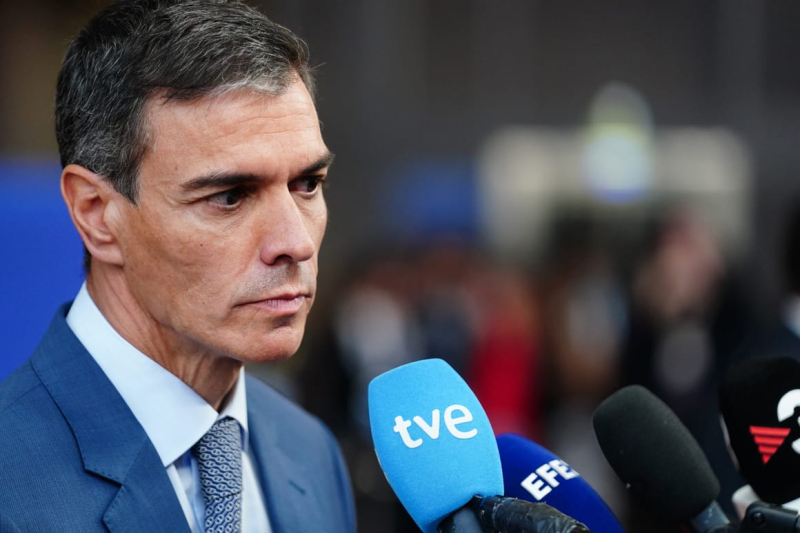

The Spanish leader is struggling to disassociate himself from a number of corruption cases involving his close political allies.
Spanish Prime Minister Pedro Sánchez is under pressure after his former transport minister, José Luis Ábalos, was sentenced to 24 years in prison for corruption on Monday.
Spain’s Supreme Court found the former minister guilty of rigging public contracts for face masks and other medical supplies in exchange for kickbacks at the height of the Covid pandemic. He was convicted of bribery, embezzlement, influence peddling, and membership of a criminal organization, while his former adviser, Koldo García, recieved a 19-year sentence for his role in the scheme.
Businessman Victor de Aldama recieved a suspended a four-and-a-half-year prison sentence and €3.7 million fine after cooperating with prosecutors and providing key documents detailing the inner workings of the corruption scheme. He also alleged that some of the profits he helped embezzle had been funneled to the Socialist Party, but failed to provide evidence to support his claims.
Criticizing the court’s leniency with Aldama, Transport Minister Óscar Puente said society should take note of the ruling. “See, kids? If you commit crimes but then behave and ‘cooperate,’ forgiveness will come through,” he wrote in a post on X. “You won’t even go to prison.”
The ruling increases pressure on Pedro Sánchez, who appointed Ábalos to top posts in both the ruling Socialist Party and his first two governments. Spain’s leader is struggling to disassociate himself from the plethora of corruption cases involving close political allies, relatives and other members of his inner circle.
Shortly after the ruling was announced, opposition leader Alberto Núñez Feijóo, head of the center-right People’s Party, demanded Sánchez’s resignation.
“The prime minister is politically responsible for the corruption of his ministers in office,” he said. “His most trusted advisor, the custodian and errand boy of the Sánchez regime, has been convicted.”
However, Feijóo said he would not attempt to bring a no-confidence vote against Sánchez in the Spanish parliament, as it’s unlikely a majority of lawmakers would back the measure.
The prime minister has vowed to govern until 2027, when the current legislature ends. But on Monday, parliamentary allies like the Republican Left of Catalonia’s Gabriel Rufián questioned whether it made sense for Sánchez to hold on to power when his party is increasingly associated with corruption.
“What is the point of resisting for the sake of resisting?” asked Rufián on X. “Governing is legislating, not resisting.”
A prime minister under fire
Spain’s prime minister once considered Ábalos to be one of his closest allies.
After the Socialist Party’s old guard forced Sánchez to step down in 2016, Ábalos remained a firm supporter and accompanied the ousted politician on a grassroots campaign to regain control of the party.
When Sánchez was reelected to lead the Socialists the following year, Ábalos was boosted to a top party post and tasked with delivering a key anti-corruption speech, which capped the successful no-confidence vote to topple then-Prime Minister Mariano Rajoy in 2018.
Upon resuming office, Sánchez gave Ábalos the development and transport portfolio — a key post overseeing many of the country’s most lucrative public contracts. According to the court’s ruling, Ábalos embezzled funds to lease or purchase several properties and to cover other personal expenses while in the role.
Sánchez has made an effort to distance himself from Ábalos since 2021, when the former minister stepped down from his roles in both the government and party leadership. After Ábalos was placed under pretrial detention earlier this year, Sánchez stated that while he once had “political confidence” in his former ally, “from a personal standpoint, he was a complete stranger to me.”
Those statements have done little to reduce the perception of corruption within Spain’s ruling party and the prime minister’s inner circle, particularly following last month’s indictment of former Socialist Prime Minister José Luis Rodríguez Zapatero — another Sánchez ally — for money laundering, influence peddling and other criminal charges, and a recent raid on the party’s headquarters as part of a separate fraud investigation.
During a hearing last week, Zapatero denied all wrongdoing and promised to “provide the necessary explanations” to prove his “decency and honesty.”
Monday’s ruling concludes the first part of a larger case involving Ábalos and García. Spain’s National Court is handling separate proceedings regarding the alleged rigging of public works contracts in exchange for kickbacks, which involve another former top Socialist official, Santos Cerdán.
In a statement, the prime minister’s office said the government “unequivocally regrets and condemns behaviors that have clearly violated these principles,” and remained “committed to continuing to work to build an exemplary Spain in which corruption is neither applauded nor tolerated.”