
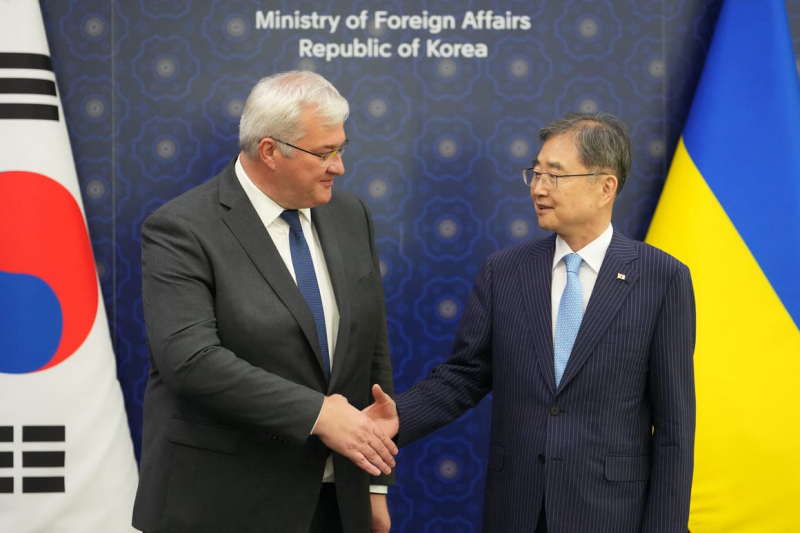

Seoul accused Ukraine of breaching a non-disclosure agreement over the transfer of two North Korean soldiers to South Korea.
Seoul recalled its ambassador to Ukraine on Thursday, two weeks after President Volodymyr Zelenskyy revealed the transfer of North Korean prisoners of war to South Korea, triggering a diplomatic spat.
“The government hopes that pending bilateral issues will be resolved smoothly and will continue consultations with the Ukrainian side to that end,” the South Korean ministry’s statement said.
On Sept 24, South Korean president Lee Jae-myung accused Ukraine of breaching a confidentiality agreement between Seoul and Kyiv after Zelenskyy disclosed the transfer of two North Korean soldiers to its neighbour to the south.
While Seoul publicly pledged to accept North Korean prisoners of war in 2025, Lee said the disclosure on such a “highly sensitive issue” may cause “many problems.”
Kyiv initially denied such an agreement existed according to Ukrainian media, while Ukrainian Foreign Minister Andrii Sybiha later described the situation as a “diplomatic misunderstanding.”
His South Korean counterpart Cho Hyun said Tuesday Sybiha had issued an apology, but suggested it was insufficient. “Because there is some gap with the level we envisioned, we intend to take resolute measures,” he told South Korean lawmakers Tuesday, broadcaster SBS reported.
“This week, we invited the Ambassador of the Republic of Korea to Ukraine to the Ministry of Foreign Affairs to present our position and seek constructive solutions. The Ukrainian side’s position was conveyed to him,” Heorhii Tykhyi, a spokesperson for the Ukrainian’s foreign ministry, told reporters on Thursday. “We are convinced that diplomacy must prevail over emotions. Despite Seoul’s decision to recall the ambassador, Ukraine remains open to resuming a constructive dialogue — even if it takes time,” he added.
South Korea has been broadly supportive of Kyiv since the start of Russia’s full-scale war, which has also strengthened ties between Moscow and Pyongyang. Tens of thousands of North Korean soldiers have been sent to join Russian troops, and Zelenskyy claimed in June that Russia was seeking to bring more North Koreans to the conflict.
This article was updated. Veronika Melkozerova contributed reporting.