
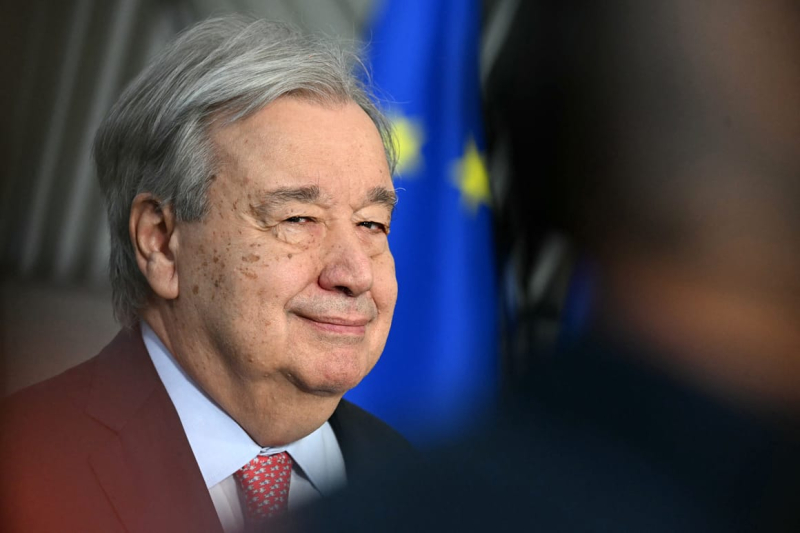

United Nations Secretary-General António Guterres decries attacks on energy infrastructure in an exclusive interview with POLITICO.
BRUSSELS — United Nations Secretary-General António Guterres said Thursday there are “reasonable grounds” to believe both sides in the U.S.-Israel conflict with Iran may have committed war crimes, as attacks and retaliatory strikes on energy facilities intensify.
Speaking exclusively to POLITICO on a visit to Brussels before Thursday’s European Council summit, Guterres said: “If there are attacks either on Iran or from Iran on energy infrastructure, I think that there are reasonable grounds to think that they might constitute a war crime.”
Israel attacked Iran’s South Pars natural gas field on Wednesday, then Tehran launched a retaliatory strike on a major energy complex in Qatar. Beyond that, Guterres said the growing civilian casualties left both sides in the conflict open to possible war crimes charges.
“I don’t see any difference. It doesn’t matter who targets civilians. It is totally unacceptable,” he said.
Representatives for the U.S. and Israeli governments did not immediately respond to requests for comment on Guterres’ remarks. America and Israel began a bombing campaign on Feb. 28, killing Iran’s supreme leader and sparking ongoing retaliatory missile-and-drone attacks from Tehran on sites across the Middle East.
Having called for deescalation in the region, Guterres appeared to blame Israel for driving the conflict forward, and called on U.S. President Donald Trump to persuade Israeli leader Benjamin Netanyahu to bring it to an end.
“The war needs to stop … and I believe that it is in the hands of the U.S. to make it stop. It is possible [to end the war], but it depends on the political will to do it,” Guterres told host Anne McElvoy for an episode of the EU Confidential podcast publishing Friday morning.
“I am convinced that Israel, as a strategy, wants to achieve a total destruction of the military capacity of Iran and regime change. And I believe Iran has a strategy, which is to resist for as much time as possible and to cause as much harm as possible. So the key to solve the problem is that the U.S. decides to claim that they have done their job.
“President Trump will be able to convince … those that need to be convinced that the work is done. That the work can end,” Guterres added.
The secretary-general also attributed America’s decision to launch strikes on Iran to Israel.
“I have no doubt that this was something that corresponds to Israel’s strategy … to draw the United States into a war. That objective was achieved. But this is creating dramatic suffering in Iran, [and] in the region, even in Israel. And it is creating a devastating impact in the global economy and whose consequences are still too early to foresee. So, we absolutely must end this conflict,” he said.
But finding an off-ramp might prove difficult, and relations between the U.N. and the Trump administration remain frosty.
Asked if he had spoken with Trump since the conflict began three weeks ago, Guterres responded emphatically: “No, no, no … I speak with those I need to speak to. But this is not a soap opera.”
He claimed, however, to have been “in contact with all sides,” including with the Trump administration, since hostilities spread across the Gulf.
“It’s vital for the world at large that this war ends quickly,” Guterres said. “This is indeed spiraling out of control and the recent attacks represent an escalation that is extremely dangerous.”
Trump said on his Truth Social site that the U.S. had not authorized the attack by Israel on the South Pars site, and that Israel had “violently lashed out,” raising questions about how much influence the U.S. has over its ally.
“My hope is that the United States will be able to understand that this has gone too far,” Guterres said.
The conflict was primarily benefitting Russia, Guterres added, with Moscow welcoming the distraction from its own war on Ukraine.
“Russia is the biggest beneficiary of the Iran crisis,” Guterres said. “Russia is the country that is gaining more with what’s happening in this horrible disaster. Russia is already the winner.”
Meanwhile, European leaders, including U.K. Prime Minister Keir Starmer and German Chancellor Friedrich Merz, have said they won’t be sending ships to the Persian Gulf in response to Trump’s appeal for help to open the Strait of Hormuz. France has said it will only contribute support vessels “when the situation is calmer.”
Guterres applauded the restraint shown by the Europeans, despite Trump’s anger at their refusal to actively support the war or help reopen the Strait of Hormuz, a critical maritime artery that Iran has largely sealed off, driving up global energy prices.
“I think these countries made their own reading of the situation, and I believe they took a decision not to get too much involved, knowing that the most important objective is the deescalation,” he said.
Listen to the full episode of EU Confidential on Friday morning.