
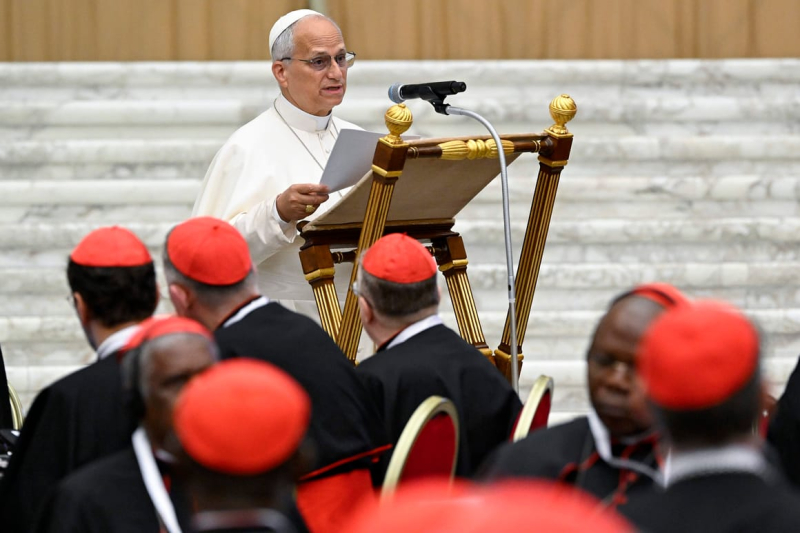

Doctrinal chief in Rome says the European Union applies international law selectively, sanctioning some military invasions but not others.
ROME — Opening Pope Leo XIV’s closed-door conference of the world’s cardinals on war, the Vatican’s doctrinal chief accused the European Union of applying international law selectively, sanctioning some military invasions while treating others differently.
The rare gathering was called by Leo to examine what he calls a global “culture of power” that fuels modern conflict and to consider how the Church should respond. A central focus of the discussions was the pope’s effort to rethink the traditional doctrine of a just war, which he argues has too often been invoked to justify military action.
That position has already brought Leo into conflict with U.S. Vice President JD Vance, who challenged the pope’s interpretation of Catholic teaching after Leo questioned whether the U.S.-Israeli strikes in Iran could meet the criteria of a just war.
Introducing the discussions on Friday, Cardinal Víctor Manuel Fernández, prefect of the Dicastery for the Doctrine of the Faith, argued that governments increasingly apply moral and legal principles according to political convenience rather than universal standards.
“If a country is an enemy, it is condemned as undemocratic and sanctioned in various ways; but if it is an ally, the fact that it lacks freedom of expression, human rights or democracy is ignored,” he said.
Turning to Europe, Fernández accused the EU of inconsistency in foriegn policy.
“The European Union, in fact, imposes economic sanctions on one country, and sends financial aid and weapons to another; yet fails to do the same in the face of other, even more serious invasions with even more brutal consequences for entire populations,” he said.
“These contradictions … suggest that, in practice, concerns boil down to the political and economic interests of different regions of the globe,” Fernández said. “There is no longer a real and stable framework of truth and values.”
Fernández argued that governments have stretched the concept of legitimate self-defense in warfare beyond recognition, citing Russia, the United States and other powers as relying on broad claims of self-defense to justify military intervention from Ukraine to the Middle East.
Catholic teaching on just war is itself manipulated by some to legitimize “the most unjust wars,” he said. “Instead of stopping wars, it helps to justify them.”
To prevent that, Fernández argued that the justification of legitimate self-defense must be understood “in the strictest sense,” rejecting the broad logic of preventive war that governments increasingly invoke to justify military action. That position is likely to deepen Leo’s disagreement with Vance, who has defended a broader reading of Catholic teaching on just war.
His remarks appeared to resonate with the global college of cardinals. After the discussions, the Vatican said in a synthesis of discussions that “many” of the cardinals’ working groups agreed on the need to move beyond the traditional doctrine of just war.
In his final speech to the group on Saturday, Leo signaled the debate on just war is far from over.
He welcomed advice from the cardinals on reexamining the Church’s teaching on legitimate self-defense “in light of the profound changes in the nature of contemporary conflicts,” pledging to address the issue “with the necessary theological and pastoral rigor.”