
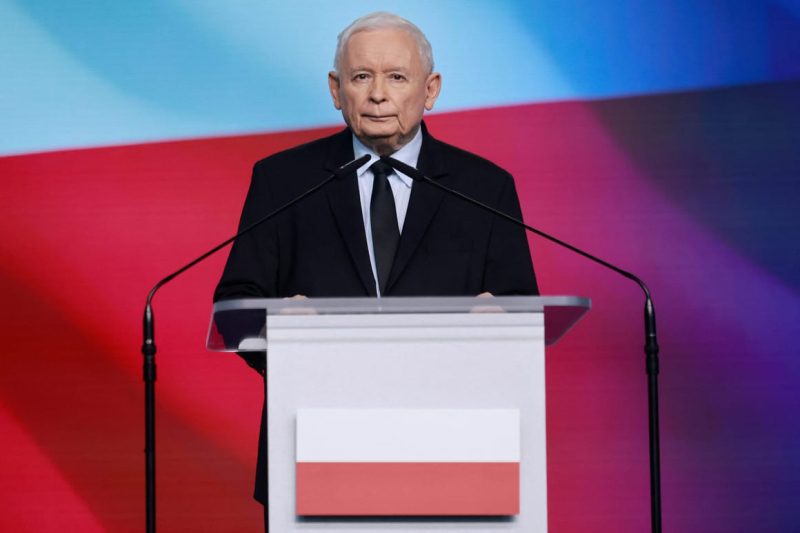

The rupture of Law and Justice is strengthening hardline parties that oppose Ukraine’s EU membership and may hold the key to Poland’s next government.
Poland’s opposition is shifting further to the right ahead of an election next year and that threatens to have a major impact for the EU and Ukraine.
The nationalist Law and Justice party (PiS) that ran the country from 2015 to 2023 — picking repeated battles with Brussels over rule of law and LGBTQ+ rights — split last Friday. At its heart, the feud centers on a clash between iron-fisted party leader Jarosław Kaczyński and former Prime Minister Mateusz Morawiecki.
The big question is what that rupture means for the political trajectory of a country that has one of the largest militaries in NATO and has been a key strategic ally to Kyiv since the Russian invasion.
Allies of pro-EU Prime Minister Donald Tusk read it as good news. When Kaczyński stepped to the microphone to kick out Morawiecki, two lawmakers from Tusk’s governing coalition filmed themselves watching the speech, eating popcorn.
You can see why they might be happy. Before the split, POLITICO’s Poll of Polls put Tusk’s Civic Coalition at 32 percent support and PiS at 26 percent. PiS has now slumped to 22 percent.
But that is hardly the whole story. The combined forces of right-wing parties are still in a strong position if they team up for the 2027 election. And Friday’s split means that PiS is more likely to veer right in its alliances, choosing ideological consolidation over an attempt to win back the center.
The wing of PiS led by Morawiecki had argued the party needed to broaden its appeal and adopt a less combative approach toward Brussels. Kaczyński instead appears determined to recapture voters who have defected further right.
It is far from certain, however, how successfully Poland’s far-right parties can agree on a common agenda with PiS.
Among the potential beneficiaries of Friday’s split are parties that oppose Ukraine joining the European Union — and, in the case of Grzegorz Braun’s Federation of the Polish Crown movement, advocate taking Poland out of the bloc altogether.
Poland votes in the fall of 2027. On current polling, most plausible routes to a right-wing majority would require the Konfederacja party, Braun’s party or both.
“For years, a right-wing voter in Poland had no alternative. If you had right-wing views, you voted for Law and Justice, because there was nothing else,” said Anna Bryłka, a member of the European Parliament and vice-president of Konfederacja, the biggest of the hard-right parties now gaining sway. “Today that alternative exists. Law and Justice is simply losing its hegemony on the right.”
The breakup came to a head over a midnight deadline to renounce the faction Morawiecki had built inside the party, or leave. About 45 lawmakers refused to sign. Kaczyński declared them outside the party, triggering PiS’s most serious rupture in two decades.
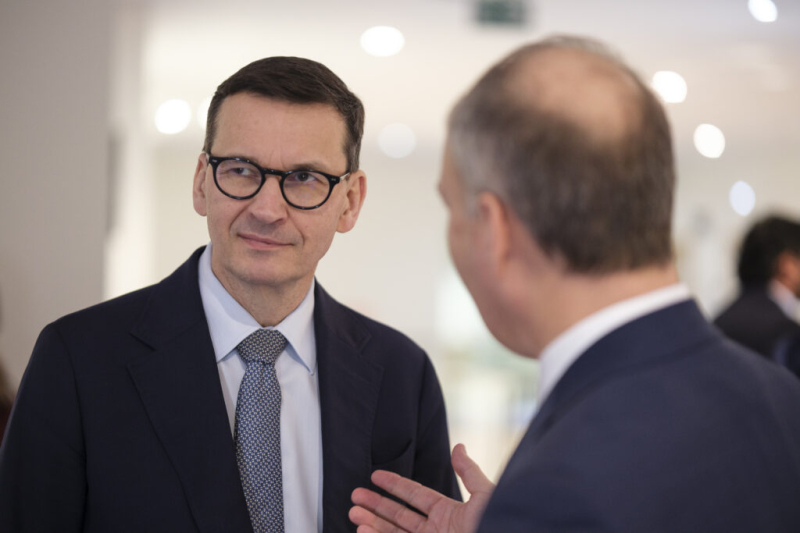
Morawiecki, prime minister until 2023, was hardly a centrist by European standards. But within PiS, his supporters represented a more economically liberal and tactically less confrontational camp — and a rival center of power.
Yet PiS is bleeding voters rightward anyway. Kaczyński selected hardline former Education Minister Przemysław Czarnek as his preferred candidate for prime minister to win back Konfederacja’s electorate. The polls slid regardless.
“Why would a voter choose the copy,” Bryłka said, “when they can vote for the original?”
The kingmakers name their price
In surveys testing a separate Morawiecki list, support for PiS falls to between 16 and 22 percent, Konfederacja takes roughly 13 to 15 percent and Braun’s party about 10 percent. Morawiecki’s Rozwój Plus (Development Plus) project has backing ranging from below the 5 percent parliamentary threshold to around 7.5 percent.
No party with such weak support can govern alone. Bryłka’s conditions for forming a right-wing alliance hinge on Brussels: There must be no more transfer of powers to the EU, no softening on the climate policy that her party has opposed since 2019, and a firm “no” to Ukraine’s membership of the EU.
Even Braun, whom Kaczyński has called too toxic for any coalition, is not beyond the pale for her party. “We maintain good relations,” said Michał Wawer, Konfederacja’s treasurer and a member of the national parliament. “We are ready for cooperation in government in the future, if the majority works out that way.”
Morawiecki’s camp has ruled that out. “Not a chance,” said Paweł Jabłoński, a former deputy foreign minister expelled with Morawiecki. Braun’s party, he added, “is destructive.”
Others in PiS are less categorical. “There is no enemy on the right,” Kaczyński loyalist Jacek Sasin told reporters Friday, floating “some form of non-aggression pact.”
The real enemy, he added, was Tusk’s coalition.
Can the right unite?
For all the acrimony, Morawiecki’s breakway camp is not looking across the aisle. Jabłoński said his group wants to keep cooperating with PiS, and ruled out any deal with Tusk — whose coalition, he said, remains the opponent.
The one figure who could reach across the splintered right and unify it is President Karol Nawrocki, elected last year with the support of PiS and Konfederacja voters — and talk of a single right-wing list under his presidential umbrella has circulated in Warsaw for months.
Kaczyński has embraced a version of the idea.
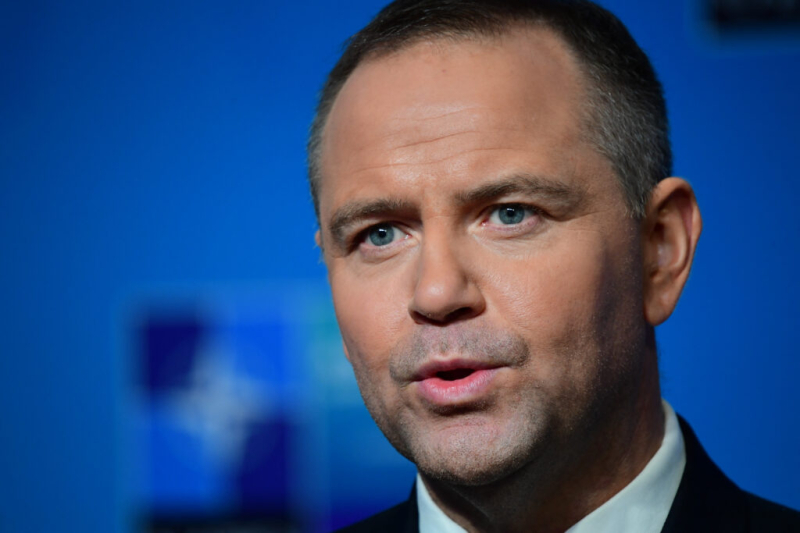
“We are working to win the election, to unite as large a part of the right as possible, so that we go on one list,” he said in June — provided Konfederacja drops its hostility toward PiS. Braun, he made clear, would not be invited.
“Only Karol Nawrocki can sort this out,” Bryłka said. “He could be the patron of some reconciliation between Jarosław Kaczyński and Prime Minister Morawiecki” — a reconciliation she expects to happen sooner or later anyway.
“The question is whether he wants that role,” she added. “He has all the tools — and everything suggests he does.”
Not that governing would be simple. Building a coalition of three parties is difficult enough, Bryłka said. “From four, it’s a genuinely complicated process.” Her forecast for the next parliament? “Chaos.”
But even a fragmented right would not automatically save Tusk.
In one poll conducted by IBRiS, the combined support of the right-wing parties did not fall after the PiS rupture. It edged up, from 47.5 percent to 47.9 percent. The voters leaving Kaczyński appear to be shopping elsewhere on the right, not crossing over to Tusk. Meanwhile, the prime minister’s own coalition is fraying: Of his governing partners, only the Left is consistently polling above the threshold required to enter parliament.
Tusk’s likeliest path to survival is the right wasting its own votes.
If Morawiecki runs independently and falls below the 5 percent threshold, his supporters’ ballots would win no seats. Konfederacja is candid about the risk that would pose to the entire right.
“Those 4 percent of lost votes could decide what the majority looks like,” Wawer said.
Tusk has been sounding less cheerful than the lawmakers with the popcorn.
“I won’t cry for Law and Justice,” he told reporters Monday, “but there is certainly nothing to celebrate.”