

Contents
European tech funding slowed in August, with investment and deal activity falling sharply from July. The UK remained the leading market, while AI continued to attract a significant share of capital.
European tech investment slowed considerably in August, with companies raising €3.2 billion across 165 funding rounds. This was a marked decline from July, when €8.6 billion was invested across 267 deals, representing a month-on-month drop of around 63 per cent in funding and 38 per cent in deal volume.
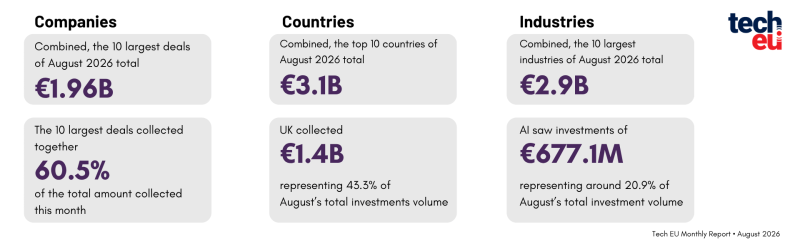
The UK remained Europe’s largest funding market, attracting €1.4 billion, or approximately 44 per cent of the month’s total. AI was among the leading sectors, securing €677.1 million and accounting for around 21 per cent of overall investment. However, funding for AI companies fell by approximately 62 per cent from €1.8 billion in July.
Exit activity followed a similar trend, with 37 exits recorded during August, down from 51 in the previous month.
Our Cate Lawrence, Senior Journalist at Tech.eu, commented on the August numbers within the European tech investment landscape in our monthly report:
European tech investment cooled in August. The UK led European funding, with companies raising €1.4 billion, while AI remained the biggest magnet for capital, attracting €677.1 million. Software, fintech, semiconductors, security, healthtech, robotics, energy and space also attracted significant investment.
August marked a sharp slowdown from July, but substantial investment in AI and other deep and strategic technologies suggests investors remain willing to deploy significant capital into companies with strong growth potential.
For her more detailed review and more in-depth analyses of the European tech ecosystem, including industry and country performance, exit activities, and more, check out our August report.

Here are the 10 largest tech deals in Europe from August, accounting for 60.5 per cent of the month’s total funding.
1

Lovable (Sweden)
Amount raised: $400M
Lovable develops an AI-powered software development platform that allows users to build and deploy applications using natural-language prompts.
The Stockholm-based company targets both non-technical users and businesses, using multiple AI models to support software creation and increasingly proactive development workflows. Applications built using the platform receive hundreds of millions of visits each month.
The company raised $400 million in Series C funding to expand its business customer base, grow its team across Sweden and the US, and further develop the platform beyond prompt-based interactions.
2

Olix (UK)
Amount raised: $312M
OLIX develops computing infrastructure for AI inference, designing the chips, optical interconnects and networking systems that make up its platform.
Its X-1 architecture distributes AI inference workloads across specialised chips connected through optical technology, while its first chip, DX-1, is designed specifically for the decode stage of AI models.
The company raised $312 million in Series B funding to deliver DX-1 to its first customers, build out its wider custom silicon platform, and support the manufacturing and supply-chain commitments required to scale its hardware.
3

Cambridge Aerospace (UK)
Amount raised: $300M
Cambridge Aerospace develops defence technology focused on counter-drone and air-defence systems.
Its products include the Skyhammer drone interceptor, Starhammer missile interceptor and Looking Glass radar system, with the company securing contracts to supply technology to the UK Ministry of Defence.
Cambridge Aerospace raised $300 million in Series C funding to expand its manufacturing capabilities, fulfil existing and new contracts, continue developing its current products and bring new defence systems to market.
4

Volta (UK)
Amount raised: $300M
Volta develops AI infrastructure combining compute capacity with infrastructure financing to help companies deploy large-scale GPU systems without bearing the full upfront cost.
The company is developing data centre capacity and financing programmes for AI companies, alongside long-term cloud computing agreements.
Volta raised $300 million in venture funding to build out its AI infrastructure platform and support the expansion of compute capacity for customers.
5

Gravis Robotics (Switzerland)
Amount raised: $200M
Gravis Robotics develops autonomous technology for heavy construction machinery.
The ETH Zurich spinout builds software that can transform existing excavators and other heavy equipment into autonomous machines capable of carrying out work on construction sites without human drivers. Its technology combines machine telemetry with physical inputs to adapt equipment to changing ground and operating conditions.
Gravis Robotics raised $200 million in Series A funding from SoftBank to scale its autonomous heavy machinery technology globally.
6

PLD Space (Spain)
Amount raised: €158.9M
PLD Space is a space transportation company developing reusable launch vehicles and related infrastructure for satellite and payload missions.
Its portfolio includes the MIURA family of launchers, with MIURA 5 designed to provide dedicated and rideshare orbital launch services for small payloads. The company vertically integrates rocket engineering, manufacturing, testing and launch operations.
PLD Space was awarded €158.9 million by the European Space Agency under the European Launcher Challenge to support Europe’s autonomous and competitive access to space.
7

Ingenico (France)
Amount raised: €150M
Ingenico develops payment acceptance technology for merchants, banks and other financial services providers.
Its offering spans payment terminals, software, services and cloud-based platforms designed to support in-person commerce and simplify payment operations. The company is developing its next generation of payment acceptance technology around cloud-based infrastructure.
Ingenico secured €150 million in new capital from a PIMCO-led investor group to accelerate product innovation and strengthen customer services and support.
8

HappyRobot (Spain)
Amount raised: $150M
HappyRobot develops an AI platform for automating complex enterprise operations across voice, email and messaging.
Its AI agents integrate with business systems to carry out workflows such as scheduling, shipment tracking, maintenance coordination and customer interactions. Initially focused on logistics, the company is expanding into sectors including energy, insurance, telecommunications and airlines.
HappyRobot raised $150 million in Series C funding to expand its AI capabilities and enterprise integrations, strengthen its infrastructure and grow its engineering, deployment and go-to-market teams globally.
9

Nexeon (UK)
Amount raised: €116.7M
Nexeon develops silicon-based anode materials for lithium-ion batteries, targeting applications including electric vehicles and consumer electronics.
Its technology is designed to replace or supplement conventional graphite anodes, with the aim of increasing battery energy density and improving performance while supporting the development of next-generation battery cells.
Nexeon raised €116.7 million to expand its UK operations, strengthen the domestic battery supply chain, create jobs and support further growth.
10

Elekta (Sweden)
Amount raised: €100M
Elekta develops medical technology for treating cancer and neurological conditions, including radiotherapy, radiosurgery and related software systems.
Its technologies are used by healthcare providers to deliver precision radiation treatments while supporting clinical workflows and treatment planning.
Elekta secured up to €100 million in financing from the European Investment Bank to fund research and development focused on the next generation of cancer and neurological treatments as part of a broader research programme running through 2029.
1/10