
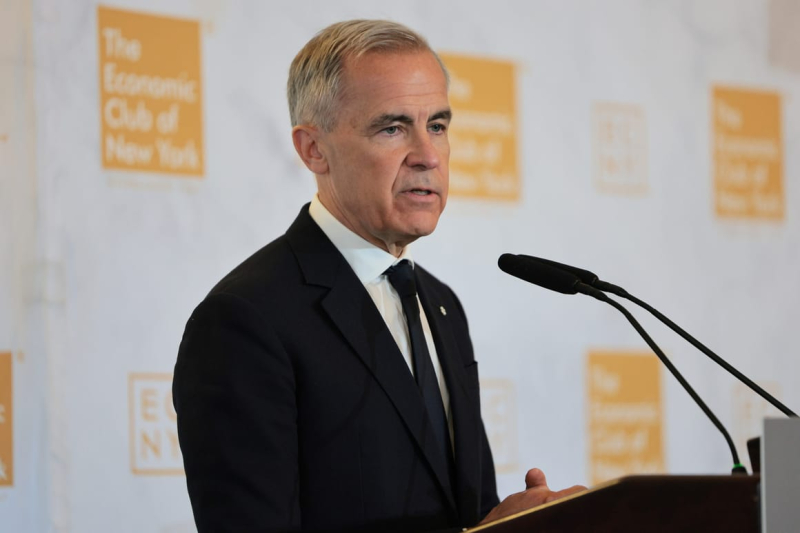

Amid the ongoing clash between Ottawa and Washington, Dublin is working hard to stay out of the kerfuffle and charm both sides with its famous hospitality.
DUBLIN — Two contrasting ways of dealing with U.S. President Donald Trump are set to politely collide this weekend, when Canadian Prime Minister Mark Carney makes his first official visit to Ireland.
Carney has been embroiled in a clash with Trump since taking office last year. The president frequently insults his Canadian counterpart and has even floated the idea of making America’s neighbor to the north its 51st state. In response to the relentless shellacking, the prime minister has taken to promoting the idea of a world in which smaller democracies band together to resist bullying by the big powers.
But that message is unlikely to be embraced fully by Irish Taoiseach Micheál Martin, who is set to meet Carney in Dublin before the Canadian leader travels to his ancestral home in County Mayo. Ireland is a country that is dedicated to schmoozing Washington and is reluctant to do anything that could undermine the great pains it has taken to stay on the U.S. president’s good side.
“We will be resolutely and sincerely pro-Canada. We will just as resolutely avoid saying a syllable that might be construed in any way as critical of Donald Trump or his administration,” an Irish government official helping to plan Carney’s visit told POLITICO.
“We’re all about building bridges and staying out of any unnecessary fights,” said the official, who was granted anonymity to speak frankly about Ireland’s diplomatic realpolitik.
“It wouldn’t be in our interests to criticize any ally or any partner — but particularly not America with Canada in town,” the official added. “We are hugely dependent on staying in America’s good graces and I’m sure Mark Carney understands that well.”
The rationale for Irish obsequiousness is grounded in the reality that Ireland today serves as an American corporate satellite off the coast of Europe.
While Canada is keen to transform its economy to be less dependent on U.S. tech giants, Ireland can’t imagine a world without them. The country is home to nearly 1,000 U.S. multinationals — among them, a Who’s Who of top American tech, pharma and medical companies — who have been wooed here, in part, by low taxes.
That concentration of U.S. firms funds nearly a fifth of Irish wages, even more of its tax base, and has transformed tiny Ireland into an export superpower. Much of the goods produced, particularly in pharma, go back to the U.S. market rather than into the EU, producing one of America’s biggest trade imbalances.
And the Irish tax take from U.S. companies based here keeps hitting record highs despite Trump policies designed to reverse the flow.
While the economic ties that bind Dublin and Washington are fundamental, the Irish have forged more humble links with Ottawa, with only 75 Canadian companies operating from Ireland.
And the Irish haven’t done much to change that dynamic. Ireland is among the EU laggards in ratifying the Comprehensive Economic and Trade Agreement (CETA), the decade-old treaty seeking to boost business between Canada and Europe that has been provisionally in force since 2017.
That status quo may finally change this weekend. After years pledging to complete the CETA’s ratification “soon,” Martin is expected to announce that move during Carney’s visit.
The land of 100,000 welcomes
The Irish are famous for their hospitality, and have used it to their advantage by charming American leaders with Irish roots going back to the ’60s. During past presidential visits to the island, authorities delighted John F. Kennedy, Richard Nixon, Ronald Reagan, Bill Clinton and even Barack Obama by highlighting their familial ties to the country. Most recently, County Mayo rolled out the red carpet for Joe Biden, who hails on his mother’s side from Ballina.
The Irish are going much the same distance to dazzle Carney. The prime minister first will be honored at a state dinner in Dublin Castle on Saturday, then attend a series of receptions in Mayo, most crucially in Aghagower, from where his grandparents Robert and Nora Carney emigrated to Quebec in 1925. He’s expected to attend Mass in St. Patrick’s Church in the crossroads village and learn about the Carney clan buried in the adjoining cemetery.
According to the Mayo News, the Canadian leader has a few first cousins and 21 second cousins waiting to meet him; the Irish Times, for its part, puts the count at 22. One of Aghagower’s local business boosters has told Ireland’s national broadcaster, RTÉ, that Carney’s greeting will be “just as huge as JFK and President Biden.”
Underscoring their non-partisan dedication to buttering up foreign leaders, Irish authorities are already at work planning a similarly warm reception for Trump. This September the U.S. president is expected to travel to his golf resort in County Clare, which is hosting the Irish Open.
“This weekend we will give Prime Minister Carney all the admiration and respect we can muster,” the Irish official told POLITICO. “Come September, if he does come for the golf, we’ll do the same for Donald Trump. Protecting our interests means we provide céad míle fáilte [Irish for ‘100,000 welcomes’] to all our guests.”