


EU rivalry gets heated as countries accuse Commission of breaking EU law by signing agreement with Parliament.
BRUSSELS — EU countries are threatening legal action over the amount of power being given to the European Parliament, according to a letter obtained by POLITICO.
The letter, the final wording of which will be approved by EU countries on Wednesday, takes issue with an agreement struck between the Parliament and the Commission last year that grants the legislature a greater say in the decision-making process.
The Council, representing the national capitals, and the Parliament, composed of lawmakers directly elected by citizens, together shape laws proposed by the Commission, the executive branch of the EU. Often treated as the junior partner, the Parliament has over the years pushed to expand its influence over the legislative process — striking deals with the Commission and forcefully defending its role in court whenever it believes it has been unfairly sidelined.
“The Council has repeatedly expressed its strong reservations” about the deal, says the draft letter, as well as “its compatibility with the principles laid down in the Treaties.”
The countries are particularly annoyed about a Commission promise to ensure Council and Parliament get “equal treatment” in the legislative process.
“This is not the case,” the letter says, as “clearly demonstrated” by the EU’s founding treaties, which give the Council more power than the Parliament.
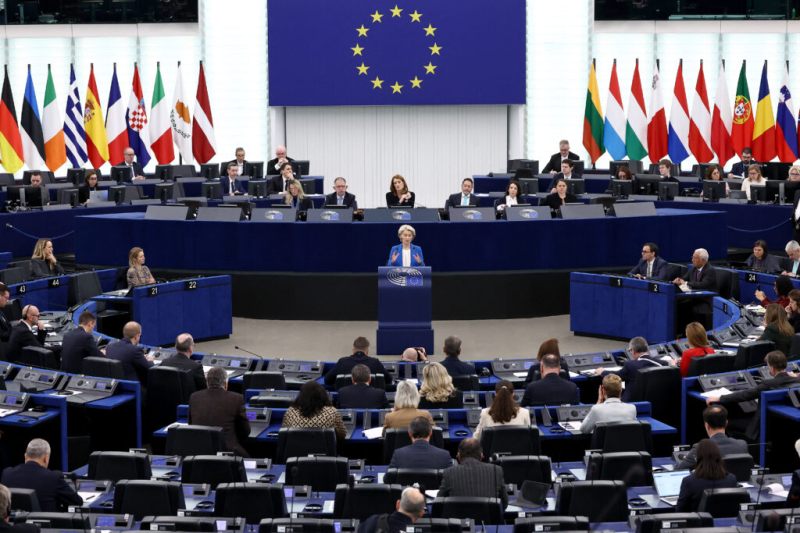
Another problem for EU countries is MEPs getting greater influence over international agreements, especially in light of the trade deal with the South American Mercosur group, which the Parliament delayed after capitals had struck a deal 25 years in the making.
If the Parliament and Commission do not amend the “problematic” sections of the agreement, “the Council reserves its right to take any appropriate actions to defend its prerogatives, including by bringing the matter to the Court,” a reference to the Court of Justice of the EU, the bloc’s highest judicial body.
The Commission did not respond to a request for comment.
Heated rivalry
In September, Parliament President Roberta Metsola and Commission chief Ursula von der Leyen sealed a so-called framework agreement on the nature of their institutions’ relationship after nine months of arduous negotiations. The text is due to be ratified by the Parliament plenary on March 9-12 and signed off on by the Commission after that.
The Parliament’s lead negotiator on the agreement with the Commission, German conservative Sven Simon, who chairs the constitutional affairs committee, pushed back against claims of a power grab.
“I am confident in our assessment of competences and institutional balance, and I see no cause for concern whatsoever regarding any potential proceedings before the Court of Justice,” Simon, who is also a professor of EU law at Marburg University, told POLITICO.
He added it is “regrettable” that countries appear “increasingly preoccupied with institutional defensiveness, national reflexes and procedural minutiae, rather than focusing on our shared responsibility to move Europe forward decisively.”
The Commission-Parliament deal is on the agenda of a meeting of EU ambassadors on Wednesday, said a spokesperson for Cyprus, which holds the rotating Council presidency.
“The aim is for the Council to approve a letter to be sent to the Parliament and the Commission, and to hold a discussion on this topic,” they said. “The Council has expressed concerns with regard to the revised framework agreement in connection to its prerogatives and the institutional balance established by the Treaties.”
What keeps Council up at night
The letter from the Council pushes back against parts of the agreement that would allow the Parliament to be present during international negotiations. The treaties “do not grant the Parliament a right of consultation during the negotiations stage, but only a right of information which does not include, nor justify, the participation of members of Parliament in coordination meetings,” the letter reads.
Countries also don’t like a clause that would require the Commission to get approval from Parliament before temporarily putting trade deals into effect while they are still being ratified. Under the treaties, only the Council has a say in allowing a trade deal to be applied on a temporary basis.
Included in the deal between Commission and Parliament is the former’s promise to provide a detailed justification if it uses Article 122 of the treaties, which allows the Commission and the Council to bypass the Parliament in emergencies. For example, Article 122 was used when setting up the loans-for-arms program SAFE to boost defence. The Council says this would “interfere with the Council’s prerogatives and therefore alter the institutional balance.”
While the treaties grant only the Commission the power to propose or amend legislation, Parliament has increasingly pushed the Commission to draft laws at the request of MEPs. Under the new deal, the Commission pledges to provide a detailed justification if it does not follow through with a Parliament request to draft a law, and it vows to give lawmakers technical and financial support in designing pilot projects to test proposed laws.
Countries argue this creates an imbalance at the heart of EU lawmaking, as it risks the Commission straying from its role as a neutral broker, giving Parliament “a more favorable position” over the Council when it comes to initiating laws.
MEP Simon dismissed the countries’ concerns, saying the new text follows EU law and simply “strengthens democratic accountability.”
“This is not a matter of institutional rivalry, but of making the Union more capable, more transparent and more responsive to citizens,” he added.