

The Kremlin’s crimes cannot go “unpunished,” High Representative Kaja Kallas says.
All EU countries except Hungary pledged support on Tuesday for a special tribunal to prosecute Russian war crimes, as a dozen of the bloc’s foreign ministers and other top officials gathered in Kyiv.
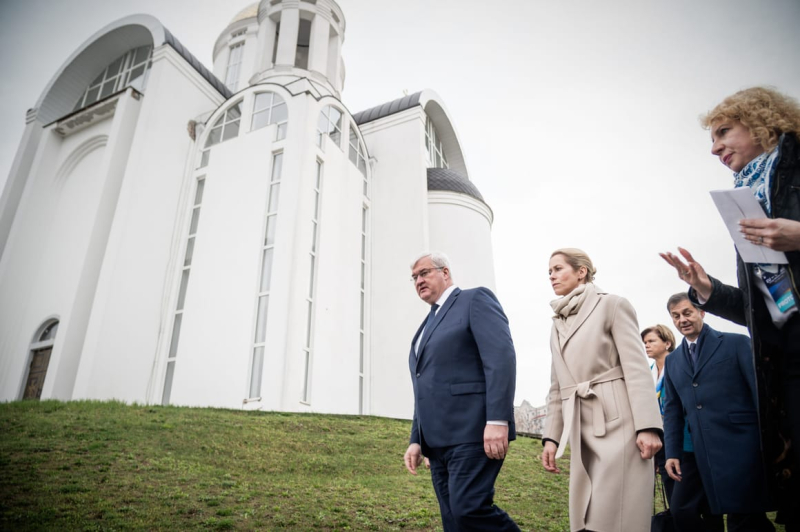
Speaking to reporters after observing a minute’s silence for the victims of the March 2022 Bucha massacre, EU High Representative Kaja Kallas said the focus of the informal summit — which involved the foreign ministers of Germany, Italy, Poland, Latvia, Ukraine and others — was ensuring “accountability” for Russia’s aggression.
In the early days of Moscow’s invasion, advancing Russian troops murdered over 400 Ukrainian civilians and prisoners of war in Bucha, a quiet commuter town near Kyiv. The atrocities triggered global outrage, and Ukrainian President Volodymyr Zelenskyy described them as evidence of “genocide.”
“Some were just walking on the street, some were killed in their own homes, some were tortured and raped,” Kallas said, adding the slaughter was just one example of Russia’s barbarity throughout the war and could not go “unpunished.”
She added that the EU was “pushing forward” with creating a special tribunal to prosecute Kremlin officials over the full-scale invasion, along with a “claims commission” that will allow individuals to petition for Russian war damages.
Ukraine signed an agreement with the Council of Europe to establish the tribunal in June last year, but it still needs legal and financial backing from states in Europe and beyond to get off the ground. All EU countries but Hungary put out a joint statement of support on Tuesday, welcoming the tribunal’s eventual “operationalisation.”
Budapest, which is among Moscow’s closest allies in the EU, continues to use its veto to block a €90 billion tranche of funds for Ukraine over a bitter dispute with Kyiv about a pipeline transporting oil from Russia. Hungary is also refusing to approve the bloc’s 20th package of sanctions on the Kremlin.
Kallas said there had been no breakthrough on the funds or sanctions, but that she hoped to see a resolution by the next European leaders’ summit. An informal meeting of leaders will be held in Cyprus in late April, with a summit in Brussels in June.
Zelenskyy told reporters Tuesday that Hungary’s stonewalling was affecting his country’s ability to prepare itself for the next winter.
“We have a plan, but because the €90 billion support package is still blocked, we cannot use the €5 billion planned for protection and recovery to get ready,” he said. “And this is happening because one person in Europe is standing against all of Europe simply to please Moscow.”
Kallas said the EU will be “providing an additional €80 million to Ukraine, drawn from the profits of Russian frozen assets.”
She also warned it was important not to “let Ukraine slip off the table” amid the spiraling situation in the Middle East and the global energy shock resulting from U.S.-Israeli strikes on Iran.
“Because this is happening here and now, this is part of Europe,” Kallas stressed.
Veronika Melkozerova contributed to this report from Kyiv.