
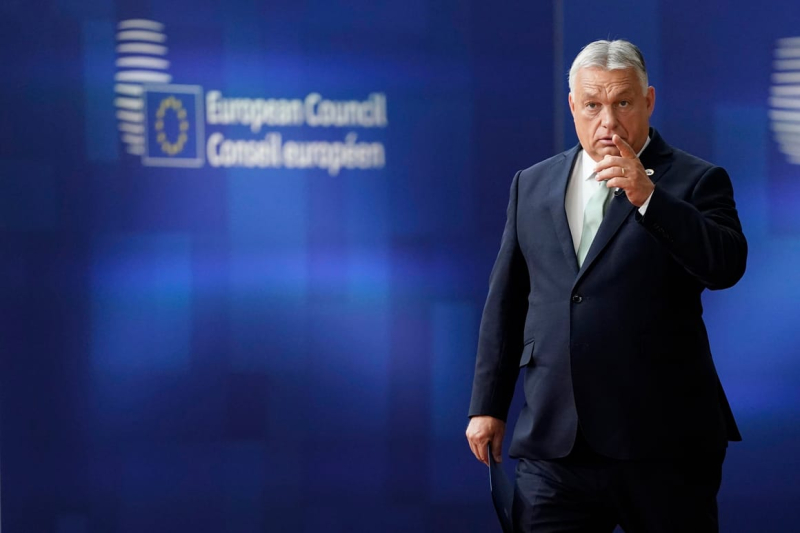

After agreeing to help get Russian oil flowing again, Brussels and Kyiv hope for a Ukraine loan breakthrough at Thursday’s crunch EU leaders’ summit.
BRUSSELS — The EU’s announcement that Ukraine has accepted its offer to help repair the Druzhba oil pipeline gives Viktor Orbán a chance to end his showdown with Brussels over a loan to Kyiv, according to two EU officials.
Two days before EU leaders meet for crunch talks in Brussels, European Commission President Ursula von der Leyen and European Council President António Costa said that “the Ukrainians have welcomed and accepted” an offer of “technical support and funding” to help repair the damaged pipeline, in a bid to restore Russian oil flows to Hungary and Slovakia. Orbán has refused to back a €90 billion loan to fund Ukraine’s war effort unless the oil starts flowing.
The agreement gives Orbán a way out of the standoff with the EU as he attempts to overturn a nine-point polling deficit ahead of Hungary’s April 12 election, according to the two officials, who granted anonymity to speak freely on the sensitive diplomacy, as were others in this article.
In a video posted to social media after Tuesday’s pipeline news, Orbán doubled down, saying that “if there is no oil, there is no money” for Ukraine. But a diplomat familiar with Budapest’s thinking hinted there could be room for a breakthrough ahead of Thursday’s summit, given the movement from the EU and Ukrainian President Volodymyr Zelenskyy.
Brussels wants Orbán to lift his veto on the delayed 20th package of sanctions against Russia and on the loan to Ukraine, which EU leaders, including the Hungarian prime minister, agreed to in December. Orbán later changed his mind, taking the unprecedented step backtracking on a decision agreed at a European Council meeting. Two senior EU officials said Brussels believed Orbán was looking for an off-ramp.
Orbán has used the spat with Ukraine over the Druzhba pipeline to score political points against his rival, Tisza party leader Péter Magyar. Orbán accused Kyiv of intentionally delaying repairs to the pipeline, which was damaged during a Russian drone attack in late January, to help Magyar in the election — a claim Tisza and Kyiv strongly deny.
Zelenskyy has denied he has been slow-walking repairs to the pipeline for political reasons. He said he didn’t want to fix Druzhba both because Russia has repeatedly attacked it, including during repair works, and because doing so would help fill the Kremlin’s coffers and allow Moscow to continue its full-scale invasion of Ukraine. He has decried the pressure placed on him by his EU allies, accusing them at the weekend of “blackmail.”
But on Tuesday, Zelenskyy finally agreed to the request. In a letter sent to von der Leyen and Costa, Zelenskyy said, “We are undertaking all possible efforts to repair the damage and restore operations” of the pipeline.
“Ukraine is a reliable energy partner for the European Union and honours fully its commitments,” he added.
In their response to Zelenskyy, von der Leyen and Costa said his acquiescence “would allow [the EU] to move forward in a timely manner with the EU Ukraine Support Loan funding for your own macro-economic stability and for the purchase of defence equipment, as well as the final adoption of the 20th package of sanctions.”
The Council and Commission presidents also said their priority “is to ensure energy security for all European citizens,” while working on “alternative routes for the transit of non-Russian crude oil” to Central and Eastern Europe.
Speaking to POLITICO on Monday, before the announcement, Hungary’s EU Minister János Bóka said: “I see that the mood has changed after the escalation of the crisis in the Middle East. I think now that most member states do understand that the Ukrainian decision to cut off access to the Druzhba pipeline undermines energy security and security of supply in the Central European region, and this will have implications for the European Union as a whole.”
“I think that this understanding is slowly but surely sinking in and my feeling is that the Commission can no longer pretend that it is OK not to do anything in order to help two member states in securing their energy supplies through Ukraine via the Druzhba pipeline,” Bóka added.
The episode has been a bruising one for Brussels and for Ukraine, which needs the EU cash to keep afloat through this year and was meant to start receiving the money from April. A previous bid to use frozen Russian assets to fund Ukraine collapsed at the last minute in December amid opposition from Belgium.
Any EU country can block the €90 billion loan, because one of the bills that needs approval before the cash can be disbursed requires a unanimous yes from all member countries.
Kyiv was expected to run out of money by April, but the urgency eased somewhat after the International Monetary Fund approved an $8.1 billion loan late last month. Ukraine should have enough money to stay solvent until early May, POLITICO reported last week.
The EU now appears cautiously optimistic that Orbán may climb down from blocking the loan and sanctions — but potentially not until after the Hungarian election next month.
Costa expects Orbán to follow through on the commitment he made at the December EU leaders’ summit “in the very short run,” said one of the EU officials above. But while a German official conceded there is now “some momentum” to resolve the issues over Druzhba, whether a deal on the €90 billion loan will be done at Thursday’s leaders’ summit “remains to be seen.”
Nette Nöstlinger, Sebastian Starcevic, Gabriel Gavin and Gerardo Fortuna contributed reporting.