
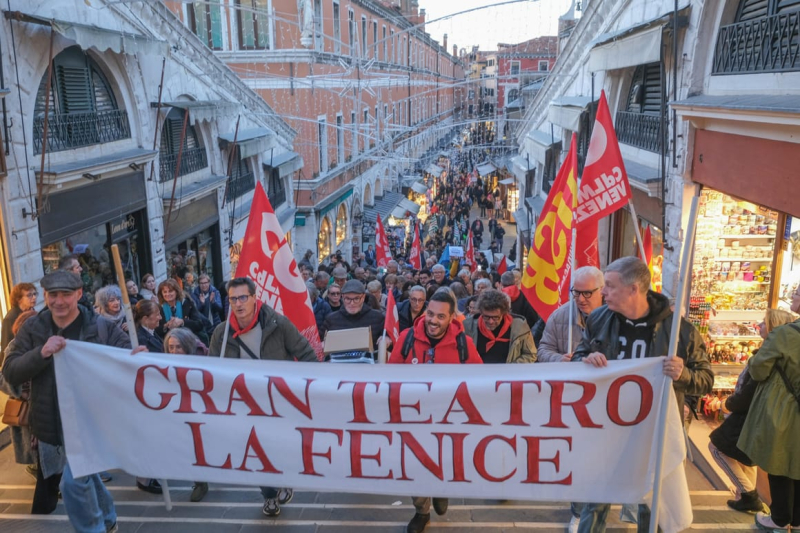

The left looks to win back the iconic northern city in potential sign of Italy’s changing political winds before next year’s general election.
Venice was meant to be the showcase for a right-wing cultural revolution led by Italian Prime Minister Giorgia Meloni’s government, but the center left now fancies its chances of winning the lagoon city’s mayoral election on May 24 and 25.
The vote is being closely watched as the first big electoral test for Meloni’s right-wing coalition since her government’s bruising defeat in a referendum on justice reform in March and will offer clues on whether Italy’s political tides are shifting ahead of a general election next year.
In recent years, the conservative camp turned Venice into a major ideological battleground, seeking to pry elite cultural institutions out of the left’s control and celebrating the appointment of right-wing allies to run the Biennale cultural exhibition and La Fenice opera house. Center-right independent Luigi Brugnaro has led the city for more than a decade.
But the left now reckons it is poised to end the right’s grip over Venice — one of about 900 municipalities holding elections on Sunday and Monday — arguing that Meloni’s politicized culture war played badly in a city where the arts really count.
The center-left’s hope of reclaiming Venice echoes its broader optimism after the referendum that it can finally muster enough strength to challenge Meloni, who had previously seemed politically invulnerable, at the national level in 2027.
Despite the high-profile national arguments over the Biennale and the opera, candidates stress that the Venetian election is likely to focus heavily on bread-and-butter issues such as overtourism, housing, immigration and the cost of living for locals.

On a crowded vaporetto crossing the Grand Canal, Marco Gasparinetti, a city councilor and activist, was clear on where he thought the election would be won and lost.
“The Biennale and La Fenice are niche issues,” he said. “Since the Airbnb phenomenon, it’s impossible to find housing in Venice. La Fenice and the Biennale are of no use if you don’t have a home.”
The final polls in early May suggested the center left had an eight-point lead, but almost half of voters were undecided.
Culture war
By taking the reins of the Biennale and the Venice opera, Italy’s right saw its opportunity to build its own cultural class. But Venice became a far messier stage for those ambitions than Meloni’s allies had hoped.
“The right has long viewed Italy’s cultural institutions as dominated by the left, which fostered a sense of cultural inferiority, said Davide Grippa, of the contemporary history department at the University of Naples, L’Orientale. “What we are seeing in Venice is the result of an effort to reverse that by installing figures associated with the right at the top of major institutions.”
At the center of the storm is Pietrangelo Buttafuoco, the conservative intellectual appointed president of the Venice Biennale, one of the world’s most prestigious cultural institutions.
Initially hailed by the right as evidence that conservatives could lead elite artistic spaces long viewed as hostile territory, Buttafuoco caused a furor over the inclusion of a Russian pavilion this year, curated by the daughter of the Kremlin’s foreign policy chief, Sergey Lavrov.
The scandal triggered accusations from critics that he was allowing Kremlin propaganda, the resignation of the entire jury, and the withdrawal of EU support.
Simultaneously, another high-profile right-wing effort to remold Venice’s cultural institutions imploded when Beatrice Venezi, one of the most visible cultural figures associated with the conservative camp, was pushed out of her role at La Fenice after an increasingly polarizing tenure.
Promoted by sections of the right as the symbol of a new generation ready to challenge Italy’s progressive cultural establishment, Venezi instead became a lightning rod in a broader debate over whether the government’s cultural agenda relied too heavily on political symbolism.
Andrea Martella, the center-left candidate for mayor and currently an MP for the Democratic Party, argued the controversies surrounding both La Fenice and the Biennale had damaged the city’s standing.
“With both, there was a short circuit between Rome and Venice which ended up humiliating the institutions,” Martella said. “In a city like Venice, this carries enormous weight, because culture is not only part of the past but also the present and future of this extraordinary community: its identity, work, prestige and capacity to attract talent.”
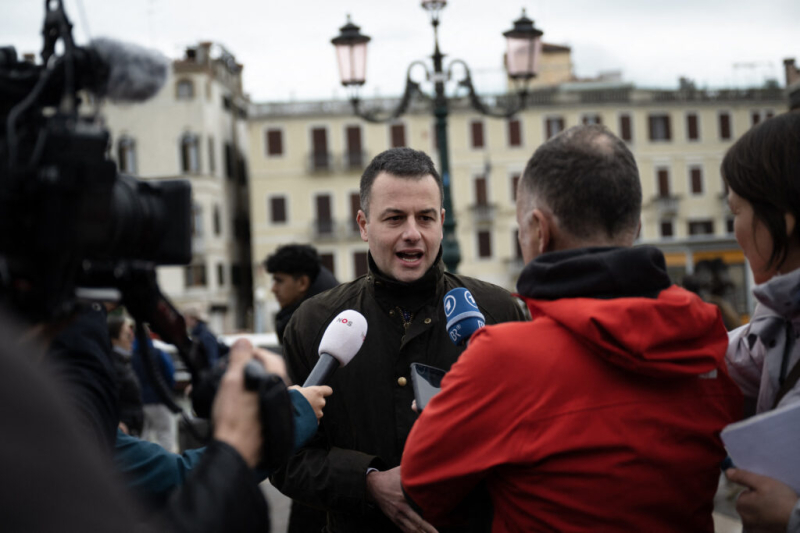
While Venice has become symbolically important in national politics, the center-right’s candidate for mayor and current councilor for tourism, Simone Venturini, argued that disputes over the city’s cultural institutions mattered far less to ordinary voters than to political and media circles.
“These are issues tied to a bubble connected to the national media and a certain Venetian milieu,” Venturini told POLITICO. “The controversies have largely been fueled by national political battles.”
He defended the outgoing administration’s management of tourism pressures, arguing his administration did more to shield the sinking city of Venice from the worst effects of overtourism than had been done in the previous 50 years, including entry fees for day tourists and restrictions on converting palazzos into hotels.
Pocketbook issues
While the left is taking heart from polling, the Venice race also exposes the chronic weakness of Italy’s fragmented opposition.
Surveys suggest the left could emerge ahead in the first round, but a runoff could prove far more unpredictable if progressive forces struggle to remain united behind a single candidate. Some left-leaning voters could be tempted to vote for Roberto Agirmo of “Resistere Veneto”, the movement founded by a vaccine-skeptic doctor, or for Michele Boldrin, an economist and academic.
In Mestre, the mainland district where many working Venetians now live after being priced out of the lagoon city, debate surrounding a proposed mosque project has helped sharpen tensions over immigration and integration during the campaign.
The controversies have helped transform Venice from a local race into a broader test of the Italian right’s direction after the referendum defeat.
Martella argued that a center-left victory would demonstrate not only that the right was beatable after the referendum setback, but that a broad progressive coalition could remain competitive when focused on concrete issues rather than ideological abstractions.
“Winning in Venice would show that on housing, the environment, tourism and work there is a credible alternative to the right,” he said.