
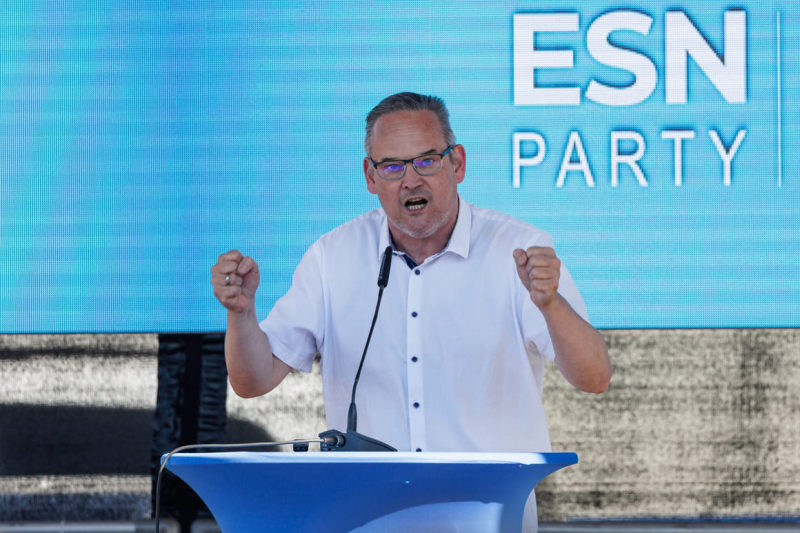

It’s unclear whether the revelation will dent the AfD’s large lead in polls ahead of key state elections in eastern Germany.
BERLIN — A senior lawmaker in the far-right Alternative for Germany party is under mounting pressure after a newly surfaced photograph appears to show him making a Nazi salute — an allegation he denies, insisting the gesture was intended as a joke.
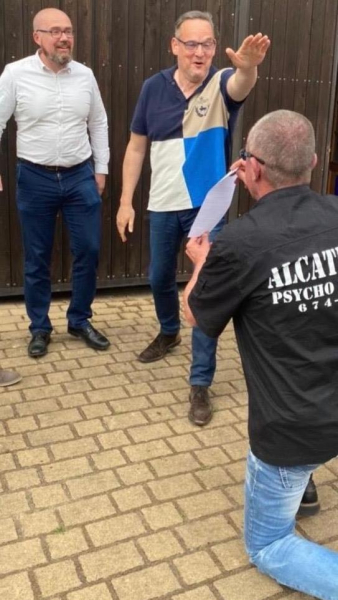
The previously unpublished image, obtained by POLITICO’s Inside AfD podcast, shows Martin Reichardt, a member of Germany’s federal parliament, raising his left arm while smiling during a gathering six years ago. While Reichardt denies the gesture was meant to be a Nazi salute, two people who were in attendance, granted anonymity due to the sensitivity of the manner, said it was intended as one.
“It wasn’t a Hitler salute,” Reichardt said when asked by POLITICO. Rather, he said, the gesture was part of “a humorous knighting ceremony” performed with one of the men present.
That man, Markus Motschmann, knelt on one knee as he presented Reichardt with an application to join the AfD, addressing him as “Mein Führer,” according to the two people who were present. Motschmann denied using those words but confirmed the photograph is genuine.
“It was meant to be funny,” Motschmann told POLITICO. “It’s absolutely ridiculous that this is being blown up again.”
The revelation comes at a politically sensitive moment for the AfD ahead of two state elections in eastern Germany, where the party is leading in polls. Big victories in the September elections would further cement the AfD’s dominance across swathes of eastern Germany and intensify the debate over whether German Chancellor Friedrich Merz’s conservatives can continue to maintain the so-called “firewall” that keeps the far-right out of federal government.
Merz’s conservatives, who currently trail the AfD in national polls, sharply attacked Reichardt over the photo.
“A Nazi salute is a statement of belief, not a slip-up,” said Saxony-Anhalt’s conservative premier, Sven Schulze. “Anyone who displays something like that has no place in a parliament.”
Despite such condemnations, it’s not clear whether the incident will dent the AfD’s strong lead in polls, particularly in the former East Germany, where distrust of centrist parties and mainstream media is more prevalent than elsewhere in the country.
National AfD leaders have sought to present the party as a credible governing force, even as some of its politicians have faced scandals over extremist rhetoric and slogans in recent years. Those scandals have failed to hurt the party in the long term — and, in fact, the party is reaching new heights in national polls.
Reichardt, in addition to serving as a federal lawmaker, chairs the state branch of the AfD in Saxony-Anhalt, where one of the elections is set for September. Current polls put the AfD at nearly 42 percent in the state, within reach of an absolute parliamentary majority that would give the party governing power for the first time since its founding in 2013.
Germany’s intelligence agency in Saxony-Anhalt has classified the AfD state branch as an extremist organization, but that has not stopped the party’s ascent in the region.
The AfD’s Saxony-Anhalt branch released a statement on X, calling the allegation that Reichardt made a Nazi salute “a desperate attempt to launch a smear campaign.”
It’s also not the only accusation involving an AfD politician and an alleged Nazi salute.
AfD lawmaker Matthias Moosdorf is currently facing a criminal charge of using “unconstitutional symbols” over allegations that he performed a Nazi salute inside Germany’s Reichstag parliament building, near the coat check, in 2023. A spokesperson for Berlin’s criminal courts, Lisa Jani, confirmed that Moosdorf’s case is scheduled to go to trial in October.
Moosdorf denies the allegations.
“I vehemently reject the accusation that I made the so-called Hitler salute on the premises of the Bundestag, and I view this as an attempt at political character assassination,” he told POLITICO’s Inside AfD podcast in April.
Public displays of Nazi symbols and gestures, including the Nazi salute, are illegal under German law. Courts evaluate such cases based on whether an objective observer would understand a gesture as a Nazi salute, regardless of whether it is performed with the right or left arm.
Reichardt is expected to seek another term on the AfD’s federal board during the party’s convention next month.