
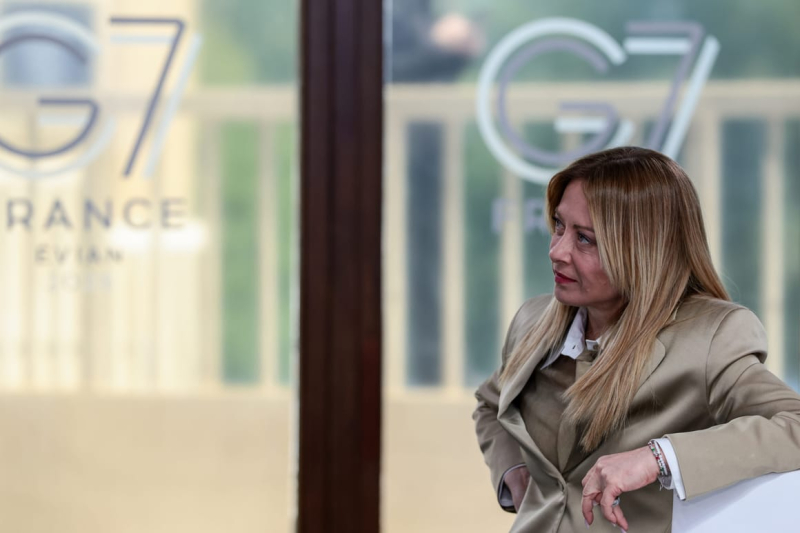

With its low defense spending and trade surplus with America, Italy was always bound to clash with Trump. Their spat can now help Meloni’s re-election hopes.
ROME — U.S. President Donald Trump’s America First agenda was always going to set him on a collision course with Italian Prime Minister Giorgia Meloni.
Although the transatlanticist right-wing Meloni had traded for years on the idea that she was Trump’s most natural European ally and could act as intermediary for his relations with the EU, Italy had no way to avoid MAGA’s blacklist.
Meloni aligned with Trump on topics such as migration and the culture war, but it was only a question of time until MAGA cried foul over Italy’s low defense spending and major trade surplus with the U.S.
In fact, Italy was precisely the sort of country Trump habitually complains about for free-riding on U.S. security guarantees. “Given the radical collision of U.S. and European interests, a clash was always on the cards,” said Daniele Albertazzi, professor at the University of Surrey and author of several books on Europe’s radical right.
Although the fight was always coming, it was uncertain how Meloni would respond. Unlike most world leaders who have brushed off Trump’s personal slights, the pugnacious Italian premier ultimately took the unusual step of escalating the dispute, skewering the American leader for impugning Italy’s national dignity.
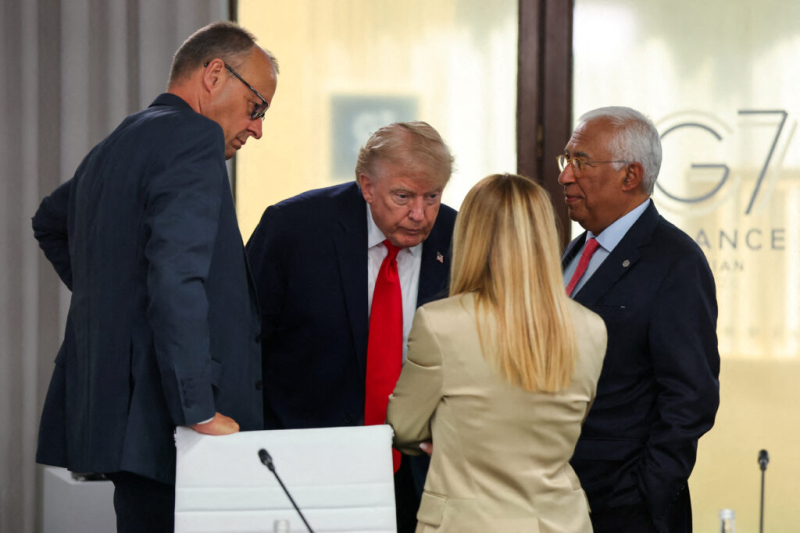
After Trump mocked Meloni on Friday for allegedly “begging” him for a photograph at a recent meeting of the G7 leading economies, and accused her of exploiting their relationship for domestic political gain, she shot back that he had invented the incident and said her own popularity was suffering because of her friendship with him.
The intensity of her response was carefully politically calibrated in a country where Trump is roundly hated, and where Meloni faces re-election next year. An Ipsos survey in May found 77 percent of Italians had a negative view of Trump.
Her coalition partners in the center-right Forza Italia party have supported her, seeing the compelling political logic of standing up to Trump.
Foreign Minister Antonio Tajani, leader of Forza Italia, called Trump’s words “grave and offensive” and cancelled a trip to the U.S. scheduled for early this week.
That doesn’t mean Meloni is escaping criticism. The opposition center-left Democratic Party criticized her for thinking that she could ever harness Trump.
For Lia Quartapelle, a foreign affairs spokesperson for the Democratic Party, the dispute has exposed the folly of relying on a privileged relationship with an unpredictable Washington that “weaponizes our dependence on the U.S. against us.”
The incident should prompt Meloni to invest more heavily in European alliances, she added. The Italian leader “didn’t understand that Trump doesn’t have allies; he thinks of the world as a place of great powers and their subjects.”
Quartapelle continued that the clash signaled a broader shift in relations between the Italian right and MAGA, which could now look to “very dangerous” figures such as extreme-right General Roberto Vannacci as a more natural ally.
The turning point: Iran
After Trump’s re-election, Meloni cultivated ties with the White House and was presented as a bridge between Washington and Brussels.
The Iran war changed that mood music.
Trump’s decision in February to launch military action against Tehran proved deeply unpopular in Italy, where voters worried about rising energy prices and the risk of a wider conflict, making Meloni’s perceived closeness to the White House “a huge liability,” Albertazzi said.
Trump’s attack came after Meloni had already begun putting distance between herself and Washington, refusing access to Italian bases for U.S. bombers.
From the perspective of Trump’s supporters, the problems run deeper than Italy’s trade surplus.
Ben Harnwell, the international editor for Steve Bannon’s War Room TV show, said the White House had been increasingly irritated by Meloni’s efforts to present herself as an intermediary between Washington and Europe.
“What really upset those around the president was that she was spinning herself as a bridge between the U.S. and Europe,” Harnwell said. Trump “doesn’t need an interlocutor. He can make a phone call to anyone who matters, without Giorgia Meloni’s help.”
Harnwell said Meloni’s positions on defense spending and her defense of Pope Leo XIV — another of Trump’s sparring partners — would also have been noted in MAGA circles. Trump’s public attack, he argued, was intended to send a message.
By speaking to an Italian network, “Trump clearly wanted to humiliate her in front of her own people,” he said.
The attack was too demeaning to ignore, Albertazzi said. “She had to push back because I think the political price [of not reacting] would have been too high.” Trump had treated her “as frivolous, like a fan. As a nationalist she needs to preserve an image of somebody with dignity and strength.”
Yet Harnwell cautioned against interpreting the dispute as a permanent break.
“Trump doesn’t bear grudges,” he said. “You can fall out with him and come back in the tent as long as you recognize he is the alpha.”
Even so, he suggested Italy’s importance inside the White House should not be overstated.
“They don’t spend much time thinking about Italy in the White House or about any country other than America,” he said. “If the prime minister of a middling European power won’t take his calls, he’ll get by.”
No other option
Despite the potential electoral advantages to Meloni of a high-profile bust-up with Trump, Rome is showing little genuine sign of abandoning its broader strategic alignment with Washington.
Despite canceling this week’s trip to America, Tajani insisted he will still attend America’s 250th anniversary July 4 party in Rome — celebrations that are highly important to Trump.
Claudio Borghi, senator for the far-right League party in Meloni’s coalition, argued that Rome should have aligned more closely with Trump’s goals for Europe from the outset, including by pursuing bilateral tariff negotiations with Washington rather than acting through Brussels.
He advised the government to “make every effort from today to diplomatically overcome this unfortunate situation.”
Leo Goretti, political scientist and associate dean of the Rome Business School, said that behind the public rhetoric, Italy was as reliant on the transatlantic alliance as ever.
Meloni’s “very tough initial response doesn’t affect Italy’s policy, which is still trying to cling to the transatlantic relationship,” he said.
“The government tried to play tough but realized it can’t play tough.”