

Right-populist Reform UK leaps forward in crucial by-election race — without actually winning.
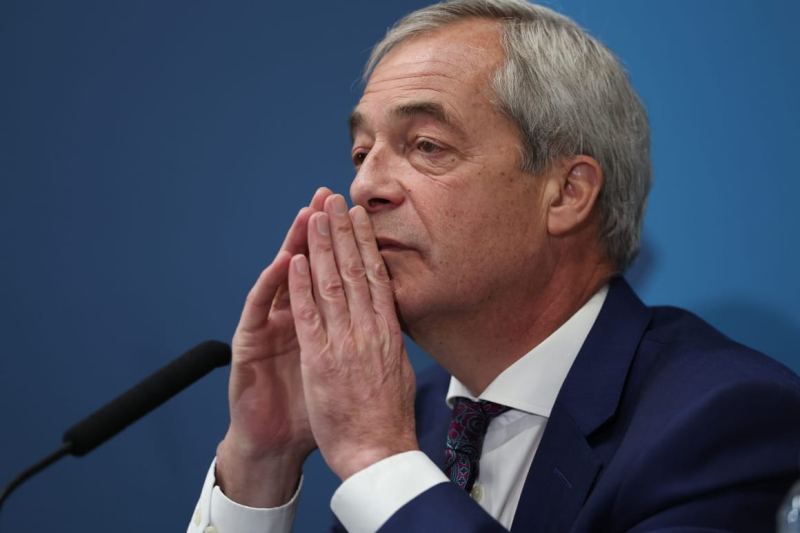
LONDON — Nigel Farage is having to make do with being a runner-up.
Almost a year after his Reform UK won the Runcorn and Helsby by-election on a night of local election euphoria, his party came second Friday in the Gorton and Denton contest.
But despite not making it all the way in the Greater Manchester parliamentary seat, the populist insurgents are still talking up their chances of becoming the key right-wing challengers in the U.K. And they have a fresh set of numbers to back up their thesis.
Candidate Matt Goodwin came second in the local race, with 10,578 votes. That’s a 28.7 percent share of the vote, and, crucially, is a sharp 14.6 percentage points up on Reform UK’s general election result in 2024.
Though still more than 4,000 votes behind the victorious Greens — and empty-handed under Britain’s first-past-the-post electoral system — the result put them ahead of the governing Labour Party in a seat it has dominated for decades.
Allies say it shows Reform once again as the primary vehicle for right-wing support — and not the Conservatives. Skeptics say it shows the limits of strategy tacked squarely to the right.
“This is a massive change,” says Reform UK’s former Director of Communications Gawain Towler, who now sits on the party’s board. “When was the last time any right of center party got anywhere near that?”
Defeated candidate Matt Goodwin vowed to run again at the general election and “continue the fight,” while Farage said he would “roll on” to the local elections this May.
The two were quick to blame local factors, including making strident claims about sectarian voting in a constituency with a large Muslim population. But they have not indicated any pivot from their core message of a “broken Britain” beset by too much immigration.
Towler argues the Gorton results hint at a realignment in British political allegiances that could see two-party politics return — just not in a way the once-dominant Tories or Labour will like.
“There’s a bit of fragmentation, but it’s starting to settle on the right and I think it might settle on the left as well,” Towler argues.
“We are seeing voters on both sides of the spectrum have legitimate other choices away from the Conservatives and Labour,” says Savanta’s Political Research Director Chris Hopkins. He believes Farage’s “electoral legitimacy” may increase after the May elections, but not solely for ideological reasons.
“Reform’s popularity isn’t necessarily because they’re seen as the ‘true right’ but is more down to them being de-risked as voters see the Conservatives and Labour as so bad,” he says.
Psephologist John Curtice says Reform was on tricky ground in a seat with a high ethnic minority population, less likely to favor the party’s hardline immigration and anti-equalities policies.
That doesn’t mean the polling, which consistently shows Reform ahead at a national level, is “in any way a false picture of where they are at.”
In the wilderness
By contrast, Britain’s Tories, who were running the country in government under two years ago, had a bruising night. They dropped from an already-dire general election showing of 7.9 percent to just 1.9 percent — receiving a paltry 706 votes.
By polling under 5 percent, the party’s worst ever by-election result, the Tories lost the £500 deposit all candidates must pay to stand.
In the immediate aftermath, Tory figures stressed that the party never had a chance of winning a constituency that has been reliably Labour for decades. Instead, they talked up Reform’s failure to seal the deal.
“While last night’s result was disappointing for my party (we had a cracking candidate) it was not really our battlefield,” said former Deputy Foreign Secretary Andrew Mitchell. “The result was, however, very bad for Reform and may mark the beginning of the end of their hegemony.”
Tory MP and former minister Graham Stuart said voters cast their ballots differently at by-elections compared to general elections, when they choose the next government.
“The public is unhappy with the way the country is and has been run, and so has turned to parties on the left and right that reflect that anger,” he argued. “When the public is looking to replace this government at the next election they will look for something else,” Stuart added, referring to Tory Leader Kemi Badenoch.
The difference in support for the two right-wing parties also raises questions about a non-aggression between Reform UK and the Tories at the next election. In the 2019 election, Farage’s Brexit Party stood down in Tory-held seats to give fellow Euroskeptics a better chance of success.
Queen Mary, University of London academic Tim Bale says the Gorton and Denton result reinforces “the idea that there are some places where one of the two has a much better chance than the other and it would therefore make sense for both parties to do some kind of deal.”
Both Reform and the Tories have flatly rejected making such an agreement — though minds may be focused if the alternative is a progressive alliance. Bale argues that the result in Gorton and Denton shows the limits of any appeal to Conservative voters to get over the line.
“Their failure there … should give Farage pause for thought,” Bale, who wrote the book “The Conservative Party After Brexit,” says. “Maybe Farage shouldn’t, at least in private, rule out a deal with the Tories in the long run, even if he still says publicly he intends to replace them.”
Pollster Hopkins says the dire Tory performance shouldn’t be overstated given “their voters don’t need to turn out at this by-election, or could happily vote tactically for Reform.”
Instead, it shows “we are in multi-party politics now and they [the Tories] will have to work much harder to secure votes when Reform pose a very, very legitimate threat.”