
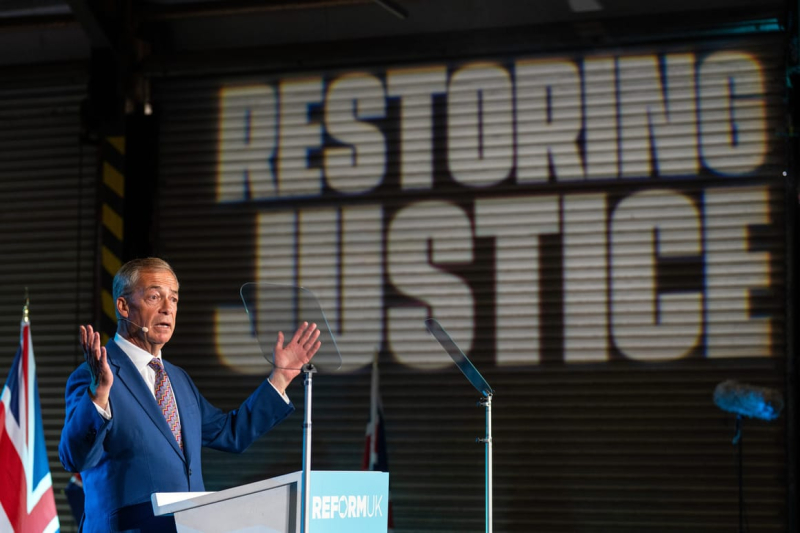

The leader of Britain’s right-wing Reform UK declined to repeat Donald Trump’s verbal assault on Kyiv — but argued Ukraine is “one of the most corrupt countries on earth.”
LYMPNE, England — A Reform UK government would take a “keen look” at Britain’s support to Ukraine, the populist right-wing party’s leader Nigel Farage said Monday.
Farage said Ukraine is “one of the most corrupt countries on earth” and that he is “very worried” about where some of Britain’s money has ended up — while also acknowledging the threat from Russian President Vladimir Putin is now the greatest it has ever been.
The Reform leader added: “I’ve never said we shouldn’t support Ukraine — ever. But I have said I would like to have a keen look to make sure British taxpayers’ money is not being swallowed up in corruption.”
The Ukrainian embassy in London declined to comment.
The U.K. has committed £25 billion to Ukraine since Russia’s full-scale invasion, according to government figures published in July 2026. That includes £16 billion of military support, up to £5.6 billion in non-military support and a £3.5 billion cover limit for export finance.
Farage was answering questions at a press conference after Donald Trump deepened the gulf between Washington D.C. and Kyiv by saying he would suspend sanctions on Russian diesel exports. After Ukrainian President Volodymyr Zelenskyy criticized the deal, Trump said Saturday: “It’s time for Ukraine to get a new president.”
Farage, an old ally of Trump who previously spoke at his campaign rallies, said he did not agree with the U.S. president’s decision to buy diesel from Russia, but criticized EU nations for “buying vast amounts of Russian petrochemicals” during the course of the war.
Farage also declined to agree with Trump’s call for regime change, saying: “I understand that Trump and Zelenskyy have a somewhat tempestuous relationship, so it’s not any particular surprise. At some point, Ukraine needs an election. That’s true if it is to be a country that aspires to have Western-style values. As to when that election comes, we’ll have to see. After all, we did have an election during World War Two.”
Asked if there is a limit to his support for Ukraine, Farage added: “No one’s support for Ukraine is limitless, is it? Is [U.K. Prime Minister] Andy Burnham’s support for Ukraine limitless? No, it’s not. But do we need to go on supporting Ukraine?
“Look, this is one of the most corrupt countries on earth. We know that. I’ve been very, very worried about where some of our money has gone. And goodness me, Zelenskyy’s administration has been rocked by corruption claims, which perhaps makes at some point a general election there an important thing to do.
“But I am in no doubt at all that Putin now poses a greater threat than he’s posed at any point.”
Farage accused his critics of a “willful attempt to misconstrue” comments he made in 2024, when he said the eastward expansion of NATO and the EU gave Putin “reason to his Russian people” to justify the war. Farage said at the time: “We provoked this war. Of course it’s his fault — he’s used what we’ve done as an excuse.”
Farage said Monday that he believes NATO has been a “huge success over many, many years” and Britain’s role in the alliance is “a vital one, as a bridge between Europe and America, and keeping America on side with NATO.”
Right-wing rifts
Reform’s opinion poll lead ended in the summer and the party now trails four points behind Burnham’s center-left ruling Labour Party in POLITICO’s Poll of Polls. Polls currently predict that the right-wing vote would be split between Reform and the Conservative Party in a general election, due by 2029.
While Conservative Leader Kemi Badenoch said last week that she would sooner force a second general election than form a governing pact with Reform, Farage said he “would work with anybody from any party” after an election to see his plans through.
Farage was speaking at an industrial estate in Kent to pledge a series of hardline reforms to the migration system, including halting all asylum claims for five years and deporting anyone left on the waiting list for a decision.
Reform officials previously said that Farage planned to meet France’s National Rally Leader Marine Le Pen in late October, around the time the party holds its conference, and that he was examining a possible visit to Ukraine.
Farage avoided saying, when asked by POLITICO, if he would travel to meet leaders of the far-right Alternative for Germany (AfD) party. Instead he appeared to suggest that Reform was a more moderate alternative to far-right politics rising up in parts of Europe.
“I have friends in the AfD. I have some of the AfD I’m less certain about,” he said. “But it is quite ironic when people attack Reform and say Reform is extreme. I’ll tell you what. There is a politics now developing in Europe directly as a failure of migration policy that would make most people in Reform blush. And this is why our fighting the next general election and winning it is so important — because it might just be the last chance to re-establish trust and faith in the electoral system.”