

“Pressure, pressure, pressure on Russia” is the only way to end the war, Lithuania’s foreign minister said.
European governments rebuked U.S. President Donald Trump’s plan to import hundreds of thousands of tons of Russian diesel, and vowed to keep isolating Moscow and supporting Ukraine as it heads into a brutal wartime winter.
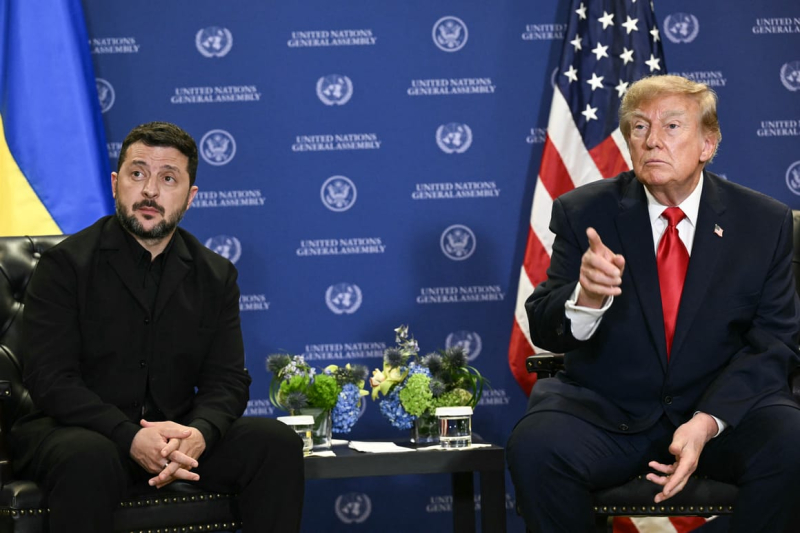
Trump said over the weekend he would import 300,000 tons of Russian diesel, weeks ahead of U.S. midterm elections in which the Republicans are polling badly and in which energy prices and cost-of-living concerns are expected to play a major role.
But his announcement — which included a claim that Russia and Ukraine had agreed an “energy ceasefire” and a call for Ukrainian President Volodymyr Zelenskyy to step down — drew skepticism and scorn from European capitals and the EU.
“This deal doesn’t help neither the price of oil products nor the unity of the transatlantic community,” Lithuanian Foreign Minister Kęstutis Budrys said at a gathering of the bloc’s foreign ministers on Monday morning, adding “it is not the European way.”
Irish Foreign Minister Helen McEntee called Trump’s announcement of a deal with Moscow “concerning,” while German Minister of State for Europe Gunther Krichbaum said every dollar spent on Russian energy funded the purchase of weapons used against Kyiv.
The EU’s top diplomat, Kaja Kallas, reminded Washington that “Russia has started this war. We should not forget this.”
On Monday, Zelenskyy suggested that Washington had other motives for pursuing an energy agreement with Moscow, arguing that the Russian fuel involved would make little difference to global supplies.
Speaking at the Warsaw Security Forum, Zelenskyy said proposed Russian diesel deliveries were insignificant compared with global monthly consumption of roughly 120 million tons.
“I don’t think that this will have a tangible impact,” Zelenskyy said. “I believe that there are different rationales behind this decision.”
Zelenskyy also suggested Washington should consider an alternative arrangement with Kyiv. “Why doesn’t America then conclude a diesel deal with Ukraine?” he asked. “Let’s propose a diesel deal with Ukraine.”
He also revealed that Kyiv had not been informed beforehand of Trump’s announcement that he had secured an energy ceasefire. “No, we did not know about that,” Zelenskyy said. “We’ve learned that from the media as well.”
On their way into their meeting, the EU’s foreign ministers remained united in their insistence that increasing pressure on Moscow was the only way forward.
“Obviously our position has not changed — pressure on Russia, sanctions, support to Ukraine, Russia’s isolation is the way to peace,” Latvian Foreign Minister Baiba Braže said.
The British Foreign Office’s minister of state Stephen Doughty said London was “not planning to follow suit with” purchasing Russian energy and would ratchet up “economic pressure” on Moscow.
“Pressure, pressure, pressure on Russia,” Lithuania’s Budrys said.
What ceasefire?
Trump’s claim that Ukraine and Russia had agreed to an “energy ceasefire” drew confusion from Kyiv and its allies over the weekend, with Zelenskyy saying the truce and its terms were “news” to him but that he would support it nonetheless — provided Moscow followed suit.
Just hours after Trump’s announcement, however, Russian bombs fell on Ukrainian power plants, causing widespread blackouts.
Kyiv is bracing for its fifth winter since Russia launched its full-scale invasion in February 2022, which Polish Prime Minister Donald Tusk said last month could prove “tragically critical” for Ukraine due to Russia’s near-constant strikes on infrastructure.
At the opening session of the Warsaw Security Forum on Monday, Tusk slammed “anyone who is trying to introduce any symmetries, who suggests it is Ukraine responsible for the war,” saying doing so “gives a valuable present, gift, to the aggressor, to Putin.”
Kallas said any ceasefire shouldn’t “only apply to the refineries, where Ukraine has one and Russia has plenty,” adding that would “definitely [be] in the benefit of the Russians.”
She also called on Washington to join Brussels and London in imposing harsh sanctions on Russia. “Of course the U.S. is our biggest ally,” she said, “but our message is clear: If we want to end this war, the only way we can do this is putting more pressure on Russia.”
Ukraine’s financial needs are set to come up at a meeting of European heads of state and government on Thursday in Brussels. The IMF estimated that Kyiv will face a financing gap of $30 billion to $35 billion next year.
“Ukraine will be front and center at this week’s European Council,” European Commission President Ursula von der Leyen said in a statement Sunday night after a phone call with Zelenskyy, adding the war was entering a “new, grimmer phase.”
Zoya Sheftalovich contributed reporting from Brussels. Nick Vinocur contributed reporting from Warsaw.