

Orbán supporters are already gearing up for a confrontation once the results come in, with experts warning the outcome could be challenged in court no matter who wins.
BUDAPEST — Hungarian Prime Minister Viktor Orbán’s camp and the opposition are accusing each other of electoral fraud as both sides gear up for a potential clash over the results of Sunday’s crucial election.
Orbán is facing an unprecedented challenge to his 16-year rule in Budapest as challenger Péter Magyar, a former government insider, and his Tisza party were leading in the polls going into Sunday’s vote.
Some 54 percent of registered voters had cast their ballots by 1 p.m., compared with 40 percent in the previous parliamentary elections in 2022, according to data from the Hungarian national election office. The early turnout is a record in Hungary’s post-communist history.
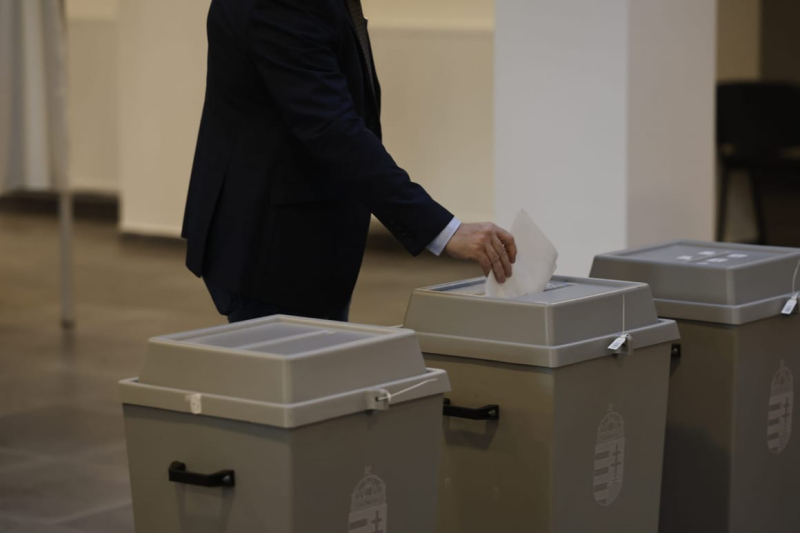
As Hungarians continue to vote, Orbán supporters are already preparing for a confrontation once the results come in after voting stations close at 7 p.m. Both camps are exchanging accusations of electoral fraud, with experts warning the outcome could be challenged in court no matter who wins.
Hundreds of international observers have descended on Budapest, while Orbán’s camp has set up its own monitoring groups. A dozen EU lawmakers from the right-wing Patriots for Europe group are registered as observers, alongside 100 observers tied to Orbán-aligned groups — setting the stage for what experts warn will be a clash of narratives with the Organization for Security and Cooperation in Europe, which the Hungarian government has dismissed as politicized.
A documentary by independent journalists titled “The Price of a Vote” that aired on March 26 alleged widespread vote-buying and pressure on voters in favor of Orbán’s Fidesz party in rural communities. Eyewitnesses claimed the party offered cash in exchange for votes.
Mihály Gér, Green local councilor in the village of Albertirsa, told POLITICO that in his area people have been offered up to 30,000 forint — 80 euros — to vote for Fidesz.
Hungarian businessman György Wáberer said on Facebook on Sunday that he would give 300,000 forint to anyone who uncovered electoral fraud.
The same consortium that produced the “The Price of a Vote” documentary has organized a 2,400-strong network of observers in more than 100 locations across Hungary to document fraud, the DE! consortium press office told POLITICO. They plan to livestream any fraud allegations they detect on a YouTube channel.
Magyar’s Tisza party has made available its own system for voters to report fraud.
Fidesz has followed suit by enabling a hotline and a dedicated email address. “The overwhelming majority of these violations are tied to Tisza. They cry fraud — but they are the ones committing it,” Fidesz MEP Csaba Dömötör said Sunday morning.
“Based on Fidesz submissions, 639 cases of electoral violations have been established, with 74 police reports currently underway,” Dömötör said.
Opposition leader Magyar said early Sunday that he would accept the results as long as there is no serious electoral fraud, urging voters to report any irregularities they see, HVG reported.
Magyar said that if the election is fair and free then Tisza will win; and he accused Orbán’s government of preparing false flag actions to invalidate results in Tisza-led districts.
Orbán’s international spokesman Zoltán Kovács, meanwhile, posted a message on X Sunday morning accusing Tisza of preparing the ground to storm government buildings if they lose.
“Location matters — and this one speaks volumes,” Kovács said about the election watch party planned by Tisza, which he pointed out is taking place few streets away from the prime minister’s residence.
“A short walk is all it takes to move a crowd from ‘watching results’ to ‘taking action’,” Kovács warned. “If the outcome turns unfavorable, the setup allows rapid mobilization at a politically sensitive location. In a tense moment , proximity can turn into escalation.”