
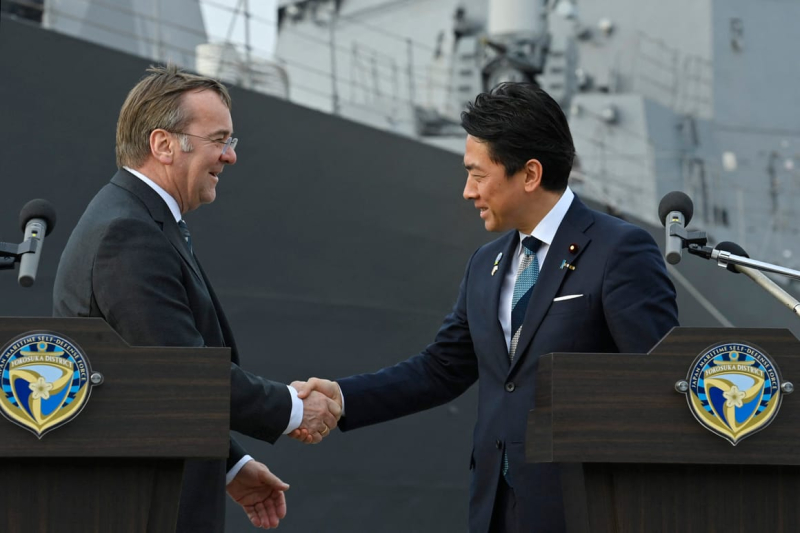

German Defense Minister Boris Pistorius is proposing a new agreement to make it easier for troops from both countries to operate on each other’s territory.
YOKOSUKA, Japan — Germany is seeking to deepen defense ties with Japan, with Defense Minister Boris Pistorius proposing a new agreement to make it easier for troops from both countries to operate on each other’s territory.
Speaking at Japan’s Yokosuka naval base after talks with Japanese Defense Minister Shinjirō Koizumi on Sunday, Pistorius said Berlin had floated a so-called Reciprocal Access Agreement — a framework designed to “ease the exchange of soldiers in each other’s countries and significantly reduce bureaucratic hurdles.”
Such agreements allow partner countries to deploy troops on each other’s soil more easily for training, exercises or operations by streamlining legal and administrative procedures. Japan has signed similar deals with countries like the United Kingdom and Australia as it deepens its own security ties amid rising regional tensions.
The proposal marks a step beyond Germany’s recent Indo-Pacific engagements, which have largely focused on joint exercises and short-term deployments. It signals a shift toward more structured military cooperation with Berlin’s partners in the region.
Pistorius framed the move as part of a broader response to growing global instability. “How close our partnership is has become clear in light of the current developments in Iran and the Middle East,” he said, pointing to Japan’s heavy reliance on energy imports through the Strait of Hormuz. “The freedom of sea routes must be guaranteed and protected.”
Germany and Japan share an interest in securing global trade routes, he added, stressing that both countries remain committed to the rules-based international order. “We are united by the conviction that the strength of the law must prevail,” Pistorius said.
The initiative also reflects a broader strategic shift in Berlin and Tokyo. As both governments face rising pressure from authoritarian powers — from Russia’s war in Ukraine to China and North Korea in East Asia — they are increasingly treating their security challenges as interconnected, translating those shared concerns into closer bilateral defense cooperation.