
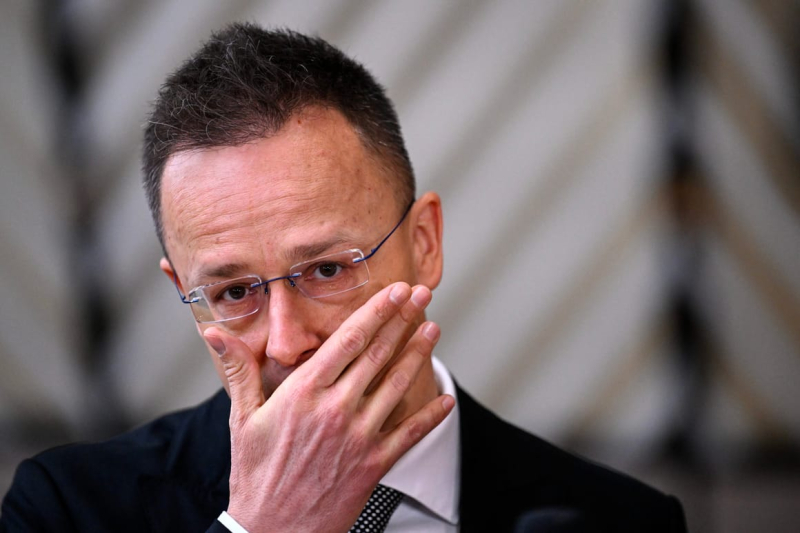

“Nice work! They proved that I say the same publicly as I do on the phone,” Budapest’s foreign minister scoffs after a new report on his contacts with the Kremlin.
BUDAPEST — Hungary’s top diplomat Péter Szijjártó admitted Tuesday he spoke to Russian officials as EU ministers considered new economic measures targeting Moscow.
According to an investigation published Tuesday by a consortium including VSquare and TheInsider, Budapest pushed to remove sanctions on rich Russian businesspeople and spoke up against further actions hitting Russia’s shadow fleet of oil tankers.
The inquiry cites transcripts of calls between Szijjártó and Russian Foreign Minister Sergey Lavrov and Deputy Energy Minister Pavel Sorokin.
But Szijjártó, who has been foreign minister in Prime Minister Viktor Orbán’s government since 2014, played down the accusations — and alleged that his phone was being tapped.
He explained that he has regularly coordinated with several foreign ministers from non-EU countries “on sanctions-related matters.”
“Nice work! They proved that I say the same publicly as I do on the phone,” he added about the investigative journalists, saying that it’s been “long” known that foreign intelligence services intercept his phone calls.
“For four years we have been saying that the sanctions policy is a failure, causing more harm to the EU than to Russia,” Szijjártó said, adding that “Hungary will never agree to sanction individuals or companies that are important for our energy security or for achieving peace.”
Hungary’s international spokesperson Zoltán Kóvacs told POLITICO on Monday that the foreign minister’s contacts with Russia’s Lavrov were common diplomatic practice, and that he did not exchange sensitive information.
“He’s not talking about those elements, actually, that do not belong to the Russians; they talk about public policy matters that are with the European Union,” Kovács said. Whether EU leaders “like it or not, he … tries to be the broker between Europe and Russia … to explain why decisions are happening,” he added.
The spokesperson described the claims that Hungary shared confidential information with Russia as “simply unfounded” and that “you won’t be able to show any kind of proof.”
On March 24, Szijjártó also admitted to liaising with Russia, Israel, Serbia, Turkey and other partners before and after EU foreign affairs ministers’ meetings, qualifying it as a common diplomatic practice.
The European Commission said at the time that the revelations were “greatly concerning” and demanded clarification. Polish Prime Minister Donald Tusk said he was not surprised by the reports and added he is careful how he shares information during meetings with Orbán, taking the floor “only when strictly necessary.”
The EU has been limiting the flow of confidential material to Hungary, with leaders meeting in smaller groups on the sidelines of summits to discuss sensitive matters, POLITICO reported last week.