
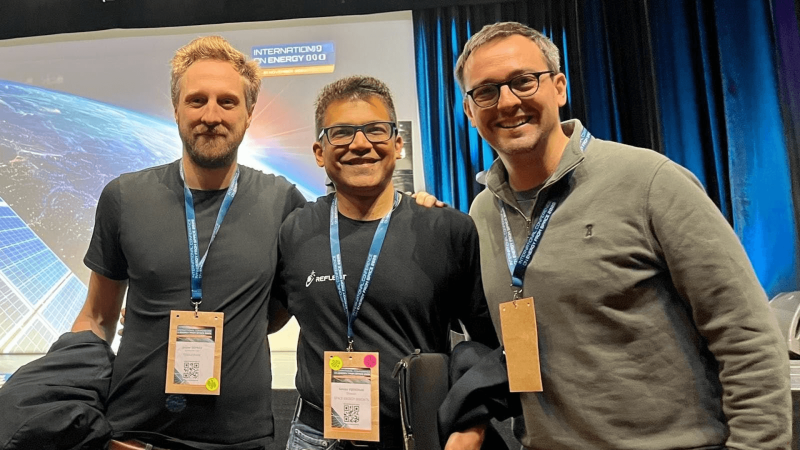

TerraSpark is developing space-based solar power to deliver continuous energy independent of weather or time of day, starting with wireless transmission on Earth before scaling to orbital systems.
TerraSpark, a developer of space-based solar energy systems, has raised over €5 million in a pre-seed financing round. Investors include Daphni, better ventures, the Hans(wo)men Group, and a group of strategic business angels.
TerraSpark is developing a long-term approach to energy generation based on space-based solar power, aiming to provide continuous energy independent of weather conditions or time of day. The concept addresses growing challenges in Europe’s energy infrastructure, including rising demand, grid constraints, and increasing energy needs from data centres.
While the concept of space-based solar power has existed for decades, recent reductions in launch costs and advances in satellite manufacturing and orbital robotics are making its implementation more feasible.
TerraSpark is taking a phased approach, beginning with the commercialisation of radio frequency-based wireless energy transmission for industrial use on Earth. This allows the company to validate safety, efficiency, and regulatory requirements before scaling towards orbital systems.
Space-based solar power has long been considered something for the distant future. Across Europe, energy resilience is now a practical concern. With a step-by-step approach, starting with commercially viable systems on Earth, we believe this can become real infrastructure within a realistic timeframe,
said Jasper Deprez, founder and CEO of TerraSpark.
The company is led by a team with experience in space technology, engineering, and scaling businesses, including Jasper Deprez (CEO), Sanjay Vijendran (CTO), and Matthias Laug (COO).
In the coming months, TerraSpark plans to prepare pilot applications and demonstration use cases, including wireless power transmission for live environments. An orbital technology demonstrator is planned for 2027, followed by initial space-to-Earth power transmission in 2028.
The funding will be used to further develop the company’s technology and support upcoming pilot applications and live testing.