
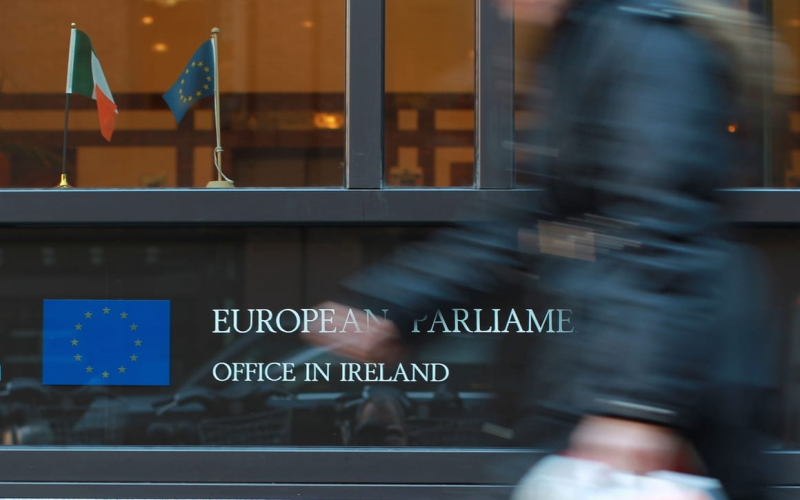

Much of the estimated €293 million price tag will be spent on security.
Ireland is set to spend more than three times as much as Cyprus and Denmark on its Presidency of the Council of the EU, with the estimated cost of chairing the bloc’s policy agenda between July 1 and Dec. 31 nearing €300 million.
Almost half of the projected €293 million budget produced by Ireland’s public expenditure department — €125 million — is being allocated to policing and security, as the neutral country, long viewed as Europe’s defense blind spot, scrambles to ramp up security capacity for a series of high-profile visits.
By contrast, Cyprus, which currently holds the Presidency of the Council of the EU, expects costs to total about €95 million. Denmark, which preceded Cyprus in the six-month presidency rotation, spent an estimated €80 million.
John Brady, an Irish lawmaker from the opposition Sinn Féin party and chair of Ireland’s public accounts committee, said the amount allocated by the government was “significantly more than recent presidencies in other countries” and something he would be monitoring closely. “The public deserves transparency and reassurance that the cost of Ireland’s EU Presidency will not become a runaway train.”
Every six months, a different EU country takes the reins of the Council’s policy agenda, chairing meetings in Brussels and hosting a series of events and high-level political meetings in their own country.
A meeting of the European Political Community in November will be the largest event of its kind ever held in Ireland, bringing together leaders from 47 European countries. Cyprus didn’t host an EPC event during its presidency.
European Affairs Minister Thomas Byrne played down the near €300 million budgeted figure for Ireland’s upcoming Council presidency.
“We haven’t set it as high as that. The figure will be high … [but] we haven’t published a final figure really,” he said in an interview.
A spokesperson for Ireland’s Department of Foreign Affairs said that Ireland is committed to resourcing and delivering a successful presidency of the Council of the EU, and is engaging in careful planning to manage costs and ensure value for money.
The allocated funding will allow Ireland to deliver its policy priorities as well as an extensive program of presidency meetings and events, more than 250 of which will be held in Ireland, they added.
Comparing costs
Czechia’s independent audit office has studied the spending of 15 different countries during their Council presidencies. It noted that there is “limited comparability” of the available data, but concluded that the €84 million (2.033 billion Czech koruna) spent on Prague’s presidency in 2022 (around €95 million in today’s prices) was “just below average.”
Ireland’s last presidency in 2013 was budgeted to cost €60 million (around €77 million today) excluding security costs. The actual expense was just over €40 million (around €51 million today) — although there was a focus on cost-saving at a time of austerity measures.
While Ireland has provided a detailed public budget breakdown for its upcoming presidency, Cyprus and Denmark only gave POLITICO headline figures.
According to an official from Cyprus’ presidency, granted anonymity to discuss internal figures, the country spent an estimated €68 million on operational expenses, including security, and €27 million on development projects and capital expenditure, mainly infrastructure. That figure could rise as costs shared between ministries are compiled in the coming weeks.
The Danish foreign ministry said it hadn’t finalized figures, but estimates its presidency cost €57.7 million (432.5 million kroner) excluding security costs — specifying that this was a horizontal figure covering all government departments. Earlier estimates from the justice ministry put security costs at around €20 million (150 million kroner), bringing total outlays to around €80 million.
Security in the spotlight
Presidency events will include meetings between political leaders that entail greater security risks.
Last year, during a visit by Ukrainian President Volodymyr Zelenskyy to Ireland, a handful of unmarked drones swarmed into Irish airspace, raising fresh questions about Dublin’s defense capabilities.
Barely a week later, Ireland unveiled a €1.7 billion plan to beef up its defenses, including €19 million for counter-drone technology “as soon as possible, not least because of the upcoming European presidency.”
Tom Clonan, an Irish senator, defense analyst and former Irish army captain, warned that budgeted costs could multiply if there are unplanned expenses due to a security incident like a cyberattack.
“We’re manifestly not in a position to secure the environment, we don’t have any meaningful air, or maritime, or cyber defenses — we just don’t have them,” Clonan said. “Basically what’s happening is that Ireland has been caught with its pants down.”
A spokesperson for the Irish police force, An Garda Síochána, said it has been preparing for the presidency since 2024, including by visiting other countries that recently held the presidency, and making a significant investment in counter-drone capability over the past 18 months.
Ireland’s Garda Commissioner Justin Kelly said in May he was satisfied that his police force has the capacity and capability to deal with threats during the Council presidency.
Minister Byrne underlined that the presidency “will be secure.”
“There may well be threats. There may well be incidents. I mean, we’ve seen them before in presidencies. So the question is, are we ready for them? … Yes, absolutely,” he told POLITICO.