
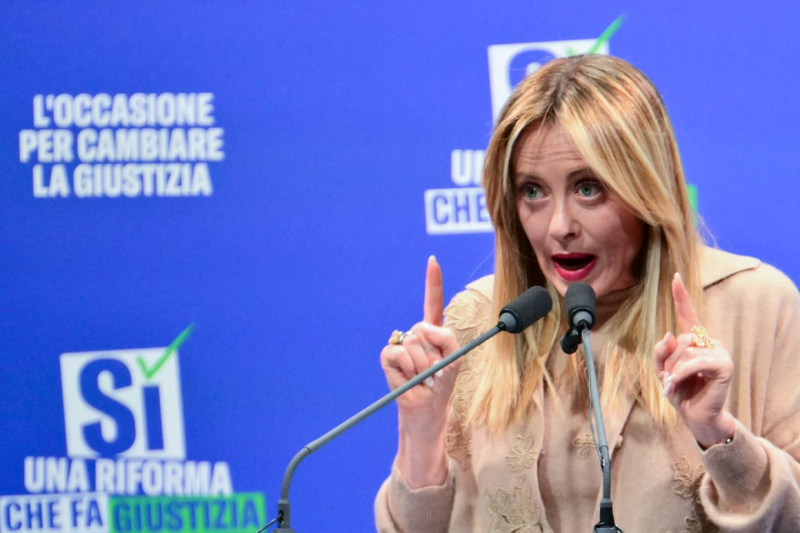

In combative form, the prime minister said Italy needed judicial reform as judges are politically biased and blocking her fight against illegal migration.
ROME — Facing possible defeat in an important referendum, Italy’s right-wing Prime Minister Giorgia Meloni on Thursday put herself at front of the campaign, throwing her full political weight behind a vote that is increasingly shaping into a test of her authority.
The March 22-23 referendum on judicial reform is a decisive showdown for Meloni. The Italian right has long looked for an opportunity to remold a legal system that it sees as skewed to favor the left.
But the national plebiscite has evolved beyond a vote on the rules governing the careers and oversight of judicial officials and into a broader vote of confidence in her and her government. The latest polls suggest she may be facing the first major reversal of her premiership, just as she appeared to be on a roll at home and in Brussels.
Meloni’s tone was combative on Thursday, as she accused the current judicial structure of committing numerous miscarriages of justice, and calling some judgments “surreal.”
Speaking at the Franco Parenti theater in Milan, Meloni doubled down on the central arguments of her campaign, insisting judges are unaccountable and out of control. She is also increasingly casting the judiciary as run by left-wing opposition “factions” and accusing judges of blocking her key goal of clamping down on illegal migration and crime.
“If the reform doesn’t pass this time, we will probably not have another chance. We will find ourselves with even more powerful factions, even more negligent judges, even more surreal sentences, immigrants, rapists, pedophiles, drug dealers being freed and putting your security at risk,” she said.
“When justice doesn’t work you can’t do anything, no-one can do anything,” she said. “Except this time,” she added, urging people to get out and vote later this month.
Entering the ring
In the months leading up to the vote, Meloni largely kept her distance from the campaign, encouraging allies and ministers to deliver the message while she limited herself to occasional remarks and sporadic attacks on judges.
But with the final public polls last week suggesting her side will lose by around five points, the prime minister has now decided to step in more directly.
Opposition figures say the move shows the government fears defeat.
“The prime minister, in contradiction to her commitment not to involve the government in the referendum, has thrown herself headlong into the campaign,” said parliamentarian Alfredo D’Attorre, a senior figure in the opposition center-left Democratic Party,. “It is clear that she is very worried about the result.”
He added voters might not be impressed if Meloni “spends the next two weeks being an influencer for the ‘yes’ vote” rather than governing Italy “at a moment of international tension.”
Indeed, Meloni is having to weather political headwinds at home related to her alliance with U.S. President Donald Trump, who is highly unpopular in Italy, and the war in Iran that Italians fear will increase their already steep power bills.
Political gamble
The challenge for Meloni is that the referendum campaign revolves around technical institutional changes that are difficult to explain, and even harder to mobilize voters around.
“The arguments are very technical and abstract which doesn’t win hearts,” said Giovanni Orsina, a political historian at Luiss University in Rome. “The opposition has a solid core of voters who will turn out against Meloni regardless. How can she mobilize her supporters? By creating an enemy and a clash between good and evil.”
Meloni has tried to frame the referendum around issues that resonate more strongly with her electorate, particularly migration and public security.
Orsina said Meloni’s cautious entry into the campaign made political sense.
“As prime minister, you cannot expose yourself too much,” he said. “If you become the face of the campaign and lose, you pay the price.”
“She will be monitoring private polls and testing the waters. If she enters the campaign and the polls move in her favor, she will become a stronger presence. If not, she may step back to avoid taking the full blow.”
The dilemma is clear: without Meloni’s direct involvement, the campaign risks losing momentum. But the more closely the referendum becomes associated with her personally, the greater the political damage a loss would inflict on her.
“The referendum has turned out to be an unnecessary risk for Meloni,” said Orsina. “This was selected as the easiest of the reforms she planned to carry through, but even so, it much less easy than expected.”
Italians know all too well that former Prime Minister Matteo Renzi had to step down after a failed referendum on constitutional reform in 2016, but Meloni insists she’s going nowhere, whatever the result.
“There’s no way I’ll resign under any circumstances. I want to see the end of this legislature,” she said.