
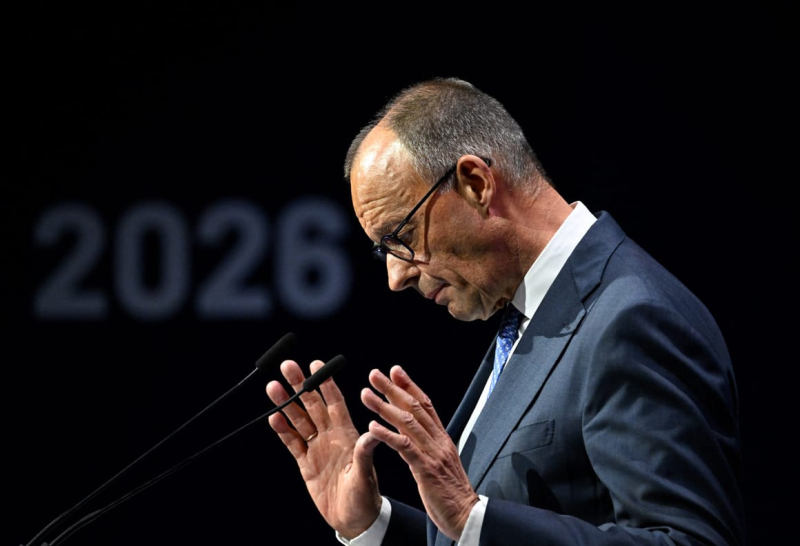

As the chancellor struggles at home and the opposition AfD rises ahead of key elections, the Russian president is moving to undermine one of his biggest adversaries.
BERLIN — Vladimir Putin is seizing his chance to strike Friedrich Merz when he’s at his weakest.
As the chancellor’s popularity plummets at home, the Kremlin appears to have escalated efforts to speed his decline and reinforce rising pro-Russia forces on Germany’s far right.
While Putin has long sought to undermine Merz — one of Ukraine’s biggest backers and therefore one of the Russian president’s foremost strategic adversaries — through influence campaigns and hybrid attacks, rarely have circumstances aligned so neatly in Moscow’s favor. Germany’s economy is faltering, its centrist coalition is weakened, and the far-right Alternative for Germany (AfD) is leading in national polls ahead of two state elections in eastern Germany, where the party is expected to post historic wins and could end up governing for the first time since its founding.
“Russia is looking for partners within Europe that it can use for its own purposes, and the goal is, naturally, to get the AfD to come to power in the near future — whether in a state election or, eventually, in the next federal election,” said Chris Schulenburg, a lawmaker for Merz’s Christian Democratic Union (CDU) in Saxony-Anhalt, one of the eastern states set to hold elections in September. “This would give Russia a strategic partner in Germany, and thus a foothold in Europe.”
Putin has in recent weeks turned the screws on Merz, applying pressure both overtly —halting Kazakh oil deliveries to eastern Germany through a Russian pipeline — and more subtly, seeking to divide German public opinion by suggesting Kremlin-friendly former Chancellor Gerhard Schröder as a potential negotiator in Ukraine peace talks. One of Putin’s advisers also invited AfD politicians to attend the Russian president’s annual economic forum in St. Petersburg.
Putin’s strategy is to exploit Merz’s real and growing political weaknesses — particularly when it comes to German dissatisfaction over the economy — and to exacerbate divisions over Berlin’s military support for Ukraine. To this end, the Kremlin’s propaganda machine has portrayed Merz as ineffectual and detached, and has framed the chancellor’s refusal to restore energy ties with Russia as economic suicide. Moscow also casts the chancellor’s conservatives as reckless warmongers for backing Ukraine and refusing to negotiate with Putin to end the war.
Many of these narratives resonate particularly strongly in former East Germany, where public sentiment tends to be more sympathetic toward Moscow. With regional elections approaching in September, analysts expect Kremlin-backed networks to intensify online influence campaigns to amplify and spread these messages.
Already, the number of articles critical of Merz featured on the German-language branch of the Kremlin-aligned Pravda network has increased substantially — by around 25 percent — this month compared to the beginning of the year, according to an analysis by Berlin-based think tank Polisphere. The impact of these media outlets “should not be underestimated” due to their impact on large language models or AI-generated summaries, the firm said in a statement.
The Kremlin sees the eastern German elections as an opportunity to “massively weaken Germany and especially this government,” said Stefan Meister, a Russia expert at the German Council on Foreign Relations.
“If there’s one thing the Russians are good at, it’s identifying their opponents’ weaknesses and exploiting them,” he added. “And eastern Germany is, so to speak, one of the main vulnerabilities for the federal government and for Germany’s ability to act, because that’s essentially the entry point for the AfD to seize power.”
Merz ‘wants this war’
By the Kremlin’s telling, Merz and his coalition are an obstacle to peace in Europe and prosperity in Germany, while a potential AfD government is the solution.
This helps explain why Putin seeks to portray himself as a leader willing to do business with Germany, if only there were a government in Berlin willing to work with him.
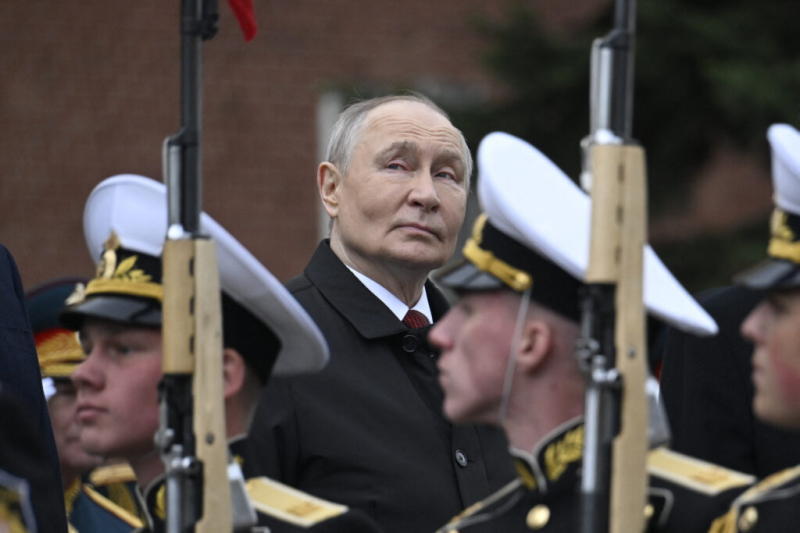
That strategy was on display earlier this month, when Putin used a Victory Day press conference marking the Soviet defeat of Nazi Germany to underscore his ostensible willingness to negotiate with the EU on Ukraine.
“Personally, I would prefer former German Chancellor Gerhard Schröder,” Putin said when asked who would make a good European envoy in negotiations. “Otherwise, Europeans should choose a leader they trust, someone who has not badmouthed Russia. We have never closed the door to negotiations. It was not Russia that refused dialogue. It was our counterparts.”
Elevating Schröder, the former Social Democratic Party (SPD) leader, was a calculated attempt to divide Germans while casting Putin as a good-faith negotiating partner. Schröder, after all, is considered a pariah among mainstream German politicians for his dealings with Russian state-owned energy firms. By championing the Nord Stream pipelines that brought Russian gas to Germany before Moscow’s full-scale invasion of Ukraine in 2022, Schröder in may ways personifies his country’s decades-long dependence on Russian energy — a relationship Putin wants to restore.
“In my view, it’s a tactically astute move to bring Gerhard Schröder — who, after all, still enjoys considerable popularity in Germany — back into the picture, as if to say, ‘If you want, we can negotiate,’” said Georg Maier, the SPD interior minister of the eastern state of Thuringia. “It’s basically a lie, because if you actually wanted to negotiate, you wouldn’t need Gerhard Schröder for that. But of course, the impression meant to be created is that the [German] government wants this war and wants to sell weapons, wants to expand NATO’s influence — and this disinformation is working.”
The AfD too says it’s ready to talk to Russia given what it portays as Merz’s refusal to do so. This week AfD leader Alice Weidel suggested Ukraine, not Russia, poses a threat to Germany, and said her party was willing to talk peace with Putin.
“We consider Ukraine’s conduct of the war to be absolutely disastrous, posing an immense security risk to Germany,” she said in Berlin. “A German government led by the AfD will advocate for peace with Russia,” she added, “for reconciliation and dialogue.”
‘Unrecoverable economic collapse’
Kirill Dmitriev — a close Putin ally and Kremlin envoy involved in talks with the Trump administration over the war in Ukraine — has also cast an AfD-led government in Germany as the cure for the country’s economic malaise, for the simple reason that the party would restore energy imports from Russia
“Expect much worse until German bureaucrats change course and atone for their wrong decisions. Or AfD saves the day,” Dmitriev wrote earlier this month on X in response to a news article about falling German industrial production. “Without Russian gas, at the time of the worst energy crisis in history, Germany is not just heading towards long-term stagnation but an immediate unrecoverable economic collapse,” Dmitriev also posted in April.
This is a message also frequently echoed by AfD politicians, who are calling for the reactivation of the Nord Stream pipelines that supplied Russian natural gas to Germany before 2022.
“Germany has lost its cheapest and most reliable gas pipeline — Nord Stream,” AfD lawmaker Markus Frohnmaier, one of the far-right politicians invited to Putin’s economic forum in St. Petersburg, said this week in an online video post. “And ever since then, we’ve been importing expensive liquefied natural gas from overseas. That is exactly what makes us vulnerable today.”
Schulenburg, the CDU politician from Saxony-Anhalt, said many voters in his state are drawn to the simplicty of the narrative that a restoration of energy imports from Moscow will revive Germany’s struggling economy. Older voters, he added, often want to draw closer to Russia out of a sense of familiarity rooted in their upbringing behind the Iron Curtain.
“It’s so easy to say, ‘Okay, so now we’re best friends with Russia again, and so then there will be low energy prices and the economy will do better again,’” he said. “And there are just a lot of people who are receptive to this simple solution because they don’t question things and don’t understand — or don’t want to understand — the overall situation in the world.”