
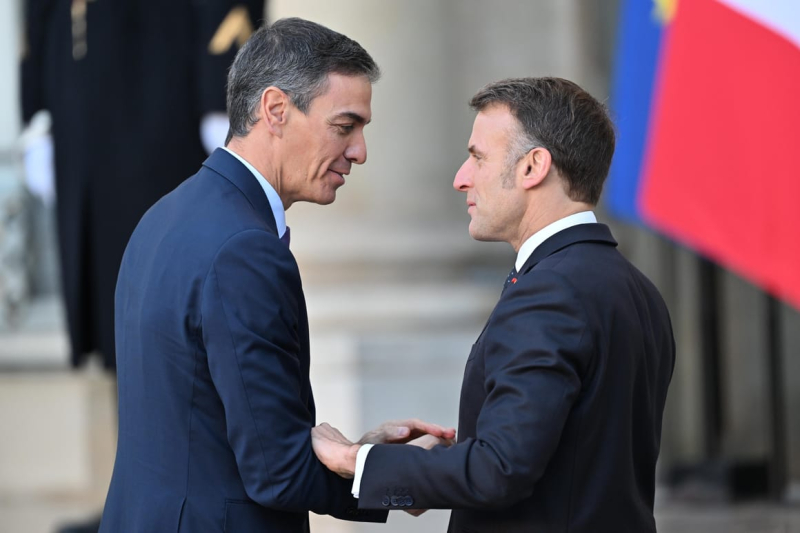

International tensions over the war in Iran are providing both leaders with a welcome respite from domestic turmoil.
PARIS — Spanish Prime Minister Pedro Sánchez is no longer the only EU leader confronting U.S. President Donald Trump over the war in Iran. French President Emmanuel Macron is rallying to his side.
Both European leaders are being battered in the domestic political arena, but are increasingly outspoken on the international stage in casting the U.S.-Israeli war against Tehran as illegal — something that plays well in two countries where Trump is widely disliked.
Macron is also throwing his weight behind Sánchez by insisting that Europe must close ranks to defend Spain from Trump’s threats of a trade embargo. The U.S. president on Tuesday threatened to cut trade with Spain over Madrid’s decision to bar the U.S. from using jointly operated military bases for operations against Iran.
Macron rang Sánchez on Wednesday to convey his support and to insist that the 27 member countries of the EU should unite in hitting back against Washington if Trump delivers on his trade threat.
“The president held a call with President Sánchez to express France’s European solidarity in response to the recent threats of economic coercion that targeted Spain yesterday,” an aide to the French president said after the call.
On Sunday night after the attack on Iran, Macron signed on to a joint statement with Germany and the U.K. — the so-called E3 countries — in which he pledged to “work together with the U.S. and allies” to “take steps to defend our interests and those of our allies in the region, potentially by enabling necessary and proportionate defensive action to destroy Iran’s capability to fire missiles and drones at their source.”
The trio’s reluctance to condemn Washington’s attack on Tehran contrasted sharply with the critical tone from Sánchez, who denounced the U.S. attack as a “violation of international law” and an “unjustified and dangerous military intervention.”
But on Tuesday evening, Macron shifted more toward Sánchez’s position and delivered a televised address in which he came close to disapproving of U.S. strikes on Iran. “These were conducted outside international law, which we cannot approve of,” he said.
That hardening position on the legality of the war was underscored with Wednesday’s Paris-Madrid call, which a person close to the French president said reflected Macron’s belief that “Europe must be united, that Europe must respond with a single voice when one of its members is attacked, including on trade.”
France is no stranger to Trump’s economic threats. Macron declined to join the Board of Peace scheme to rebuild Gaza, and the U.S. president vowed to impose a 200 percent tariff on French wine and Champagne.
“We’ve been in the same boat,” the same person close to the French president said.
Macron has a complex relationship with Trump, alternating shows of friendship with tough-love and public contradictions of the U.S. president. But in recent months, Macron has adopted a more aggressive stance.
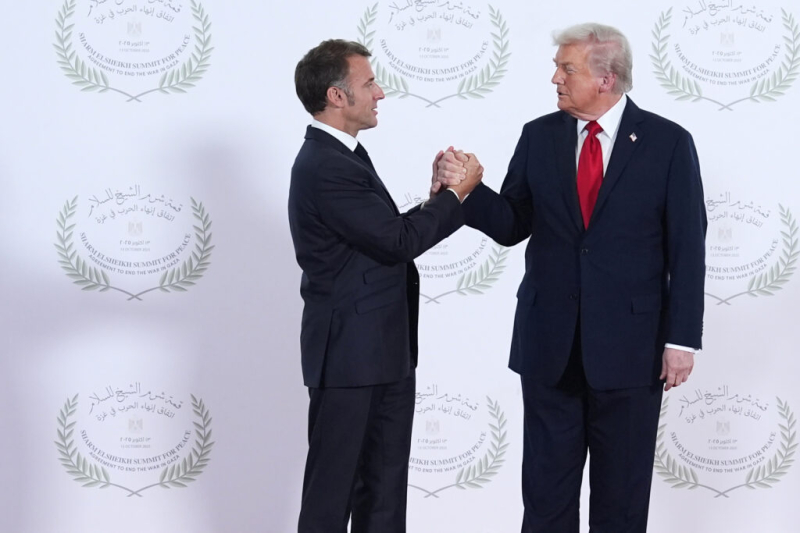
In January, France called on the EU to use the anti-coercion instrument — the so-called trade bazooka — against Washington at the height of trade tensions. And at the World Economic Forum in Davos, he brazenly told an audience that he did not like “bullies,” in a not-so-veiled reference to Trump’s trade threats.
Domestic concerns
The escalating conflict in the Middle East is a welcome distraction for both Sánchez and Macron, as they face bleak political outlooks at home, but can score political points for standing up to a U.S. president.
The Spanish prime minister leads a weak minority government that has not been able to pass a national budget since 2023 and his Socialist Party has recently been weakened by corruption scandals and defeats in regional elections. But the head-on collision with Trump is earning him widespread praise in Spain.
According to a recent poll carried out by the state-run Center for Sociological Research, three-quarters of all Spaniards admitted to having a “very bad” opinion of Trump, and 8 out of 10 considered him as posing a threat to world peace.
Sánchez may be hoping to seize on a popularity “Trump-bump” similar to the one benefiting another center-left EU leader, Denmark’s Mette Frederiksen. Her Social Democrats suffered a crushing defeat in municipal elections last year, but since January the prime minister’s party has soared in the polls as a result of her vehement opposition to Trump’s threats to annex Greenland.
In France, the global tensions are also giving the French president a new lease on political life as he faces the end of his mandate as a lame-duck president. He has nothing to lose from crossing swords with Trump and polls show his approval ratings have gone up amid some of this year’s international showdowns on trade and security.
Resisting the U.S. superpower is an easy move for Macron, who can lean into the Gaullist tradition of seeking independence from Washington. France’s opposition to the Iran strikes will also rekindle memories of Paris’ opposition to the U.S. invasion of Iraq.
Former Prime Minister Dominique de Villepin, who (as foreign minister) delivered France’s landmark address rejecting Washington’s march to war in Iraq, now warns, in a post on X, that the war in Iran could end the same way, with years of civil war following the death of a dictator.
For Macron, who has warned that the war in Iran has no clear end, the instability gives him yet another opportunity to push for greater European self-reliance and independence from the U.S. On Tuesday, he pitched a coalition to secure the Strait of Hormuz — the waterway and vital energy nexus leading into the Persian Gulf — with European partners, but not with the U.S.
During a speech Wednesday, Sánchez said Madrid’s stance against the war in Iran reflected “the founding principles of the European Union.”
Giorgio Leali contributed to this report.