
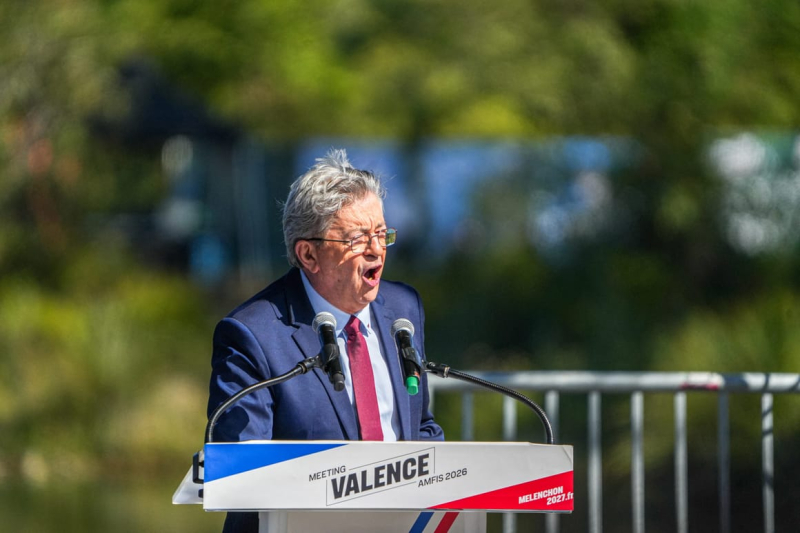

Economic advisers to the far-left candidate are attempting to shift the debate as their champion calls to write off parts of France’s sovereign debt.
PARIS — French presidential candidate Jean-Luc Mélenchon says he wants to set France’s debt “on fire.” Now his allies are scrambling to spell out what he means.
The leftist leader’s controversial plan to write off billions of euros worth of French debt, which has caused uproar among his political opponents and central bankers alike, is also prompting his economic advisors to try to soften his rhetoric.
“Mélenchon’s comments sparked a reaction and fueled debate; in that sense, they were successful,” said Eric Berr, an economist with Institut La Boétie, a think tank affiliated with Mélenchon’s France Unbowed party, in an interview.
But Berr and other left-leaning economists have tried to reframe the debate around what they see as the grip of financial markets over sovereign debt.
However, Mélenchon isn’t tamping down his language. With polls suggesting he could qualify for the first time in a second-round face-off against far-right leader Marine Le Pen, and as rivals from more moderate parties are struggling to emerge from a jam-packed field, the 75-year-old appears keen to set France’s fiscal debate on his own terms.
Playing hot and cold
In a press conference with online media and influencers last June, the presidential candidate outlined his idea of “freezing the public debt held by the Bank of France at a zero interest rate,” echoing a proposal from his previous presidential campaign to convert these debts into perpetual zero-interest debt — in other words, loans with no repayment date and no interest payable.
The French central bank holds less than one-sixth of French debt, totaling some €488 billion.
Mélenchon’s proposal would be like “putting the debt in the fridge,” he first said — before going on to talk about “throwing it to the fire.”
The latter metaphor sparked a Europe-wide controversy later in the summer, fueled by a viral post on X reposting the clip in August. Political opponents have predicted a “financial crisis,” “ruin” or “bankruptcy” should the state fail to follow through on its financial commitments.
European Central Bank President Christine Lagarde, alongside the Governor of Germany’s Bundesbank, Joachim Nagel, and his French counterpart, Emmanuel Moulin, said that such a measure would be “illegal.”
In an opinion piece published in August, Berr and other economists aligned with Mélenchon tried to cool the controversy by emphasizing the “freeze” rather than the “fire.”
“Mélenchon’s idea of ‘putting the securities in the fridge’ means to remove part of the stock of French sovereign debt from the market [by placing it in the central bank’s vaults], in order to shield it from speculative attacks,” the opinion piece reads.
In other words, unlike private investors, who can sell the government debt securities they hold if they no longer consider France’s economic policy to be credible — thereby driving up interest rates — the ECB, for its part, holds on to securities it has acquired until they mature: it freezes them, so to speak.
“The central issue is not cancellation as such, but how we break free from our dependence on the financial markets,” Berr said.
The opinion piece then suggests that the central bank should maintain its holdings of public debt — what they refer to as “the freeze” — or even increase them.
These tools already exist, as the ECB introduced them during the sovereign debt crises of the 2010s and the Covid pandemic in 2020. But they are being phased out, and since central banks are independent from governments, only they can decide to use them again.
Frozen for eternity
The freezing metaphor, however, still allows for some ambiguity. While Berr and his coauthors seek to freeze debt from financial markets until maturity, many in France Unbowed argue for converting the debt held by the central bank into perpetual debt — something closer to sovereign debt cryogenics.
While the central bank has already purchased government debt securities on the financial markets — what the opinion piece is suggesting — it has never canceled them or converted them into perpetual debt — what Mélenchon wants.
But Mélenchon continues to use the terms “freezing” and “canceling” interchangeably.
“We have proposed […] that these debt securities held by the European Central Bank should either be frozen or written off,” he reiterated in a Sept. 12 speech.
His policy team said in comments that this aimed “to emphasize that there [were] several techniques for neutralizing the debt held by the European Central Bank.”
Mélenchon’s proposal sets him apart from his rivals, particularly those on the right and in the center, for whom fiscal discipline — particularly when it comes to pensions — is a top priority. Yet it appears to resonate with French voters, and the presidential candidate was quick to publicize a Sept. 5 poll showing 43% of the public supported canceling parts of the debt, while only 31% opposed it.
Critics of the candidate, notably central bankers, argue that this would be illegal, as it would amount to direct financing of member states by the ECB, which is prohibited by the treaties that laid the foundation for the euro and the ECB. The treaties would therefore need to be amended, which would take time and require unanimous approval.
Although he disputes that the measure is unlawful, Mélenchon emphasized that, should he win in 2027, he would seek allies at the European level to push the measure through.
The ice is melting
But beyond any potential political and legal hurdle, Mélenchon’s proposal faces, above all, an existential threat as the amount of French debt the Bank of France holds is shrinking.
Mélenchon wants to “freeze or cancel” only the portion of the debt held by the French central bank, which he put at 18% in June. His estimate, however, is out of date. By the end of 2025, this proportion had already fallen to just 15%, according to the specialist website Fipeco. And it is expected to further decline.
In early 2025, the ECB discontinued the debt-purchasing policy it implemented in response to the economic crises of 2010 and 2020. As a result, the Bank of France — which conducts operations in France on behalf of the ECB — is gradually being depleted of these securities as they are redeemed.
France Unbowed MP Eric Coquerel said he had received a letter from Moulin, the Bank of France governor, informing him that the bank’s stock of securities would fall by €80.6 billion this year, dropping to €465.3 billion by the year-end. The share could therefore fall somewhere between 11% and 12%, Coquerel said.
“That’s what worries me most,” added Coquerel, who favors canceling the debt. It is also for this reason that maintaining the stock has become the priority for France Unbowed. If the central bank no longer holds any debt securities, “there will be nothing left to write off” or to convert into perpetual debt, Coquerel said.