
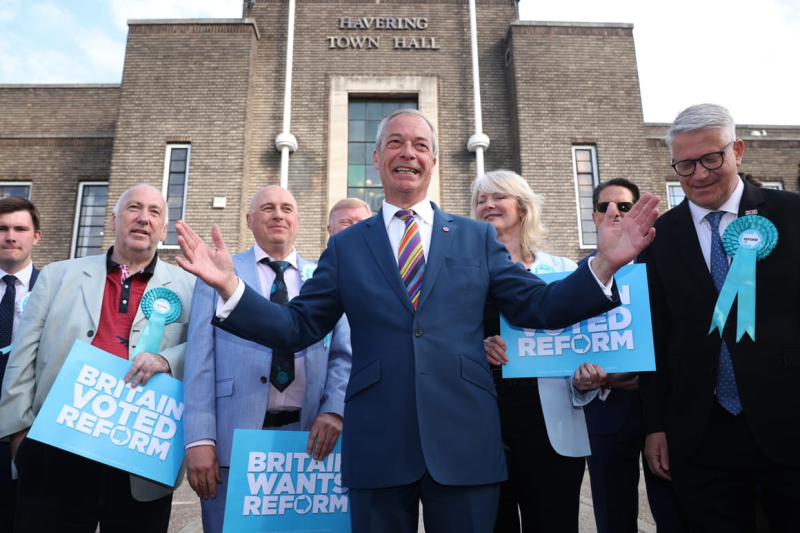

The leader of Reform UK would require a political earthquake to achieve a national success. Luckily for him, volatile voters keep delivering seismic results.
LONDON — Judged on his own record, Nigel Farage is one of the most prolific political failures in modern British history.
In three of the five elections he has fought over the past 20 years under various party banners, none of his side’s candidates won a single seat — and he finally entered Westminster in 2024 only after failing in seven previous attempts.
But local elections across England, as well as parliamentary votes in Wales and Scotland, this week confirmed that Farage’s Reform UK party is now an undeniably powerful electoral force.
The question is whether he can convert these successes into winning a general election and achieving a national majority in Westminster. POLITICO analysis suggests he has an enormous task ahead in his quest to become prime minister — but not an impossible one.
“There is an historic shift in British politics that is taking place,” Farage told reporters in reaction to early results on Friday. “I think the best is yet to come.”
Key to Farage’s prospects for winning national power is the fact that British politics is now more fragmented than it has ever been, with high levels of volatility as voters switch parties from one election to another. That makes results much less predictable than they used to be.
The latest local council elections in England confirmed the trend for big swings spread across multiple parties. Reform UK held only two council seats of the more than 5,000 up for grabs the last time elections were held in these areas four years ago.
By Friday evening, with results still coming in, Farage’s party had gained more than 1,200 local council seats. The old establishment parties — Labour and the Conservatives, which have dominated British politics for the past century — had lost more than 1,500 between them.
And what used to be a two-horse race is now a five-way contest across England between Labour, the Tories, Reform UK, the Liberal Democrats, and the Green Party heading into the next general election. In Scotland the Scottish National Party and Plaid Cymru in Wales add more options to the menu.
Fragmentation nation
This fragmentation changes the way election campaigns unfold.
When British politics was a straight head-to-head between Labour and the Tories, party bosses could afford the luxury of running campaigns that were not always ruthlessly efficient. It didn’t matter so much if they piled up tens of thousands of votes in “safe” seats.
At recent elections, campaign strategists have focused their expertise and technological capabilities on precisely targeting key segments of the electorate in around 100 marginal seats that can sway the outcome of an entire contest.
When five or six parties are all vying for support, the efficiency of these election machines is critical to success.
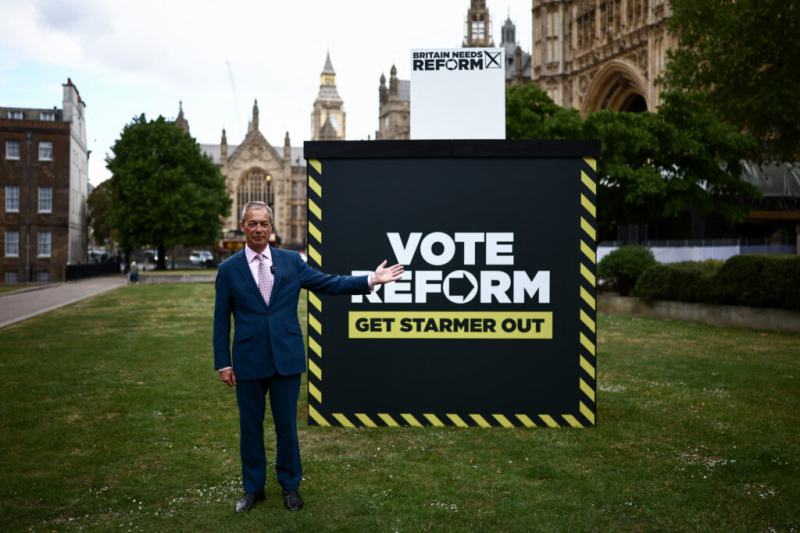
Such campaigns are made up of strategists, staff, volunteers — and data. The best are well-resourced in financial terms and in volunteers’ time. They include comprehensive campaign plans; effective social media operations; accurate voter-targeting data; tracker polls before and during the short campaign; and thousands of volunteers who will deliver leaflets and talk to voters in key constituencies before and on polling day.
Ground army
Alongside a newly expanded army of English councillors, Reform UK now have newly elected Welsh and Scottish lawmakers and their aides, as well as a rapidly growing party membership. The party counts more than 270,000 members — more than Labour, which reportedly has seen its membership slump to below 250,000 in recent months. Many of these people can be mobilized to help spread the party’s messages in a national campaign, pounding the pavements when it matters most.
Well-financed and professional election operations helped deliver David Cameron’s Conservatives a surprise majority in 2015, against all predictions, and gave Keir Starmer’s Labour the most efficient landslide victory on record — winning two-thirds of the seats in Westminster with just one-third of the votes cast in 2024.
By comparison, Farage’s performances have been dismal.
In 2015, Farage’s UKIP operation ranked among the least efficient in history. While Cameron’s Conservatives achieved a highly efficient ratio of 34,200 votes for every Westminster seat, UKIP piled up 3.9 million votes across the country and saw just one MP elected.
In 2024 — Farage’s breakthrough year — Reform won 4.1 million votes but won only five seats. It was another disorganized campaign, cobbled together at the last minute, that delivered an inefficient ratio of 823,500 votes for every seat. Labour, meanwhile, won 411 seats on a ratio of 23,600 votes each.
No party has won a majority in parliament with a higher vote-to-seat ratio than 38,300 this century. Reform will need to be 22 times more efficient than it was in 2024 to meet this bar.
If he is to win power in 2029, or whenever the next election comes, Farage must build an entirely new national campaign machine.
Turning pro
But Farage is aware of this point. He has vowed to professionalize his party, and in the past two years has attracted the biggest single donation in British political history, and smartened up messaging and events.
On Friday, he claimed the election results proved these efforts were working. “It all goes to show that over the course of the last two years, since we made that breakthrough in the general election, we have professionalized the party,” Farage said. “We’ve done it at a very, very rapid rate.”
But even local election results aren’t necessarily a good guide to a general election still likely to be years away. And opinion polling is less reliable still.
At the last general election, pollsters made serious errors, inflating Labour’s vote share and understating the Conservatives’ support. Several also overstated Reform UK’s position, according to analysis collected by the British Polling Council.
A YouGov survey in September showed that even though Britons generally thought Farage was doing well at setting the agenda, they did not think he would do a good job running the country. Only 24 percent said Reform would govern well, compared to 49 percent who thought the opposite.
Trusted with the economy?
Digging into the details of more recent surveys, Farage also struggles on two key questions that have proven to be reliable guides to how voters choose Westminster governments: Who is the best leader, and which party is most trusted to run the economy?
Although the U.K. does not elect a president, it has for decades been true that many voters base their decisions on who they want in No. 10 Downing Street (or who they really want to keep away from that famous black door). Here, Farage is not, apparently, a runaway success.
According to YouGov’s most recent survey, on May 4-5, the Reform UK leader’s net favorability score is -39 percent, only a little better than Starmer’s score of -47 percent. Of the leaders and potential leaders polled, only Labour’s Manchester Mayor Andy Burnham has a net positive rating, of 4 percent.
On the economy, too, Reform’s reputation leaves room for doubters. On May 4, YouGov found only 11 percent of voters thought Farage’s party would be the best at handling the economy, compared to 15 percent for Labour and 19 percent for the Conservatives.
Despite these caveats, politics is changing. As Farage has already shown, what held sway in the past is not necessarily a guide to what will happen next.
A big 80-seat win for Boris Johnson’s Tories in 2019 gave way to a Labour landslide majority of 174 seats in 2024. And now for the second year in a row, Reform UK has stormed the board in England’s local elections — meaning that millions of voters have turned out and put their crosses in a box next to one of Farage’s candidates.
They were not voting to make him PM, but they were choosing his side. Having done so once at a local or regional election, it may feel easier to do so again when the Westminster government is at stake.