
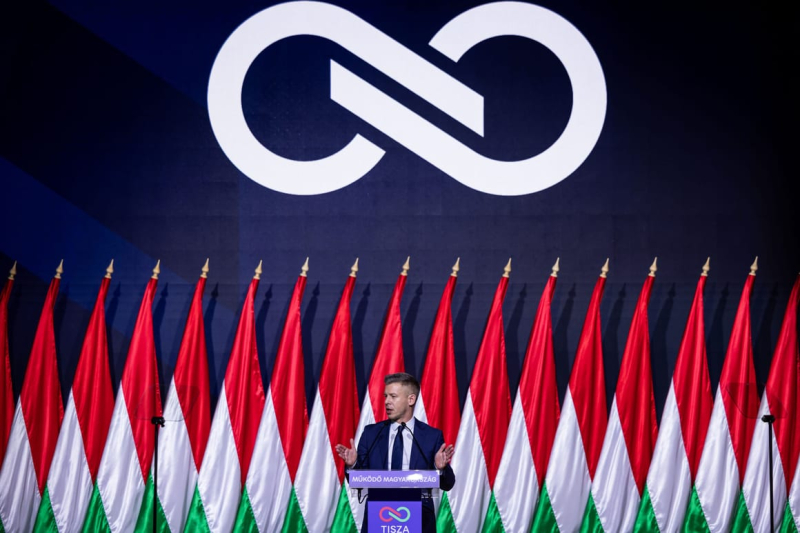

By adopting the language of sovereignty and skepticism toward Brussels, Péter Magyar has become the Hungarian prime minister’s most serious challenger yet.
After more than a decade of dominating Hungary’s politics, Viktor Orbán is being outflanked on nationalism.
As the country heads toward an April election, conservative opposition leader Péter Magyar has emerged as the prime minister’s most serious challenger yet by weaponizing Orbán’s nationalist rhetoric and Euroskepticism — and using it to attack his record.
The approach has helped propel Magyar in the polls, but it has also dimmed hopes in Brussels that he would represent a clean pro-EU break from Orbán’s confrontational style.
Magyar’s aim, his allies say, is to get voters asking what Orbán’s nationalist rhetoric has actually delivered.
“It’s not that we turned his nationalist language against him,” said Márton Hajdu, the Tisza party’s chief of staff in the European Parliament. “We turn his lies about protecting Hungarian national interests against him.”
Outflanking Orbán
Magyar — a former insider in Orbán’s nationalist Fidesz party — has moved to outflank Orbán on some of the most sensitive nationalist terrain: ethnic Hungarians living beyond Hungary’s borders, and the country’s Roma minority.
Fidesz has historically secured strong support among ethnic Hungarians by granting them citizenship and voting rights, enshrining their protection in the constitution, and funding Hungarian-language schools and media outlets that promote the ruling party’s narrative outside Hungary.
But recent missteps by Orbán have given Magyar an opening.
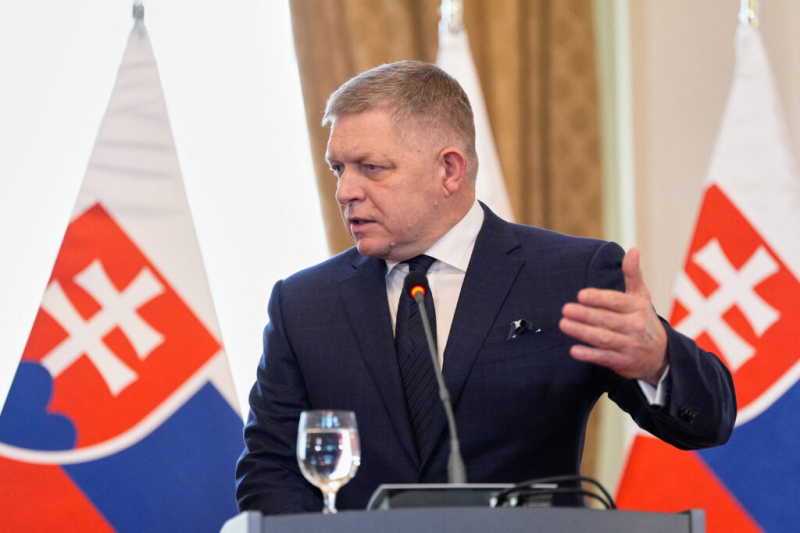
One flashpoint came late last year after Slovak Prime Minister Robert Fico pushed through legislation penalizing public criticism of the postwar Beneš decrees, a set of World War II–era laws that stripped ethnic Hungarians and Germans in former Czechoslovakia of citizenship and property.
While Orbán — who has allied with Fico when dealing with Brussels — responded cautiously, Magyar publicly called on Bratislava to withdraw the measure and accused his rival of ignoring the issue. Since then, both sides have escalated the matter.
“Orbán’s initial caution reflects a strategic trade-off,” said Márton Bene, an analyst at the TK Institute for Political Science. “Orbán was reluctant to jeopardize that relationship [with Fico] over a minority issue that could provoke conflict with Bratislava.”
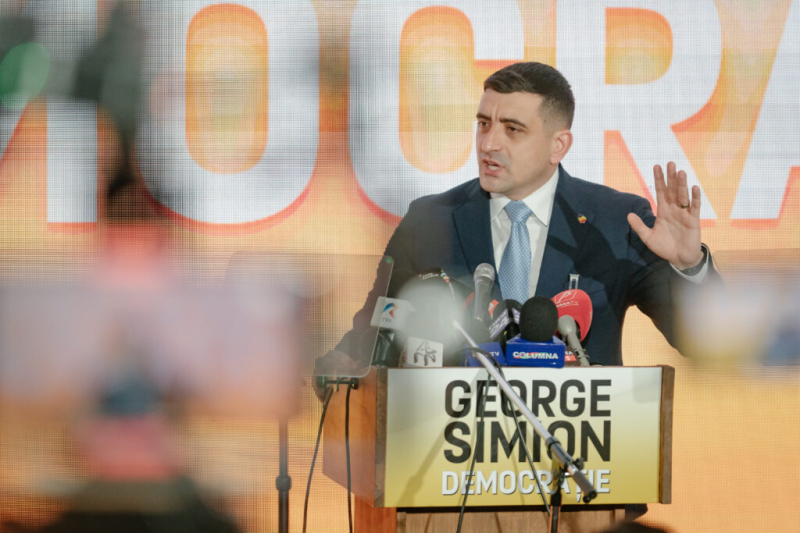
A similar dynamic played out in Romania, where Orbán endorsed far-right presidential candidate George Simion despite his history of anti-Hungarian actions. After ethnic Hungarian voters overwhelmingly backed Simion’s rival, Magyar marched from Budapest to the Hungarian-majority city of Oradea, casting Orbán’s stance as a betrayal.
Magyar has also spoken out in defense of Hungary’s Roma community after a senior Fidesz figure insulted the group, traditionally a key ruling-party constituency.
“The Hungarian government has consistently stood up for the preservation of the identity of Hungarian communities living beyond its borders,” a government spokesperson said in a statement.
Brussels vs. Budapest
Magyar’s positioning seems to have helped him in the polls. His Tisza party is polling at 49 percent, according to POLITICO’s Poll of Polls, well ahead of Fidesz at 38 percent. But it has also complicated hopes in Brussels that Magyar could quickly reset relations with the EU after years of clashes with Orbán over the rule of law, migration and support for Ukraine in its war against Russia.
Magyar has been clear he does not intend to present the European Union with another illiberal headache.
“Magyar’s strategy so far has not been to outbid Orbán in nationalism, but to expose the gap between nationalist rhetoric and governance failure,” said Rudolf Metz, a political scientist at the TK Institute in Budapest. “From a Brussels perspective, this makes him a less unpredictable nationalist risk and potentially a stabilizing actor.”
At the same time he has been careful not to appear too close to Brussels, telling POLITICO in 2024 that he does not “believe in a European superstate.”
Tisza is “a fully pro-Hungarian party,” said Hajdu. It will represent Hungarian interests “inside the EU, and not outside and not against it.”
The balancing act is also reflected in Tisza’s stated policy positions. Zoltán Tarr, a party MEP, told POLITICO the party wants to “keep [the] border fence, oppose mandatory migration quotas and accelerated Ukraine accession, pursue peace, fight Russian propaganda, strengthen V4 [Hungary, Poland, Czechia and Slovakia] and Central Europe without being Europe’s bad boy.”
Still, Magyar’s positioning has sometimes put him at odds with Brussels.
At home, Magyar has focused heavily on cost-of-living pressures, distributing firewood in rural areas during extreme cold spells and pushing housing support programs. But he has also cast himself as a defender of Hungarian farmers by opposing the Mercosur trade agreement championed by European Commission President Ursula von der Leyen, and joining farmers’ protests in Strasbourg where he accused Fidesz of having “left them behind.”
On Ukraine Magyar has struck a cautious tone, recognizing Russia as the aggressor but — like Orbán — ruling out troops or weapons deliveries.
Magyar’s biggest clash with the establishment has been in the European Parliament, where Tisza’s seven representatives were sanctioned by their pan-European umbrella group, the center-right European People’s Party, after they failed to show up to vote for von der Leyen in a confidence vote in January.
They have been barred by the group from speaking at plenary sessions or holding rapporteur roles for the next six months.
“Tisza MEPs take note of the decision,” said Magyar in a post on Facebook. “At the same time, we are thankful for the confirmation from Brussels that Tisza politicians have no owners.”
Orbán was quick to pounce, accusing Tisza of hypocrisy for not having defied the EPP more fully by voting against the Commission president.
“Empty seats, empty promises. Hungary’s fate was at stake, and the Tisza Party did not even bother to go in to vote. For them Brussels comes first,” Orbán said.