
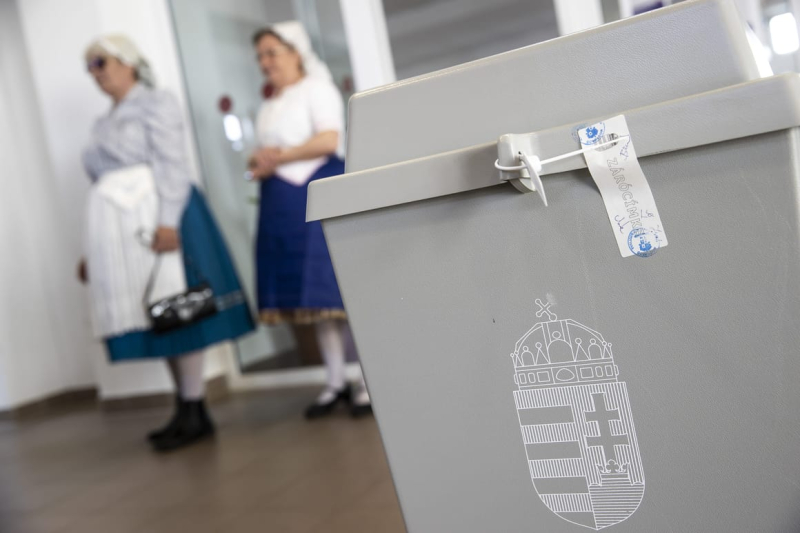

A team led by allies of Prime Minister Viktor Orbán is taking advantage of disputes over monitoring to appoint its own electoral observers.
BUDAPEST — The emergence of alternative electoral monitoring groups — including a team created by allies of Prime Minister Viktor Orbán — is raising the prospect of political turmoil and contested results after Hungary’s general election on April 12.
Concerns are already running high that the election result will be appealed by whoever loses, given that the campaign has been marked by smear tactics and accusations of foreign interference — something that only increases the importance of vote observers.
Orbán is facing the battle of his political life to cling on to power after 16 years in charge, but his rivals say he has an unfair advantage thanks to media control, gerrymandering and vote-buying. His ruling Fidesz party denies it is benefiting from an uneven playing field.
The Organization for Security and Co-operation in Europe has deployed electoral observation missions in more than 30 countries over the course of four decades, but it has now been hit by accusations of foreign interference in Hungary — notably over the role given to a former employee of the Russian foreign ministry, who worked as an interpreter for President Vladimir Putin.
Conservative allies of Orbán are seizing on the disputes over electoral oversight to create their own observation team — one that is liable to sow confusion by presenting its own version of events on voting day.
“If there are pro-government missions deployed, the outcome could be a clash of narratives that would cloud the result of the election,” said Péter Kramer, an EU election observer with over 16 years of experience who heads the voting integrity group 20k and is involved in training observers for this year’s Hungarian vote.
The controversial Russian interpreter
The OSCE deploys teams of international election observers to assess whether elections meet democratic standards. In recent years the group has been critical of Hungary, and issued reports alleging its votes are “undermined by [the] absence [of a] level playing field.”
Ahead of this year’s election, however, the organization has had to fight back against allegations that its operations in Hungary are compromised. In March, Hungarian journalists and rights groups identified Daria Boyarskaya — who worked as an interpreter for Putin at key meetings with the U.S. — as a senior adviser at the OSCE’s parliamentary assembly, helping coordinate the assembly’s monitoring of this year’s elections.
Orbán is the EU leader closest to the Kremlin and the explosive news led people such as Márta Pardavi, co-chair of the Hungarian Helsinki Committee, a non-governmental organization working on civil society, to question whether the OSCE parliamentary assembly’s mission could be relied on to assess the integrity of the vote.
“When Putin’s former interpreter is organizing the OSCE PA’s mission, the perception erodes this much-needed trust,” she said. “How could we be sure that the information we share would stay with the mission?”
OSCE Spokesperson Nat Parry said that Boyarskaya never served as a full-time “personal interpreter to President Putin” and condemned the “sustained public attack” against her, arguing the accusations were based solely on her nationality.
“She was an employee of the Russian Foreign Ministry who was, from time to time, assigned interpretation duties for foreign delegations,” Parry said. “A standard professional function in most countries’ foreign ministries that carries no special significance.”
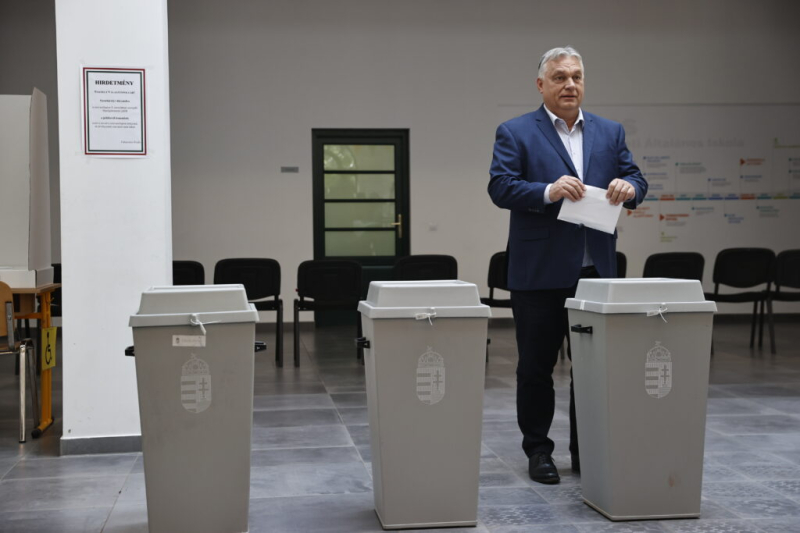
But civil society groups groups like the Hungarian Helsinki Committee and Transparency International Hungary insist that Boyarskaya’s past employment and the security clearance she would have required put the operations of the OSCE parliamentary assembly’s observation into question. Transparency International Hungary’s Legal Director Miklós Ligeti said it would boycott this year’s observation mission due to those doubts.
Pardavi, from the Hungarian Helsinki Committee, said: “In Hungary’s undemocratic context, where the government regularly threatens and intimidates civil society and journalists, international election observers should take care to ensure their mission has the full trust of the people and organizations that share sensitive information with them.”
Muddying the waters
The parliamentary assembly mission Boyarskaya is attached to has been tasked with coordinating foreign lawmakers’ visits to polling stations on election day.
But Parry expressed concerns that the controversy regarding Boyarsakaya’s role in the OSCE could undermine the work done by the organization. “The public campaign surrounding this matter risks doing precisely the kind of damage to mission credibility that its authors claim to want to prevent,” he said.
Parallel to the parliamentary assembly, the OSCE’s Office for Democratic Institutions and Human Rights also deploys hundreds of specialists to observe the vote at a technical level and delivers the final legal assessment of the election’s integrity, that risks being drawn into its sister mission’s controversy.
In a move that could further undercut the possibility of a smooth election, international right-wing groups linked to Orbán’s Fidesz party have seized on the incident to launch their own monitoring taskforce: the Liberty Coalition for a Free and Fair Election.
The mission is co-led by Anna Wellisz, president of the conservative Edmund Burke Foundation, and Polish lawyer Jerzy Kwaśniewski, head of the Catholic fundamentalist Ordo Iuris Institute for Legal Culture.
The two co-chairs are respectively linked with major right wing conferences including CPAC and National Conservatism Conference, which have drawn global conservative heavyweights like U.S. President Donald Trump , Refrom UK’s Nigel Farage and Orbán himself.
In its mission statement, the Liberty Coalition states its decision to observe the Hungarian elections was prompted by criticism of the OSCE “across the political spectrum,” as well as the organization’s decision to reject “the applications of several highly qualified experts.”
Hungarian Government Spokesperson Zoltán Kovács told POLITICO on Monday he did not trust parts of the OSCE ODHIR’s reports, calling some aspects “political opinion.”
Balázs Orbán, political director to the Hungarian prime minister, expressed enthusiasm about the new mission. “Independent eyes help ensure the outcome speaks for itself,” he said.