

Spain’s governing party has lost three key regional votes since December.
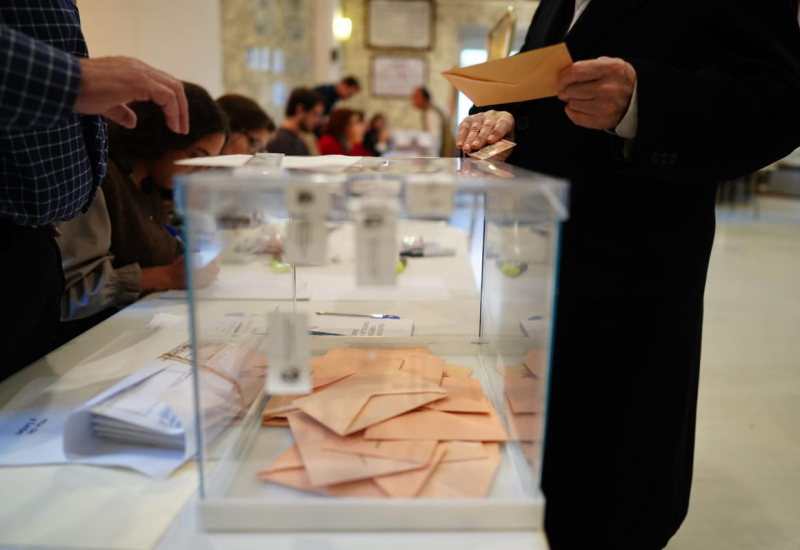
Spanish Prime Minister Pedro Sánchez’s governing Socialist Party appeared on track for a fresh defeat in Sunday’s regional election in Castilla y León, with the center-right People’s Party projected to secure the largest share of the vote.
The poor showing in the largely rural region follows similar defeats for the Socialists in Extremadura in December and Aragón last month. The trend spells trouble for Sánchez ahead of a regional vote in Andalucía this summer and in the run-up to national elections, which must be held before August 2027.
According to exit polling conducted by Sigma Dos for El Mundo, the Socialist Party is projected to lose one to three seats and end up with between 25 and 27 lawmakers in the 81-seat regional parliament — which would be one of its worst electoral results since elections were first held in Castilla y León in 1983.
The People’s Party (PP), which governs in Castilla y León, is projected to remain the largest party in the region with between 30 and 32 lawmakers. The conservatives will fall short of securing a governing majority, however, and are expected to attempt to form a coalition with the far-right Vox. For the first time, the ultranationalist group is projected to have secured over 20 percent of the vote and looks set to jump from 13 lawmakers to controlling between 17 and 19 seats in the parliament.
Castilla y León’s regional president, Alfonso Fernández Mañueco, in 2022 became the first PP leader to form a coalition government with Vox. The partnership lasted just two years, with the far-right group breaking with the conservatives over migration policies.
In the lead-up to Sunday’s election, Vox refused to cast itself as a junior partner to Mañueco’s PP, instead campaigning as a party that can truly represent Spain’s conservative voters. In Extremadura and Aragón, where the the center right similarly won recent regional elections but fell short of a governing majority, negotiations to form coalitions with Vox haven’t yet yielded results. Talks in Castilla y León could also become drawn-out.
Sunday’s election was also a testing ground for the Socialist Party’s messaging. Seizing on the current feud between Sánchez and U.S. President Donald Trump over America’s attack on Iran, and the overwhelming disapproval Spaniards feel for Washington’s ongoing operations in the Middle East, the party sought to make its anti-war stance a cornerstone of the regional campaign.
That strategy appears to have failed to spur Castilla y León’s voters to back the Socialists and has done nothing to dampen support for Vox, the only political party to explicitly back Trump and his war on Iran. Despite a notable conflict-related rise in gas and fertilizer prices in Spain, rural electors backed the far-right party.
While national parties like the PP, the Socialists and Vox netted most of the votes in Sunday’s election, several regional parties also secured seats in the parliament. The Leonese People’s Union, Soria Now and For Ávila are expected to form a bloc of up to seven lawmakers and aim to amplify the voice of historically neglected rural voters who are fed up with conventional parties, but who also reject the far right’s messaging.