
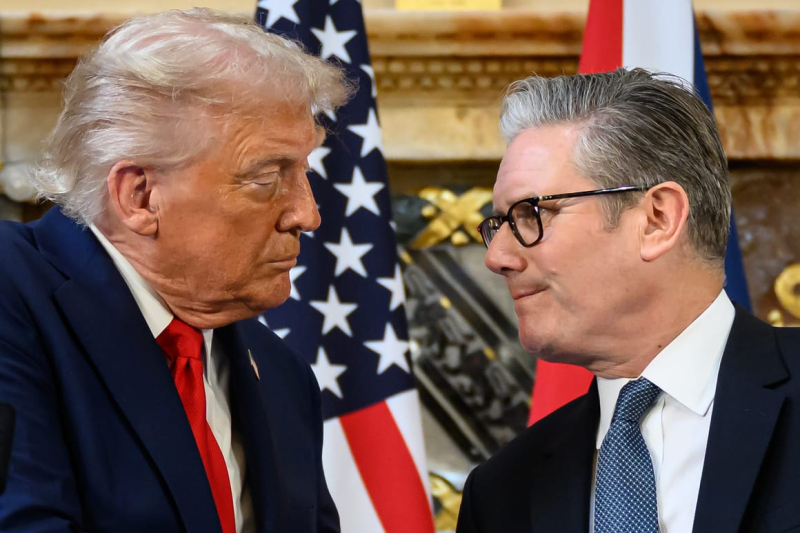

The U.S. president said his military will begin blockading ships entering or leaving the Strait of Hormuz.
LONDON — Britain is not supporting Donald Trump’s blockade of the Strait of Hormuz, Keir Starmer said Monday.
The U.K. leader said in a BBC radio interview that he is focused on getting the vital shipping route open.
Starmer, who has come under fire from the U.S. president for not providing full military support for U.S. and Israeli strikes in Iran, said he is “very concerned” about the impact of the war on people in the U.K. who’ve “obviously played no part,” adding: “I don’t want them paying the price.”
“We’re not supporting the blockade,” he said.
Starmer confirmed Britain does have “minesweeping capability,” but declined to comment on “operational matters.”
Emmanuel Macron stopped short of spelling out his opposition to Trump’s blockade in an online post Monday, instead warning the conflict in the Middle East must be resolved “through diplomacy.”
“We mustn’t spare any effort in order to quickly reach a strong and longterm resolution of the conflict in the Middle East through diplomacy,” the French president wrote.
He said he will co-host a conference of countries that want to take part “in a peaceful multinational mission” to restore freedom of navigation in the strait in the coming days.
“This mission [will be] strictly defensive and separate from the belligerents, and will be deployed as soon as the situation permits,” Macron said.
Trump announced on his Truth Social platform Sunday that the U.S. would be “blockading any and all ships trying to enter, or leave, the strait of Hormuz” shipping route in the Middle East.
It follows the failure of the first round of peace negotiations between the U.S. and Iran over the weekend.
Starmer declined, when asked, to blame the U.S. for rising costs, instead accusing Iran of breaking international law by restricting vessels through the Persian Gulf.
Increased costs to U.K. consumers are “largely because of Iran’s actions in closing or partially-closing the Strait of Hormuz,” he said.
Clea Caulcutt contributed reporting.