
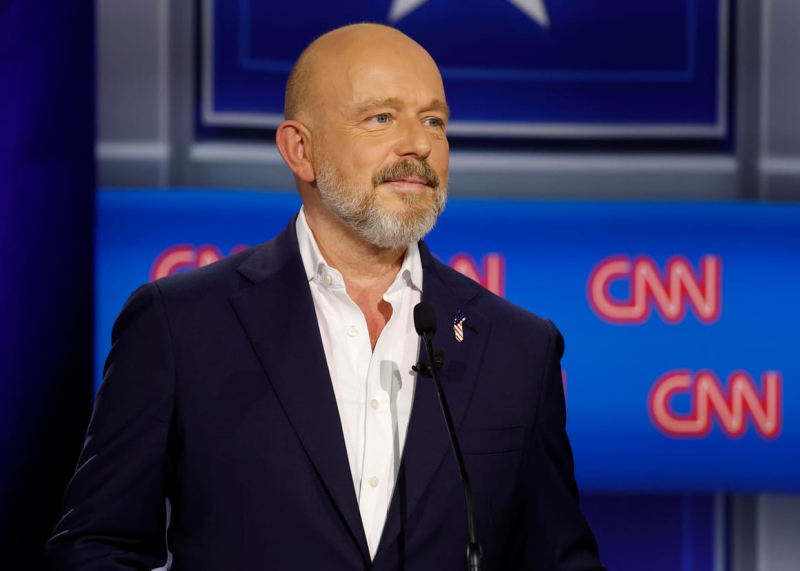

The onetime British Conservative Party adviser has a shot at making the top-two runoff in next week’s gubernatorial primary.
LONDON — If Steve Hilton succeeds in making it past next week’s gubernatorial primary in California, it will mark a breakthrough by a relative unknown. In the U.K., he is anything but.
Hilton, a Republican who played a central role in former British Prime Minister David Cameron’s rise to power, is effectively tied with Democrat Xavier Becerra in the race to be California’s next governor, according to several polls over the last week.
Under California’s primary system, the candidates who finish in the top two will go forward to the gubernatorial election regardless of their political party.
Hilton now finds himself in with a real shot at entering the final runoff, despite never previously having held elected office on either side of the pond — and a political past which appears at odds with his embrace of MAGA Republicanism.
He’s unlikely to prevail in November, given the Golden State’s Democratic ties and deep animosity towards Donald Trump — who has personally endorsed the British-American challenger. But advancing to the November election would, at a minimum, give Hilton a platform. And if there is one thing he is known for back in the U.K., it’s disrupting the status quo.
He is a character who rarely wears a collared shirt, never a tie, and doesn’t own a smartphone, instead relying on a flip-phone for texts and calls only — and was immortalized as the unbearably pretentious spin doctor Stewart Pearson in “The Thick of It,” purveyor of such pearls of wisdom as: “I like the plasmic nature of your data modeling.”
Among his compatriots from the Cameron years, he’s widely viewed as an upstart with a talent for gaining attention, though many of those who came into contact with him in Westminster claim that his campaigning zeal is not matched by an ability to govern and often implodes on impact with reality.
Yet Michael Gove, a former senior Cabinet minister who worked with Hilton for many years, insisted that his old ally should not be underestimated. “I’m absolutely convinced that it wouldn’t be where he is if he weren’t deadly serious about bringing change,” he told POLITICO. Hilton did not respond to a request for comment.
Hoodies and huskies
Hilton is almost universally credited for turning around Cameron’s image from a typical Tory toff, who was not even the favorite for party leader, into a much more modern, even relatable, kind of politician who won back power for the Conservatives after 13 years in the wilderness.
“Steve Hilton was instrumental in helping David Cameron become leader of the Conservative Party and prime minister,” Gove said. “His relationship to David Cameron is somewhat like James Carville to Bill Clinton, or Karl Rove to W, or even Steve Bannon to Trump.”
The man who Cameron came to see as his “lucky feather” joined his team properly after a spell working on the Conservatives’ 1997 election campaign and running his own consultancy advising companies on social and environmental goals.
Under his watch, Cameron scrapped the old Tory logo of a patriotic red-and-blue torch in favor of a tree, and famously posed for photos with huskies in the Arctic as he sought to embrace a new, greener image.
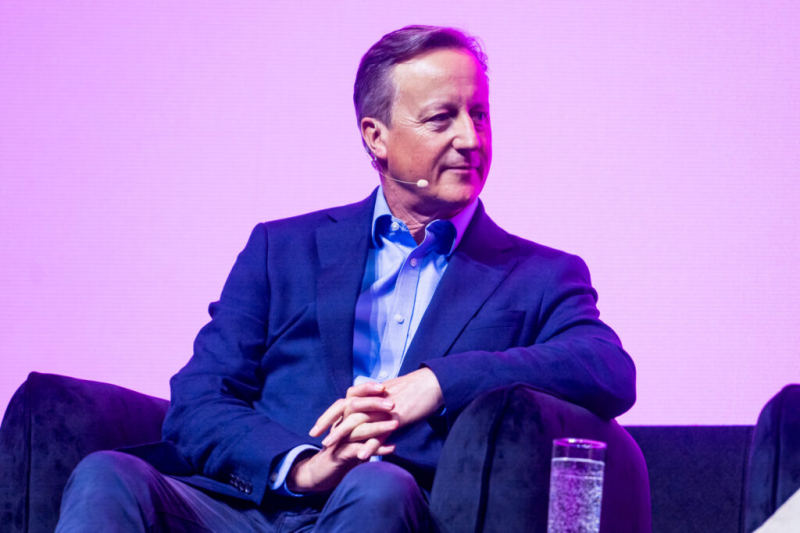
Hilton was also highly influential in a more conciliatory approach to antisocial youth — known as his “hug-a-hoodie” moment — and the “big society” agenda, which formed part of the Conservatives’ winning 2010 election manifesto and aimed to transfer more power from the state to local communities.
He followed Cameron into government as his director of strategy, with the intent of putting the same unorthodox approach into practice at Downing Street. One former colleague from those days, granted anonymity like others in this piece to speak candidly, recalled: “The first time I met him I was impressed. I could see he was approaching things differently — he’s not the stuffy, old Conservative, he’s got an idea and he’s got a vision.”
Reality bites
While some of his signature policies did get off the ground, Hilton’s blue-sky thinking and outside-the-box schemes became the stuff of legend and frequent derision.
His more memorable ideas included putting every single business regulation online and giving people a say in which ones should be scrapped, and getting rid of employees’ right to claim unfair dismissal as part of an initiative to jumpstart the economy.
Giles Wilkes, a former adviser in the Cameron government who belonged to the Liberal Democrats, said: “He reminded me of trendy teachers I used to get when I was a kid who would start on a new topic every week. This week we’re doing ‘Fiddler on the Roof,’ next week we’re going to do ‘Macbeth,’ and there was no thinking through, there was no underlying theory. It was just pizzazz, and nothing underneath it.”
The same ex-colleague quoted above complained that trying to execute these ideas “was a waste of time and effort and resources, and all it did was make us look silly.”
Hilton quit Cameron’s government in 2012, saying he wanted to spend more time with his family (his wife, Rachel Whetstone, was a senior Google executive based in California). But it was widely interpreted by those around him as a move born out of frustration that governing turned out to be a lot harder than campaigning.
An ally and admirer of Hilton said that he, like other political gurus in recent British political history, “is a wordsmith, he’s a sloganeer — but what those guys aren’t very good at is trying to corral and mobilize and sort out a big civil service architecture.”
Wilkes said: “The sheer presumption that a lot of them [Conservative aides] wandering in [to government] thinking that because they managed campaigns they’re going to be good at the running of an administrative department is a total non sequitur. He didn’t seem to be good at it, but there was no particular reason to see why he would have been.”
It is not a view shared by Gove, who said Hilton had been “indispensable” to developing the Conservatives’ policies, especially on education, and had “used policy ideas to attract attention and drive the [Californian] debate. I think that he’s easily, in terms of policy mastery, the equal of anyone else who aspires to be a governor in the United States.”
Blowing it all up
There is another source of puzzlement for British observers of Hilton’s rebirth, who find it difficult to square his track record as a liberal modernizer with his more recent past as a Fox News presenter, now hailed by Trump as someone who can “turn it around, before it is too late.”
The same ex-colleague cited earlier said they found this shift “jaw-dropping,” adding: “It’s extraordinary he’s apparently prepared to stand up to everyone in the interest of the little man, apart from the billionaire in the White House.”
Another said he was associated with “quite a lot of woke ideas back in that period: social liberalism, forgiveness not punishment, environmentalism” which seem antithetical to Trump’s approach.
Others, however, see no contradiction between his past and what he is presenting to California voters.
“The common thread running through it all is disruption, and the sense that things aren’t working, the whole system needs to be blown up,” said the same ally quoted above.