

Contents
Inside the Ukrainian startup using immersive VR to treat war stress, generate unprecedented clinical data, and export a new model of mental-health care.
When Russia’s invasion overwhelmed Ukraine’s mental-health system, clinicians faced a surge of trauma patients with no increase in staff or therapy time. That constraint — rising need without added capacity — is also familiar in the US, where provider shortages, long waitlists, and brief appointments are common.
But now, a Ukrainian startup, Luminify, has found a way forward. I met with co-founder Viktor Samoilenko at TechChill Kyiv to learn all about it.
Extending therapists, not replacing them
Instead of trying to automate therapy, Ukrainian founders Viktor Samoilenko and Max Goncharuk built a clinician-guided immersive VR system designed to help patients regulate faster, allowing therapists to use limited session time more effectively. The goal was not to replace clinicians, but to extend their reach under extreme system strain.
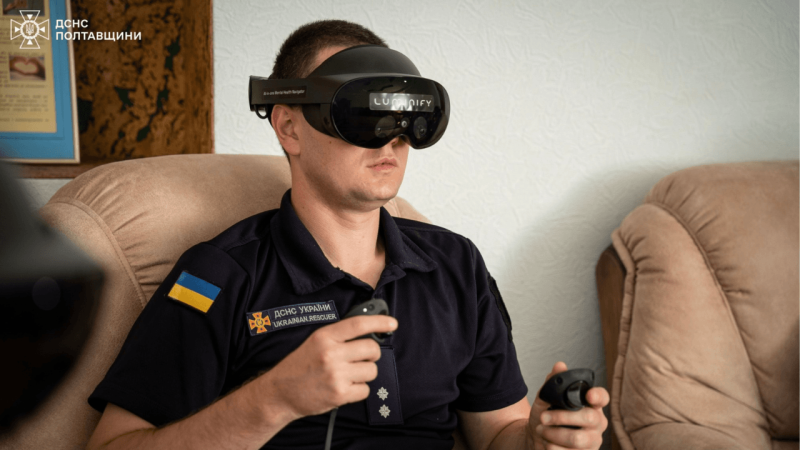
Developed by health-tech company Aspichi, Luminify translates evidence-based approaches such as cognitive behavioural therapy, mindfulness, and trauma therapy into guided mixed-reality experiences delivered through headsets.
Patients engage in structured therapeutic environments while clinicians retain oversight, using the system to monitor progress and shape treatment. AI tools personalise exercises and generate outcome data, helping practitioners adapt care to individual needs. The platform is designed for clinics, rehabilitation centres, and workplace wellness programs that aim to scale mental health support without sacrificing quality.
In essence, Aspichi positions Luminify as a bridge between clinical psychology and immersive technology — turning therapy into repeatable, measurable digital interventions that can reach more people than traditional one-to-one care alone.
From automotive AR to emotional VR
Samoilenko’s background spans IoT and automotive technology, and the origins of his current work trace back more than a decade. He previously co-founded Apostera, a developer of mixed-reality navigation solutions for the automotive industry.
Apostera’s technology — which projects navigation directly onto a vehicle’s windshield — was later acquired by Harman International, a subsidiary of Samsung Electronics.
After the exit, Samoilenko began reflecting on how access to experience shapes people.
“I was travelling a lot and realised how much money is spent on travel, and how many people simply don’t have that ability,” he said.
“That limits their experience. Experience is what makes us more advanced as people — more empathetic, more flexible, more understanding of diversity.”
Together with a partner, he began exploring the idea of an audiovisual “teleportation” platform. Drawing on his venture background and familiarity with 360° cameras and VR headsets, the concept was to let one person stream their surroundings while another experienced it immersively in virtual reality.
“The idea was that someone could appear in another place for the first time,” he explained.
“We wanted to build a platform that could share experience and knowledge at a fraction of the cost of travel.”
The company was registered in the United States, with an office opened in Ukraine shortly after. “Five days later, Russia’s full-scale invasion of Ukraine began,” he said.
“It was a moment where we were reconsidering everything — our lives, our place in the world, our place in the country.
We decided to use the initial idea to build something impactful for Ukraine.”
Building a psychologically safe space in virtual reality
In the early days, the team saw friends go out to battle in jeans, armed with guns.
According to Samoilenko, they were coming back psychologically broken and traumatised.
“We realised we could provide an ability for them to move from a stressful environment into a safe place where they could feel peaceful and comfortable.
It’s a kind of teleportation, but emotional. As we delved deeper into psychology, we realised that VR is a powerful tool for influencing emotional states. It also solves the stigma problem — it’s much easier to put on a headset than to open up immediately to a therapist.”
Four years in fight-or-flight
When asked whether mental-health awareness is growing locally, Samoilenko says the shift has been driven more by necessity than by campaigns.
“We’re trying to build it. After four years, it has become a real topic because everyone in Ukraine feels it,” he explained.
While awareness may not yet match countries with large-scale public health initiatives, he notes that more people are independently seeking support. The prolonged strain of war has reshaped the population’s psychological baseline.
“For four years, we’ve been in fight-or-flight mode. Now there’s no energy left to sustain that. You want to run, but you don’t have the energy,” he said.
Aspichi’s work focuses on restoring that depleted capacity.
“We help people restore energy and self-awareness through mindfulness and psychological techniques — basically helping them take care of themselves again.”
That said, Samoilenko stresses that trauma is delicate work:
”It cannot be optimised. We don’t replace professionals. We augment their work by helping people relax and become ready to approach trauma. We prepare them. The actual trauma processing is left to specialists.”
Turning trauma response into valuable data
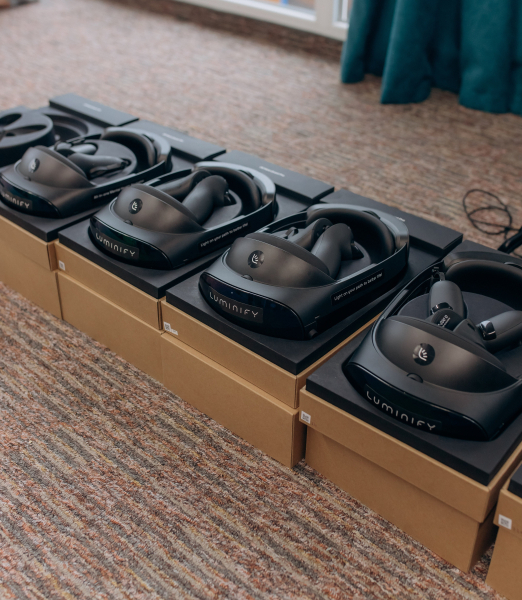
Image: Luminify VR headsets. Photo: Oksana Lahzdukalns.
However, what began as an emergency intervention quickly became measurable science.
In Ukraine, Luminify has already been used by more than 1 million people across rehabilitation settings, effectively serving as a large-scale test of a clinician-extension model in crisis conditions.
In a controlled study at a Veterans’ Mental Health & Rehabilitation Centre in Kyiv, the VR-supported group showed measurable reductions in anxiety and depression compared with standard rehabilitation alone. Aspichi published its first clinical research on Luminify in the European Psychiatry and Psychology Journal.
“On average, we saw a 20–30 per cent reduction in depression and anxiety symptoms and about a 40 per cent increase in overall wellbeing,” shared Samoilenko.
The ethics of learning from trauma
Samoilenko acknowledges the ethical tension of working at such a scale in a country shaped by trauma. Ukraine’s crisis, he says, is devastating — but it also creates conditions for unprecedented research. “Unfortunately, Ukraine has many traumatised people, but it gives an opportunity to make a global breakthrough in psychology,” he said. Demand from practitioners reflects that urgency.
“In Ukraine, there’s basically a queue,” Samoilenko explained.
Luminify currently supports around 150 rehabilitation centres and has already delivered therapy to more than one million people, with capacity projected to reach two to three million annually. The resulting dataset is drawing international attention.
“Scientists worldwide are very open to collaboration because the scale of data is unprecedented,” he said.
Typical psychological studies involve hundreds of participants; Luminify is operating at a national scale.
“That’s three or four orders of magnitude more. We’re already validating in multiple countries and working with universities.”
Crossing into mainstream care
The system is now being tested beyond trauma recovery, including post-acute rehab through a partnership with Rocky Mountain Care.
It already has customers in assisted living, nursing homes, and acute care facilities. In the US, in assisted living, there is almost no competition.
“The niche is conservative and not open to innovation. We compete with mindset, not technology,” shared Samoilenko.
Facilities can be reimbursed by insurance, so there are no objective financial barriers. However, the challenge is staff exhaustion. Medical and social workers worldwide are burned out.
“Ironically, they could benefit from the technology themselves,” admits Samoilenko.
“We’re seeing improvements even in dementia and Alzheimer’s cases, including some very bright recoveries.”
The program recommends at least ten consecutive days of daily therapy practice. It’s a structured program rather than weekly sessions. Progress is measured using professional clinical questionnaires.
Aspichi received a large donation of headsets from a manufacturer, allowing the company to provide up to 20,000 sessions per day. The headsets have built-in cameras for eye, head, and body tracking.
That allows the team to capture behavioural changes similar to those therapists observe in person.
“It’s a trend to use biometric data, but what we’re doing is capturing behavioural data. Biometric data can’t tell a lot about psychoemotional state, but behavioural data can. Amazing results can be achieved when both approaches are used,” shared Samoilenko.
From here on in, objective diagnostics is the priority.
The company is scaling in the US, using generative AI to deliver therapy in multiple languages, building personalised programs, and doing deeper research into the human brain.
Luminify’s journey so far shows how care delivery changes when time and staff are the binding constraints, and why models forged under wartime healthcare pressure may be relevant to the US system now and beyond.
WhileUkraine has become an unwilling laboratory for psychological resilience, Luminify is trying to ensure that what’s learned there reshapes care far beyond its borders.