
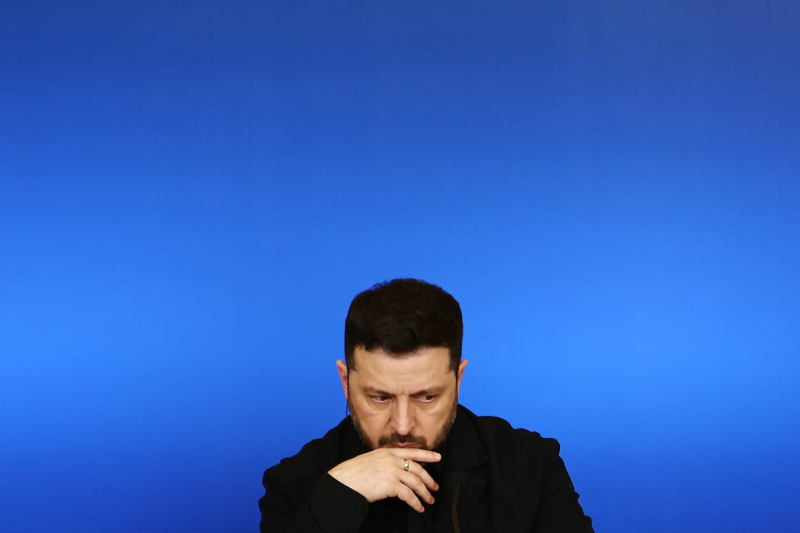

As the war drags on and talks stall, the Ukrainian president’s frustration with the West is spilling into public view.
Volodymyr Zelenskyy’s patience appears to be wearing thin — and it’s starting to show.
In recent weeks the Ukrainian president has sharpened his rhetoric toward both critics and allies, rebuking European leaders for moving too slowly on support, trading barbs with Hungary’s Viktor Orbán, and openly questioning Donald Trump’s approach to the war.
The tougher tone reflects mounting frustration in Kyiv as peace talks stall and financial support hangs in the balance — but even those close to Zelenskyy warn the rhetoric risks alienating the very partners Ukraine relies on for money, weapons and diplomatic backing.
That frustration is beginning to shape the president’s public messaging, according to a former foreign policy adviser to Zelenskyy. “This frustration is driving the harsher rhetoric,” said the former adviser, who asked not to be named as he still has good relations with the Ukrainian leader.
“It’s a cycle that’s becoming self-defeating,” he added.
Ukrainian opposition lawmaker Mykola Kniazhytskyi said the shift is also linked to pressure on Kyiv in the stalled peace talks.
“Zelenskyy understands that he cannot sacrifice national interests and give up” the country’s eastern regions, as the Kremlin has demanded, said Kniazhytskyi. “That is why his statements in communication with Western leaders have become clearer and more direct.”
He added that the Ukrainian president is also trying to show domestic resolve. “In Zelenskyy’s statements one can see both a desire to emotionally influence partners involved in the negotiations … and an attempt to strengthen his domestic political standing as a tough defender of Ukraine’s national interests.”
The strain was on display last week when the European Union publicly rebuked the Ukrainian leader over remarks in which he appeared to threaten Hungarian Prime Minister Viktor Orbán.
Zelenskyy had said he would give Ukrainian troops the address of a “certain person” so they could speak to him “in their own language.”
While he didn’t name Orbán, he was widely understood to mean the Hungarian leader, who has been blocking a €90 billion EU loan package that Kyiv desperately needs before it runs short of cash in the spring. Orbán has also infuriated Zelenskyy with his allegations that the Ukrainians have deliberately stopped the flow of Russian oil via the Soviet-era Druzhba pipeline.
Aside from irritating the European Commission, which in a rare condemnation told Zelenskyy he must not make “threats against EU member states,” the Ukrainian leader’s remark didn’t please opposition leaders and Orbán critics in Budapest. They fear Zelenskyy is being lured by Orbán into a rhetorical escalation that could help the Hungarian leader in the country’s upcoming parliamentary election.
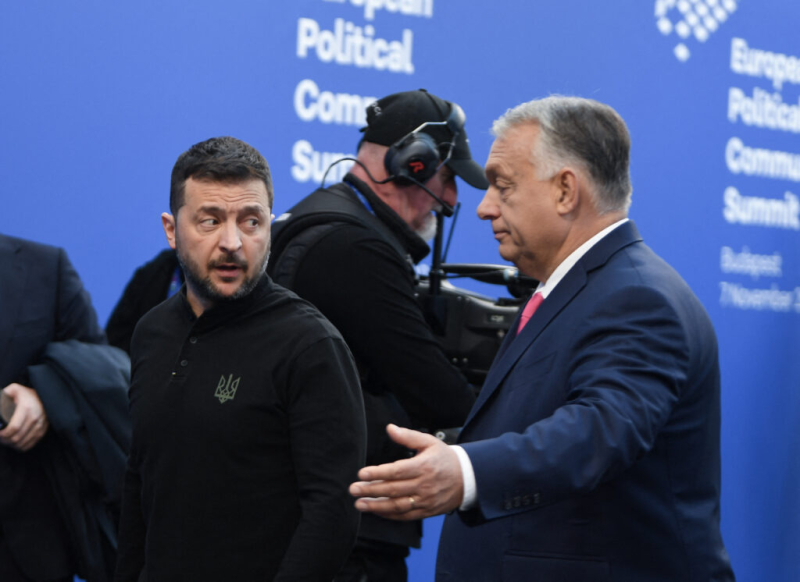
“Zelenskyy’s comment was stupid,” said Peter Krekó of Political Capital, an independent political research consultancy in Budapest. “Even if you think, as I do, that the Hungarian government is doing its fair share in escalating the situation, for example, with Orbán’s threats to take oil by force, the Ukrainian leader’s comment was highly irresponsible.”
The war of words offers Orbán’s campaign “proof of their alleged claims that Ukraine is threatening Hungary,” he added.
In an interview with Gordon Repinski for POLITICO and Welt, Zelenskyy rejected the criticism that he is helping Orbán politically and accused the Hungarian leader of siding with Moscow.
“He’s standing on the side of the Russian leader,” Zelenskyy said, arguing that Orbán had tried to block sanctions on Russia and prevent Western weapons from transiting Hungary.
Hungary “never helped us with military support from the very beginning of this war” because Orbán’s “friends, strategic partners” are in Russia, Zelenskyy added. Remaining diplomatically silent, he said, would not change the situation.
Zelenskyy also expressed frustration with the European Union for not pushing back harder against Orbán. “I didn’t see strong messages from European leaders,” he said, stressing the clash was not personal but about “Ukrainian lives and the security of Ukraine and the security of Europe.”
It isn’t only with adversaries like Orbán that Zelenskyy has been adopting a noticeably harsher tone. At the World Economic Forum in Davos in February, he surprised European leaders by devoting much of his speech to rebuking them for not doing enough to help Ukraine — nor enough for their own defense.
“Too often in Europe, something is more urgent,” he said. “Europe loves to discuss the future but avoids taking action today.”
Coming as it did the day after U.S. President Trump had already put European leaders through the wringer, Zelenskyy’s withering put-downs left his audience stunned. “It was quite surprising,” said Natia Seskuria, an analyst at the Royal United Services Institute, a London-based think tank. “Zelenskyy is unhappy with the way in which the support has been mobilized by the Europeans.”
The Ukrainian president has upbraided European leaders before, including in the early months of the war and last year at Davos. But his tenor this time was almost mocking as he reeled off a long list of complaints, starting with the EU’s decision not to use Russian assets frozen in Europe to help fund Ukraine.
Zelenskyy has also become less guarded in his remarks about Trump — a departure from the meticulous caution he adopted last year after a tense Oval Office exchange in which he veered off script, in part after being goaded by U.S. Vice President JD Vance, who accused him of ingratitude.
After that episode, Zelenskyy largely stuck to a strategy of avoiding Trump’s ire, hoping instead that Russian President Vladimir Putin would frustrate the U.S. leader by being the first to say nyet to peace.
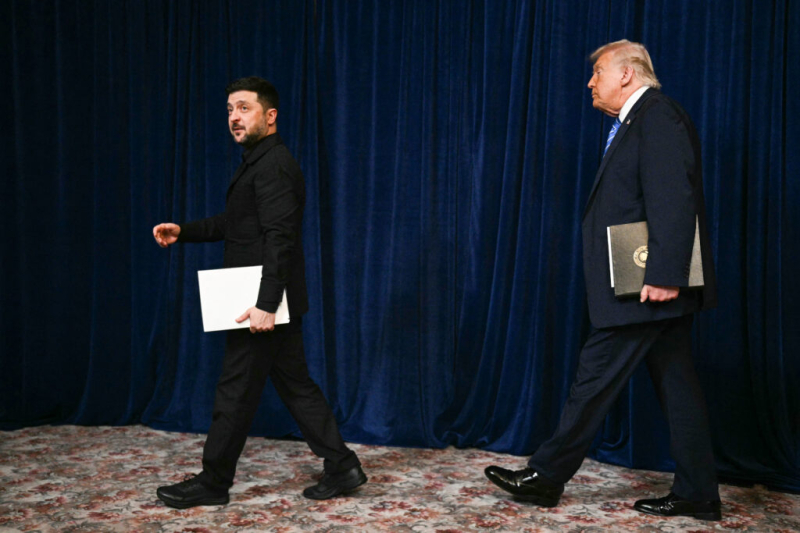
In the diplomatic tug-of-war between Zelenskyy and Putin to cast the other as the obstacle to peace, the Ukrainian leader briefly appeared to be winning. After working with Britain’s Keir Starmer and other European leaders to repair relations with Washington, Kyiv believed it had secured a breakthrough when Trump signaled a willingness to participate in security guarantees for a post-war Ukraine.
But the tone has shifted again in recent weeks. Zelenskyy has publicly criticized Trump’s repeated efforts to press Kyiv rather than Moscow to make concessions, calling the approach “unfair.” This week he complained that Trump has yet to exert serious pressure on Russia.
In the interview with POLITICO, Zelenskyy suggested Washington was overlooking Russia’s responsibility for the war. “Now President Trump didn’t raise the questions of accountability and nobody speaks about it,” he said, arguing that Ukraine had already made significant concessions in the search for peace. “Ukraine demonstrated a lot of compromises already.”
Zelenskyy also hasn’t been above the occasional sly dig at Trump. After the U.S. president requested Ukraine’s help in intercepting Iranian drones, Zelenskyy was asked at a press conference last week whether Kyiv was now holding the cards. “You tell me,” he answered with a smile.
The trouble is that the added criticism is “not achieving tangible results,” the former foreign policy adviser said.
Last week — along with the rebuke from the EU Commission — Trump doubled down on his portrayal of Zelenskyy as the main obstacle to reaching a deal with Russia, describing Putin as cooperative and adding that the Ukrainian leader “has to get on the ball” and make compromises.
The exchange underscores how quickly Zelenskyy’s sharper rhetoric can reverberate beyond Kyiv. In Washington and some European capitals, the risk is that his critics could use his comments to reinforce the argument that Ukraine — not Russia — is standing in the way of a deal.
“He needs to be a bit careful when it comes to criticizing his allies,” said Seskuria. “It will be crucial for Zelenskyy to have all the European allies on board when it comes to how to deal with the Trump administration.”