

EU top diplomat downplays reports of rivalry with Commission president.
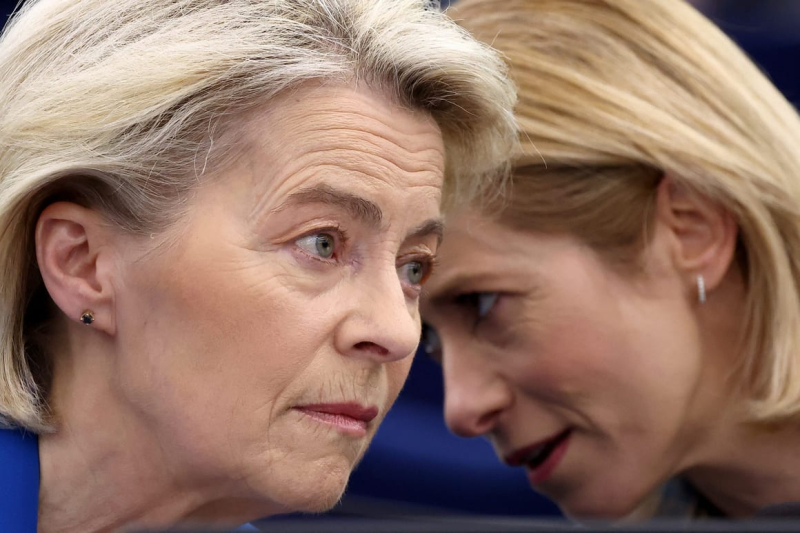
EU foreign policy chief Kaja Kallas played down talk of a power struggle with European Commission President Ursula von der Leyen, after POLITICO reported in March that the two were on a “collision course” over who should steer the bloc’s response to global crises.
The report — citing EU diplomats, officials and lawmakers — pointed to an “evident” rivalry between the two, fueled by overlapping responsibilities and competing centers of power in Brussels.
“Who doesn’t enjoy a good catfight story?” Kallas quipped in an interview with Estonia’s ERR public broadcaster, before adding that “joking aside, we get along very well.”
Kallas, a former Estonian prime minister who took up the High Representative role in December 2024, straddles multiple EU power centers — serving as a Commission vice president under von der Leyen while also chairing meetings of EU foreign ministers and working closely with member countries.
That hybrid setup has long created overlap — and occasional turf battles — with the Commission president, a leading figure in the center-right European People’s Party, while Kallas belongs to the liberal Renew Europe group.
One flashpoint has been von der Leyen’s decision to establish an intelligence cell within the Commission, mirroring capabilities already housed in Kallas’ European External Action Service.
“In my view, we cannot simply duplicate efforts in Europe,” Kallas said. “If something is already being done well in one place, then let it be done there.”
She acknowledged “institutional tensions” had been present “from the very beginning,” but framed them as a question of efficiency rather than rivalry. “Europe needs to function as a single team,” she said, noting that citizens “don’t perceive the difference” between EU institutions.
But, added Kallas: “On a personal level, we get along just fine.”
Kallas also used the interview to rebut U.S. President Donald Trump’s claim that NATO is a “paper tiger” over its lack of action in the Strait of Hormuz, which is blocked due to the threat of Iranian mines, missile strikes and drone attacks.
“To my knowledge, no request has been made to NATO, so to claim that NATO did not come to help is not justified in any way,” she said.
Such comments risk playing into the Kremlin’s hands, she added: “Who benefits from such statements or disagreements among allies? Vladimir Putin and similar figures.”
Victor Jack contributed reporting.