
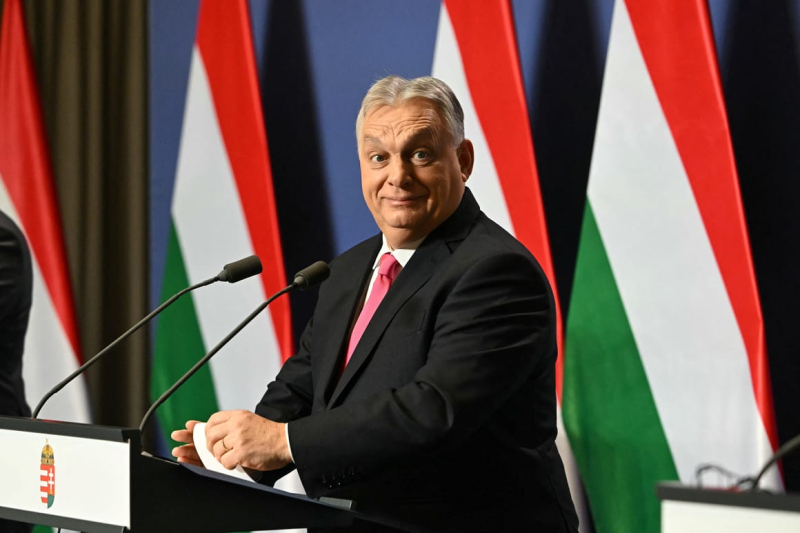

The country’s current leader has put loyalists in key public institutions who will be able to thwart the budgets and legislation of any new prime minister.
BUDAPEST — Even if opposition frontrunner Péter Magyar wins Hungary’s election this month, he will face a grueling ordeal in trying to run the country effectively thanks to a complex legal and political minefield laid by Prime Minister Viktor Orbán.
Kremlin ally Orbán has secured tight control over critical public institutions over his 16 years in power, meaning his loyalists will still have decisive powers to thwart Magyar’s budget plans and strike down legislation via a politicized constitutional court.
For Magyar, the challenge will be finding a way to govern successfully without being maneuvered into an early election in a system designed to make him fail.
In addition to Orbán’s continued influence over budgets, many key aspects of public life — including the “cardinal laws” that govern the judiciary, the media, the electoral system, public finances, family policy and the church — can only be changed if Magyar and his Tisza party can obtain an unlikely two-thirds super majority.
Orbán’s government and the ruling Fidesz party are betting that Tisza — a young party drawing support from across the political spectrum — will falter due to inexperience and won’t be able to rule.
“For Tisza to be able to govern, they would need to have some kind of coherent vision for the country, and they would need something resembling a coherent political community behind them. There is only one issue that unites them, they want to kick us out of power,” Hungarian EU Affairs Minister János Bóka told POLITICO.
“That might or might not be enough to actually remove us from power, but it is definitely not enough to govern the country,” he added.
Magyar is bracing for a difficult start if he wins, as polls suggest he may secure only a simple majority. He will also have to contend with the hostility of Fidesz loyalists who hold important jobs in the bureaucracy, as they too can only be removed if two-thirds of lawmakers vote to ditch them.
“This will be an uphill battle for sure, and I’m quite sure that Orbán won’t make it easy for his successor if he loses,” Katalin Cseh, a former liberal MEP and current opposition MP, told POLITICO while sipping coffee in one of Budapest’s grand cafés.
“You know, destroying democracy and institutions is much easier than rebuilding,” she added.
Cash crunch
Magyar’s first challenge will be to craft a budget capable of funding his costly campaign promises, which include boosting public spending such as on healthcare after years of underinvestment.
The problem is that Fidesz has depleted the coffers, hitting 50 percent of its 2026 full-year deficit target by February after rolling out massive pre-election subsidies to win electoral support.

If balancing the books weren’t hard enough, Orbán can make life even more difficult through one of his most lethal traps: the budget council. The body comprises three Fidesz loyalists, recently appointed for terms of between 6 and 12 years, who can veto the budget.
Hungarian President Tamás Sulyok, who is close to Fidesz and will be in office until 2029, can call a snap election if the government can’t adopt a budget. The budget council and the president can only be removed with by a two-thirds parliamentary majority.
Magyar will face similar problems trying to unfreeze €18 billion in frozen EU funds, as he will need to pass reforms demanded by Brussels ahead of an August deadline.
On the campaign trail, Magyar has appeared confident he will be able to access at least part of this frozen pot by demonstrating credible anticorruption efforts. “Yet he would be unable to change laws requiring a supermajority … and his success would depend in part on his largely untested negotiation skills and [on] some flexibility from the EU,” said Orsolya Ráczová from the Eurasia Group consultancy.
The two-thirds bottleneck
The need for a two-thirds majority for so many of these crucial changes is shaping up to be the biggest single stumbling block to the success of any new government.
The introduction of the “cardinal laws” on everything from the judiciary to the media was a key feature of Orbán’s 2011 constitutional overhaul, which passed in just nine days — ensuring that many core policies would be extremely difficult for any future government to change.
The Venice Commission, composed of independent experts in constitutional law, raised concerns at the time, flagging the two-thirds threshold for amendments as excessive, especially for “issues which should be left to the ordinary political process.” The commission also frowned on the excessive powers given to the budget council and its “impact on the functioning of democracy.”
Fidesz has filled other important supervisory roles with loyalists, including those of the state prosecutor, the ombudsman and media authorities. All of them are “truly important and at the moment are captured and may exhibit a potential to block a non-Fidesz government,” said Miklós Ligeti, legal director at Transparency International Hungary.
Fidesz has also embedded structural advantages in its concentration of media ownership. In 2018 it created the Central European Press and Media Foundation (KESMA), into which Orbán’s business allies helped fold hundreds of local, regional and national outlets that now broadcast the Fidesz narrative. Any attempt to reverse this will require — you guessed it — a two-thirds parliamentary majority.
The constitutional court is a prime example of how Orbán can make life difficult for Magyar, as Fidesz has appointed all of its 15 justices, including a former Fidesz defense minister. The Curia, Hungary’s supreme court, is headed by András Varga, who was appointed by the Fidesz-controlled parliament.
Any laws a Magyar government attempts to pass could fall foul of the top courts. “Because of the partiality of the Supreme Court or at least its president, and the constitutional court, this will be a very difficult battle for Tisza,” said Adrienn Laczó, a former judge who resigned in November 2024 in protest over the lack of judicial independence.
Additionally, Orbán’s lawmakers in December strengthened the veto power of President Sulyok, who was appointed in 2024 for a five-year term.
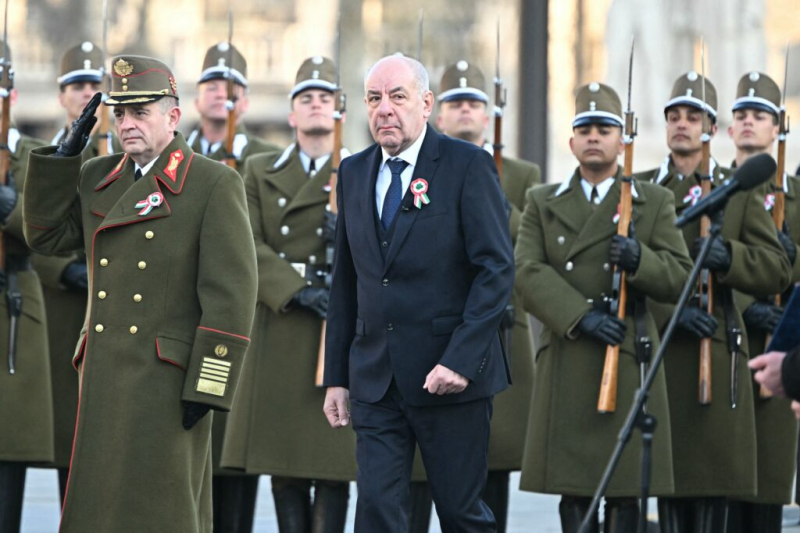
“Orbán has been worst-scenario planning in case he’s defeated,” said Kim Lane Scheppele, a constitutional law and elections professor at Princeton University. She highlighted that the amendment to the constitution passed in December would “make it almost impossible for a new parliament to impeach or remove the president.”
The president, meanwhile, can obstruct legislation by sending it back to parliament or by referring it to the constitutional court, which can deem it unconstitutional, potentially blowing up any reform efforts by Tisza.
Scheppele drew a comparison with the problems that Prime Minister Donald Tusk is facing in Poland with his efforts to advance reforms in the face of the veto power of the president, Karol Nawrocki, who aligns with the nationalist conservative Law and Justice party.
Orbán in opposition
From opposition Orbán can also make life very difficult for Tisza in terms of day-to-day politics.
Zsuzsanna Szelényi, a former Fidesz lawmaker, who quit the party when Orbán shifted its ideology from liberalism to national conservativism in the 1990s, said Orbán and Fidesz had a strong record as opposition brawlers.
Szelényi highlighted what happened in 2006, the most recent national election in Hungary not won by Fidesz.
Orbán initially accepted his defeat at the hands of the Hungarian Socialist Party, but within months that changed after Hungarians were outraged by a leaked private speech by Socialist leader Ferenc Gyurcsány. In the speech, Gyurcsány admitted to having brazenly lied to win the election by denying he’d introduce austerity measures.
“Between 2006 and 2010 Fidesz took politics to the streets and harried the government with highly obstructionist tactics in the parliament,” Szelényi told POLITICO. It’s a playbook she believes Orbán could be tempted to repeat. “Orbán will have a lot of procedural tools to use to delay the formation even of a new government,” she said.
Political scientist Gábor Tóka concurred: “If the opposition wins, I can imagine all sorts of nasty scenarios.”