
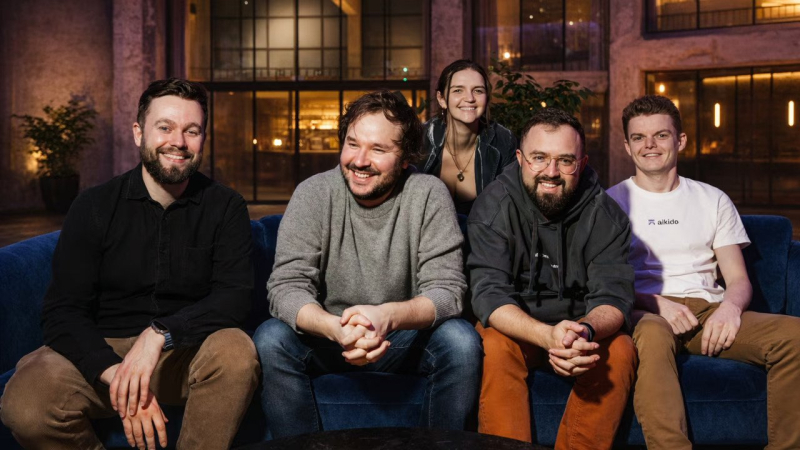

A bottom-up, developer-led model powers fivefold revenue growth, 100,000+ teams, and a new chapter backed by top global and European investors.
Belgian cybersecurity company Aikido has raised a $60M millionSeries B at a $1B valuation, led by Tom Stafford at DST Global, with participation from PSG Equity, Singular, Notion Capital, and others. Aikido is one of the fastest cybersecurity companies to reach unicorn status — in just three years — globally, and according to the company, the fastest ever in Europe.
Aikido’s Series B follows a year of rapid growth for the company, including five-times revenue growth and nearly three-times customer growth. Aikido is now the fastest-ever European cybersecurity company to reach unicorn status, reflecting this growing demand for security systems that can operate effectively as software development accelerates.
Aikido is a developer-first cybersecurity platform that helps software teams find, prioritise, and fix security issues across their entire software stack — from code to cloud and runtime — in a unified, automated way.
Built by developers, for developers
According to a blogpost written by CGO Madeleine Lawrence,
“We didn’t start Aikido because we thought the world needed another security product. We started it because we were developers ourselves, and we were tired of security being something that happened to us instead of something that helped us.
We were tired of tools that created noise instead of clarity, complexity instead of progress, and process instead of outcomes. As Willem reminds us every day, “Developers just want to get back to building fun features.”
But too often, they can’t. Instead, they’re forced to wade through a haystack of alerts, dashboards that look like the inside of an F-16 cockpit, and a barrage of four-letter acronyms developers are somehow expected to care about. “
She contends that somewhere along the way, security drifted away from how software is actually built and operated – “abstracted into quadrants, point tools, and snapshot reports that live far outside the reality of modern engineering teams.”
“That disconnect is the real problem. Today, organisations spend billions on disjointed products that can’t talk to each other. Risk correlation becomes impossible; noise becomes the only consistent outcome. As vendors and analysts chase the next four-letter acronym, vulnerabilities that matter slip by unpatched or unseen entirely.”
Aikido is built around the premise that security begins and ends with better engineering. That requires a single, unified platform to secure the entire software lifecycle — built for the people who actually ship software.
Instead of fragmenting security across five vendors, Aikido brings code, supply chain, cloud, runtime, and testing together so teams can answer one core question: “Are we actually at risk?” Detection alone, however, is not enough.
“The magic comes when we close the loop,” Lawrence writes. With full code and application context, Aikido automatically triages and remediates issues from the moment vulnerabilities are introduced through to discovery in production, turning security from a reporting function into an engineering system.
Software is being built at a pace that would have seemed impossible just a few years ago. AI-generated code is now the norm, and autonomous agents are writing and modifying systems faster than humans can review them. As engineering evolves, she argues, security must evolve with it.
Towards self-securing software
The next chapter, according to Lawrence, is “self-securing software” — systems that can secure themselves on demand.
Aikido has launched Aikido Attack, an AI-driven penetration testing capability designed to deliver “hacker creativity at machine speed.”
The system deploys hundreds of specialised agents to hunt vulnerabilities, validate exploits, and provide built-in remediation and retesting to ensure fixes hold — all observable in real time. Over time, this will evolve into continuous, autonomous testing embedded directly into every feature release.
The goal is to close the ship-test-fix loop and return developers’ focus to building, not firefighting.
Today, Aikido is used by more than 100,000 teams worldwide, including organisations such as the Premier League, SoundCloud, Niantic, and Revolut. Over the past year, the company has grown revenue fivefold and more than tripled its customer base.
Proof Europe can build and scale world-class software
Lawrence contends that in an industry long dominated by US and Israeli heavyweights, Aikido’s rise demonstrates that Europe can build and scale a world-class software security company on the global stage.
“Everything about Aikido shouldn’t have worked. A European team, based in a village, with no traditional cybersecurity pedigree, no CISO network, and a bottom-up, developer-led go-to-market strategy.”
But that outsider position became an advantage. With no established network to sell into, the company had to grow inbound. With limited budget and powerful incumbents, it had to counter-position sharply.
With a freemium, developer-first model, it had to deliver real value every day or fail. Internally, that mindset is reflected in a team of 180 people, including more than 21 former founders, shipping over 60 deployments a day.
This next phase is backed by continued support from existing investors including Notion Capital, Singular.vc, Syndicate One, Entourage, Connect Ventures, and Innovia Capital, alongside early individual backers such as Christina Cacioppo (Vanta), Gilles Mattelin and Jorn Vanysacker (Henchman), Pieterjan Bouten (Showpad, Entourage), Louis Jonckheere (Wintercircus, Showpad), and Matthias Geeroms (Lighthouse).
Aikido has also welcomed new investors for this chapter, including Mark Coucke and Alychlo, Joris Van Der Gucht (Silverfin), Ian Thiel (Sublime Security), Lorenz Bogaert (StarApps), Hendrik Isebaert (Showpad), Nik Storonsky (Revolut), VDK Bank, Dovesco, and PSG Equity.