
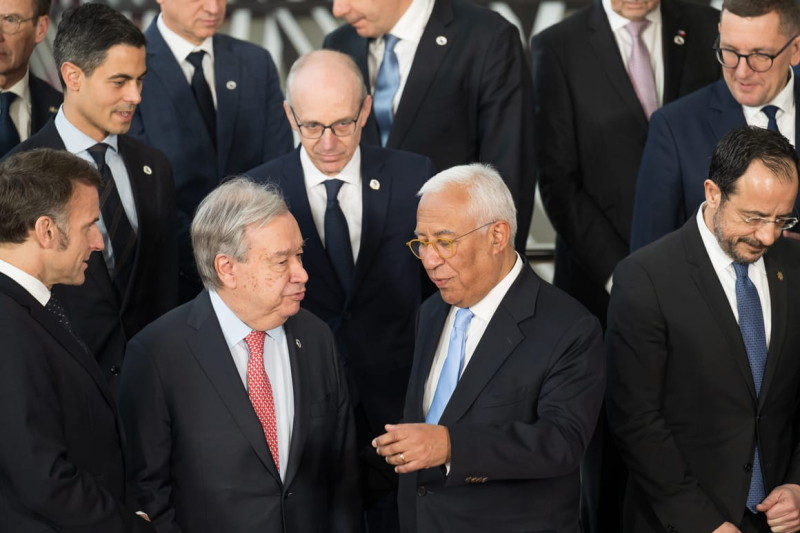

With conflicts raging in the Middle East and Ukraine, a summit in Brussels merely exposed Europe’s powerlessness.
BRUSSELS ― Two wars on Europe’s doorstep loomed over a 12-hour summit of EU leaders ― and for very different reasons they found themselves paralyzed rather than able to do much about either.
Rarely has the bloc’s inability to take a lead on international affairs been so obvious. Between Germany’s Friedrich Merz, France’s Emmanuel Macron and Italy’s Giorgia Meloni ― heads of three of the world’s top 10 economies ― and the other 24 in attendance, they could only look the other way, squabble with each other, or offer little but words as the bombing, missile-firing and killing continued.
“In these very troubled moments in which we are living, more than ever it’s decisive to uphold the international rules-based order,” European Council President António Costa, who chaired the gathering in Brussels, told reporters. “The alternative is chaos. The alternative is the war in Ukraine. The alternative is the war in the Middle East.”
And that speech was about as far as it went.
As Tehran pounded its neighbors, disrupting Europe’s energy supplies, Kyiv attacked Russian factories repairing military planes, and Donald Trump in Washington joked about the Pearl Harbor attack alongside the Japanese prime minister, European leaders used their talks to tinker with the bloc’s carbon permit scheme, the Emissions Trading System. It’s not a wholly unrelated matter to the global energy shock, but hardly an issue where the continent could demonstrate its geopolitical might.
On Iran, leaders found they had little leverage or will to make any significant intervention. On Ukraine, more than four years after Russia’s full-scale invasion ― a conflict where they do have leverage and they do have will ― they were unable to overcome internal divisions to approve sending €90 billion Kyiv’s way.
There was “no willingness to get involved across the table” on the Iran conflict, said a senior European government official, granted anonymity like others quoted in this article to discuss the talks behind closed doors.
German Chancellor Merz even complained that focusing on Iran risked shifting attention away from measures to boost Europe’s flagging economy — the summit’s original raison d’être before would affairs got in the way — according to three officials.
“The world looked very different at Alden Biesen,” an EU official said, referring to last month’s competitiveness-focused meeting in a Belgian castle that was meant to set the stage for this summit. That was before Iran’s war and Ukraine’s funding dilemma, brought about by Hungarian Prime Minister Viktor Orbán going back on his promise to approve the loan, radically reshaped the agenda.
Not our war
That’s not to say Iran was ignored completely.
There was some renewed discussion about sending French warships to protect the Strait of Hormuz, the vital oil transit point that Tehran has effectively shut down by threatening to strike ships, potentially with backing from the U.N. Security Council. “We have begun an exploratory process, and we will see in the coming days if it has a chance of succeeding,” Macron said.
But the summit’s final statement stopped short of pledging any new mission, referring only to strengthening existing EU naval operations in the region.
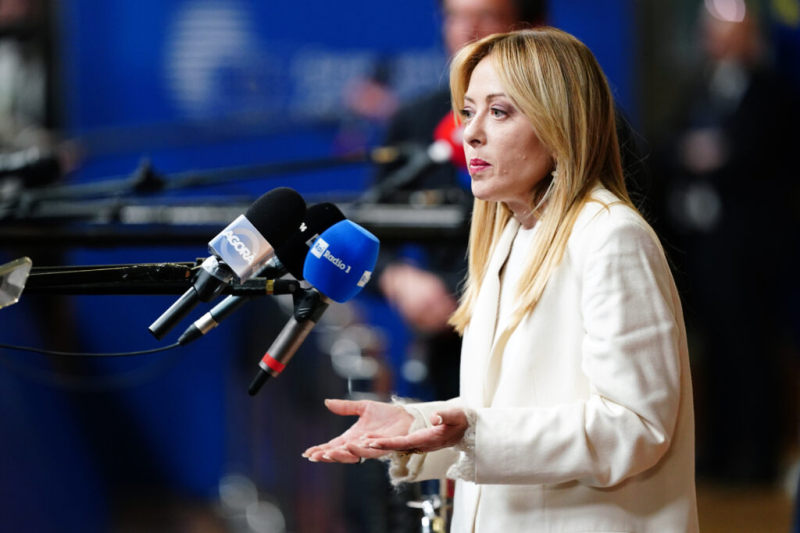
By the end of the talks, the EU’s leaders reached a sobering conclusion: Europe has little power or inclination to shape events.
“Middle East impacts us a lot — but are we a player in the game?” an EU official who was party to the leaders’ discussions asked. “They’re trying to find a place in this debate and we have a lot of statements and positions [but] is there a role for Europeans for solving this process?”
Evidently not, according to Kaja Kallas, the EU’s foreign policy chief, who warned leaders that “starting war is like a love affair — it’s easy to get in and difficult to get out,” according to two diplomats briefed on her remarks.
Translation: This is not Europe’s war — and it’s not going to be.
The EU was left with doing “what we always do,” an EU official said, writing “nice statements.”
Burning gas fields
Europe already angered U.S. President Trump earlier this week when its top envoys rejected his call to secure the Strait of Hormuz. The summit’s final conclusions leaned heavily on familiar calls for “de-escalation” and “restraint,” without proposing concrete action, sticking to that earlier position.
That’s despite Qatar warning Thursday it would not be able to fulfill its liquefied natural gas contracts with Belgium and Italy after Iran directed its wrath — and its ballistic missiles — over U.S.-Israeli strikes at the Gulf country, knocking out almost a fifth of its LNG export capacity.
Yet rather than grapple head-on with the rapidly expanding energy shock, Europe’s leaders spent hours debating the bloc’s climate policy, including its ETS, which a group of countries are eager to reform.
“To say ETS is the biggest issue when big gas fields are burning is a bit weird,” an EU official said.
European Commission President Ursula von der Leyen said the consequences of the war extended far beyond the Middle East, adding its most “immediate impact” was on energy supply and prices. She announced a slate of emergency measures to lower costs, from lowering taxes to boosting investment in ETS.
‘Just crazy’
If anything, the summit exposed where the wars in Iran and Ukraine overlap.
In what could be his final EU gathering after 16 years if he loses next month’s election, Hungary’s Orbán slammed Europe’s approach to the unfolding energy crisis.
“The behavior and the strategy that the Europeans have here is just crazy,” he said — adding the EU needed to buy Russian oil to “survive.”
Orbán has blocked a €90 billion EU loan to Kyiv because of a dispute about a damaged pipeline carrying Russian oil through Ukraine to Hungary and other central European countries.
For that reason, the bloc was similarly unable to offer much more than assurances on the Ukraine war either.
Orbán maintained his opposition on Thursday and even won the sympathy of Meloni, who told leaders she understood his position.
As frustration inside the room boiled over, many leaders sharply criticized the Hungarian premier, according to Swedish Prime Minister Ulf Kristersson.
“I have never heard such hard-hitting criticism of anyone, ever,” he told reporters during a break in the talks.
Merz concurred that leaders were “deeply upset” at Orbán. “I am firmly convinced that this will leave a lasting mark,” he said.
But the pressure from his peers failed to sway Orbán and questions of the EU loan will roll on to another summit next month ― by which time Hungary could have a new leader, or at least an old one not desperate for votes.
On Iran and on Ukraine, the EU didn’t get anywhere. Earlier predictions by diplomats that leaders might continue discussions through the night or even reconvene for a second day as the urgency of a world in turmoil forced them to face up to the challenges before them failed to materialize. Things were done and dusted before midnight.
After 12 hours of few decisions, leaders were left with little new to tell people back home.
“There are many things worrying about this war” in the Middle East, while Orban’s veto of the loan to Kyiv “is still there and we are extremely unhappy about this, and so of course is Ukraine,” Sweden’s Kristersson told reporters upon leaving the summit.
And that was that.
Zoya Sheftalovich, Nette Nöstlinger, Nicholas Vinocur, Gerardo Fortuna, Gabriel Gavin, Hans von der Burchard, Sonja Rijnen, Zia Weise, Seb Starcevic, Giorgio Leali, Hanne Cokelaere, Ferdinand Knapp, Milena Wälde, Aude van den Hove, Gregorio Sorgi, Koen Verhelst, Victor Jack, Ben Munster, Jacopo Barigazzi and Bartosz Brzezińksi contributed reporting.