
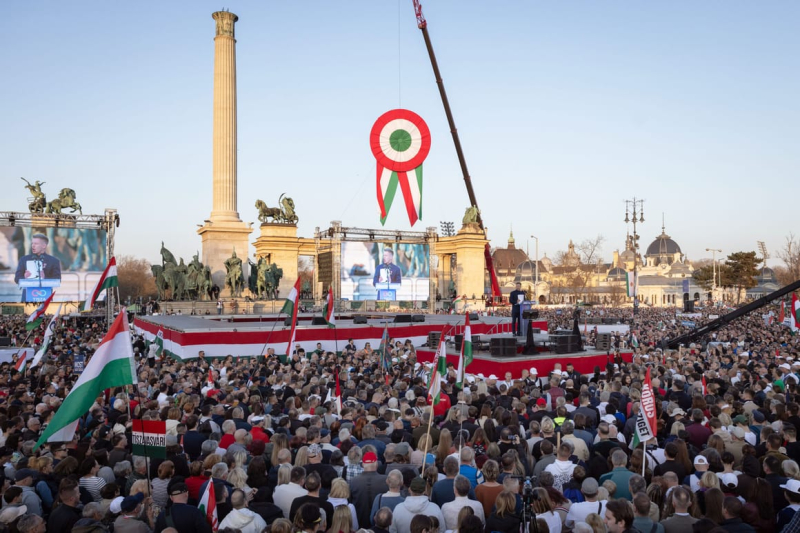

The two political rivals urge voters to rise up against the enemy. For PM Viktor Orbán the foe is Ukraine; for challenger Peter Magyar it’s Orbán’s own government.
BUDAPEST — As Hungarians awoke to a sunny national day on March 15, a question overshadowed the celebrations: Who would draw the larger crowd to the streets of Budapest?
Would it be incumbent Prime Minister Viktor Orbán, still a formidable force after 16 years of uninterrupted rule? Or Péter Magyar, a less prickly opposition wild card who is bidding to bring down Orbán’s government?
With less than a month to go until the April 12 election — and with Magyar’s opposition Tisza party polling about 10 points ahead of Orbán’s Fidesz — the national day festivities offered both parties a final chance to show off their strength and sway public opinion as the campaign enters its final stretch.
“Everything is ready for the biggest event ever,” Magyar had said the evening before. “This will be the day when size truly matters,” he added Sunday morning.
Meanwhile, as followers started gathering after 9 a.m. to march for Orbán, the Fidesz-aligned Magyar Nemzet newspaper said that “the crowd is huge.”
Small wonder, then, that the two sides disputed who had attracted the bigger crowd.
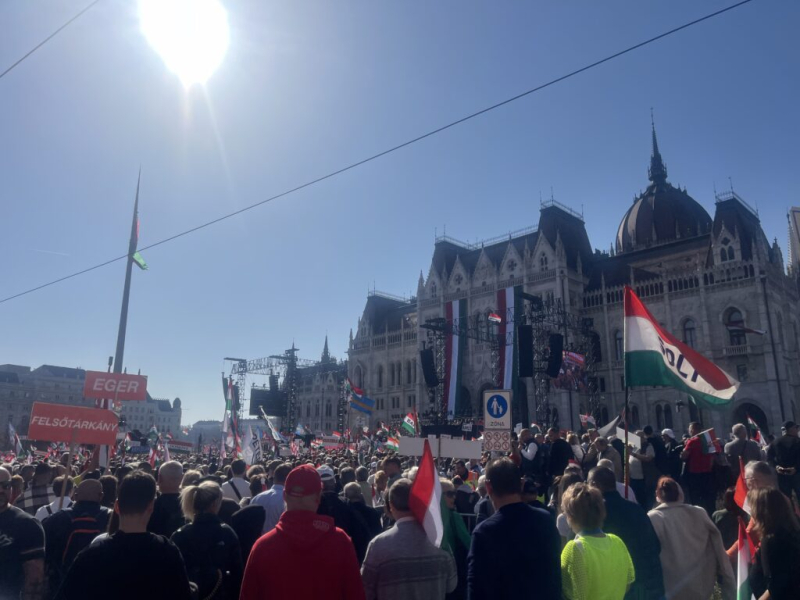
Fidesz shared data from the Hungarian Tourism Agency, which reported that Orbán’s “peace march” had drawn 180,000 people to the opposition’s 150,000; the agency, which is controlled by the government, based its estimate on how many cell phones had been connected to antennas near the respective rallies.
But people close to Tisza estimated for POLITICO that their party had mobilized 350,000 attendees.
Defending Hungary against Brussels, Kyiv
Hungary’s March 15 national day commemorates its revolution and war of independence to escape the rule of Austria’s Habsburg monarchy from 1848-1849.
Both parties used the occasion to drive home their campaign slogans and espouse patriotism and national identity. Orbán’s Fidesz has focused on the war in Ukraine and Iran, portraying itself as the party of security but avoiding domestic issues. Tisza has campaigned on a platform of complete regime change.
The competing events both featured national anthems and folk songs, most prominently “Nemzeti Dal” by Sándor Petőfi — an iconic poem and a cornerstone of Hungarian literature that is widely credited with helping spark the Hungarian Revolution in 1848.
And both Orbán and Magyar called on Hungarians to rise and defend the country just like they did in 1956 against the Soviet occupation — the former invoking Ukraine as the threat, the latter another Orbán government after 16 years of uninterrupted rule.
Orbán addressed his supporters beside the parliament in Kossuth Square, where they had marched from the Buda quarter of the capital across the Danube River.
“We will not be a Ukrainian colony,” was the motto on the placards protesters carried, a slogan that Orbán had echoed on social media the day before. Budapest is embroiled in a furious dispute with Ukrainian President Volodymyr Zelenskyy over the cessation of Russian oil flows across Ukraine and a stalled €90 billion EU loan to fund Kyiv’s war effort. Orbán has framed his rival Magyar as a Brussels proxy who will do as the EU and Ukraine say.
“I said no to the Soviets,” Orbán told the rally. “I said no to Brussels, to the war, and I’m standing before the vote now, together with you, saying no to the Ukrainians.”
Foreign Minister Péter Szijjártó took the stage to claim that Brussels, Kyiv and Berlin “want to bring Europe to war” and “want the money of Europeans to be given to the Ukrainians.”
Near Kossuth Square, Bajcsy-Zsilinszky Boulevard was at a standstill with dozens of buses still disgorging supporters from the countryside, who had been brought in to offset Budapest’s predominantly opposition voters.
High school student Mikolt, 16, and her stay-at-home mother Daniela, 42, were arriving from the village of Eger in the northeast of the country. They said they supported Orbán because he is keeping Hungary out of the war in Ukraine and because he supports Christianity, the family and Hungarians.

Magyar is a “narcissist,” Daniela said, who “behaves like a wounded little child who no longer has any power” since leaving Fidesz in February 2024.
“Russians go home”
A 20-minute walk away, the Tisza marchers were beginning to assemble. Volunteers Zsigmund and Balázs, both 18, agreed to talk with POLITICO, despite having received a caution from their team leader not to speak with media, as Orbán’s “propagandists” could use what they said against the party.
Describing themselves as “patriots,” the two students are counting on Magyar to improve the country’s health care and education systems, which they said have been battered by years of misrule.
“Orbán replaced skilled people with loyalists. Tisza has many professionals and they have a program, Fidesz hasn’t had a program for years,” Zsigmund said.
For Balazs, who plans to study economics at a foreign university, the election is existential — he says he may not come back if Orbán wins. “I would prefer to come back, definitely, but let’s see what happens.”
Once it gets going, the Tisza march fills the 2.5 kilometer-long Andrassy Avenue, heading for Heroes Square, where Magyar is due to speak at 17:00.
On stage, the opposition leader promises to fix Hungary’s health care system, restore billions of euros in EU funding that has been frozen due to rule-of-law concerns regarding Orbán’s government, improve pensions and child support, boost the economy and fight corruption.
Evoking Hungary’s “other” revolution — the 1956 uprising that killed 3,000 civilians — Magyar said Hungarians need to rise up again to regain their “freedom” and protect their rights. Framing the current government as an occupier that represses its “subjects,” he accused Orbán of allowing Russian agents in the country to meddle in the election.
“Russians go home!” the crowd chanted, repeating: “It’s over!”