
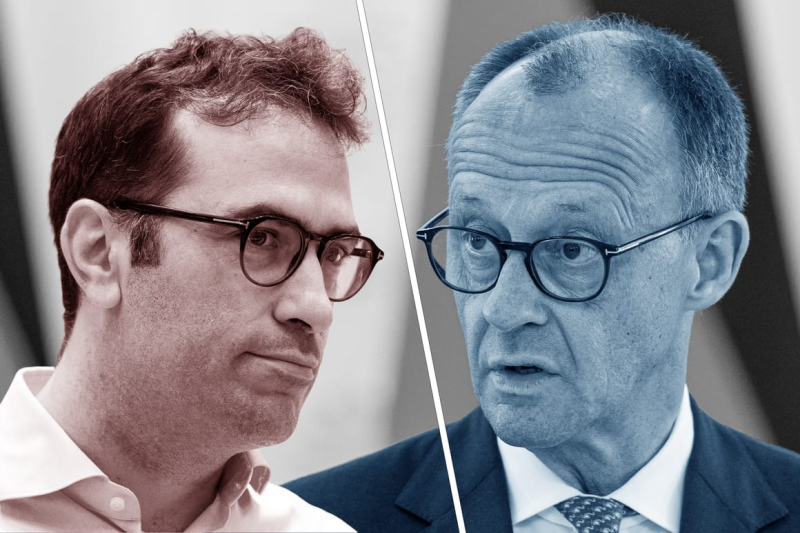

German Chancellor Friedrich Merz and four other leaders compete with Spanish finance minister in POLITICO articles signaling EU budget deal is still far off.
DUBLIN ― Germany and Spain used separate POLITICO opinion pieces to clash over the total size of the EU’s next approximately €2 trillion seven-year budget, setting the scene for tough negotiations to strike a deal before an informal end-of-year deadline.
With talks entering what officials hope will be their final few months, capitals are fighting against each other to save their pet projects and spare their taxpayers from sending more money to Brussels.
But after almost a year of painstaking negotiations, countries still seem far away from a landing zone — with disagreements growing stronger by the day, as underscored by the two articles from rival camps. One is penned by Spanish economy minister Carlos Cuerpo, the other by the leaders of Germany, Denmark, the Netherlands, Austria and Finland.
Governments are under heavy pressure to finalize a deal before elections in France, Italy, Spain and Poland next year threaten to derail negotiations and delay payouts to farmers and researchers.
Spain’s Cuerpo broke ranks to demand hundreds of billions of euros extra for the EU’s common cash pot, and a delay in repayments of post-Covid debt to free up €11 billion a year to spend on agriculture, defense and competitiveness.
“The next long-term budget should be set at 2% of EU GNI [gross national income), a level commensurate with the challenge of supporting both the economy and social cohesion,” Cuerpo wrote.
Send taxpayers the bill
But in the other article, Germany’s Friedrich Merz, Denmark’s Mette Frederiksen, the Netherlands’ Rob Jetten, Austria’s Christian Stocker and Finland’s Petteri Orpo — whose countries contribute to around 40 percent of the total budget — rejected both of Spain’s ideas.
They argued that more money and debt are not the solution but the problem.
“We cannot just add every new priority to every old one and send taxpayers the bill,” they wrote.
They are pressuring Ireland, in its position at the helm of the six-month rotating presidency of the Council of the EU, which is steering the talks, to cut hundreds of billions of euros in their next negotiating document due in October.
Officials involved in the negotiations who spoke to POLITICO and were granted anonymity because the discussions are confidential see more moderate cuts as the most likely outcome.
Debt time bomb
The EU’s seven-year budget, the multiannual financial framework, which governs EU spending from farmers’ subsidies to student exchange programs, is the subject of some of the fiercest negotiations in Brussels and pits different groups of countries against one another.
To try to bring their positions closer together, European Council President António Costa toured 25 EU countries in the past month to sound out leaders on the most sensitive questions facing the negotiations. He continued the trip in Dublin on Thursday.
In his bid to free up more budget funding, Cuerpo said he wants to delay repayment of joint debt issued in 2021 to tackle the economic fallout from the Covid-19 pandemic.
Around €300 billion must be repaid from 2028 to 2058. While interest repayments are set in stone, governments have more leeway to set the timeline for repaying the principal.
The current plan compels EU governments to front-load repayments and cough up €25 billion a year over the next budget cycle. Critics say this limits the funds available for other areas of spending and further constrains negotiations.
As a workaround, Cuerpo suggested pushing back the repayment schedule to free up an additional €11 billion per year.
“The result remains unchanged: a steady and predictable reduction of liabilities on time,” Cuerpo wrote in the POLITICO article.
His idea is backed by the European Commission and a growing number of EU countries including Italy, France, Portugal and Poland.
Several officials privately say that this option can be a last-minute workaround to smooth a deal in December.
However, supporters will have to overcome resistance from Germany and its allies, who have traditionally opposed joint EU debt.
They wrote in their op-ed that the post-Covid spending spree has “already burden[ed] the next MFF by almost €170bn. That money is no longer available for our new priorities.”
Their argument is that postponing the repayment of the principal will lead to small savings — and is therefore no alternative to slashing the overall size of the budget.
“The EU budget is ultimately paid for by European citizens,” they said. “That remains true whatever financing mechanism we invent. So, there is no avoiding the difficult question of the overall volume.”