
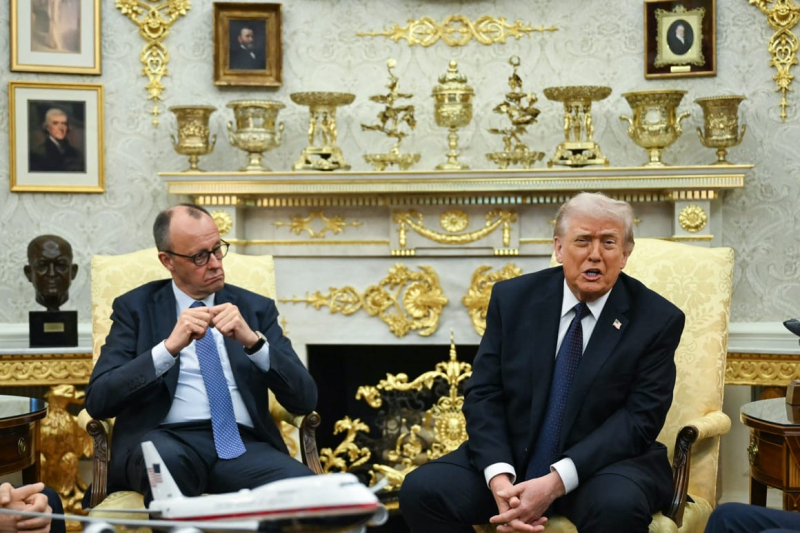

The chancellor’s attempt to steady transatlantic ties follows a recent public spat between the two leaders over the Iran war.
German Chancellor Friedrich Merz sought to cool tensions Wednesday with U.S. President Donald Trump, insisting their relationship remains strong despite a sharp public spat over the Iran war.
“The personal relationship between the American president and me remains, in my view, as good as ever,” Merz said at a press conference. “We are still, to put it in American English, on good speaking terms.”
The chancellor framed his recent criticism of the conflict in the Middle East as a response to the war’s fallout, rather than Trump’s leadership. “We are suffering considerably in Germany and in Europe from the consequences of … the closure of the Strait of Hormuz,” he said, pointing to rising energy costs and economic strain.
The conciliatory tone follows a direct attack from Trump late Tuesday. “The Chancellor of Germany, Friedrich Merz, thinks it’s OK for Iran to have a Nuclear Weapon,” the U.S. president wrote on Truth Social. “He doesn’t know what he’s talking about!”
Trump warned that a nuclear-armed Iran would leave “the whole World … held hostage,” before turning to Germany’s economy: “No wonder Germany is doing so poorly, both Economically, and otherwise!”
Merz’s attempt to steady the relationship comes after he sharpened his position regarding Washington.
When the war began on Feb. 28, the chancellor broadly backed America’s aims — but as the conflict dragged on, his tone has hardened.
On Monday, he said during a school visit in western Germany that the U.S. was being “humiliated” by Iran and had entered the war without a viable exit strategy, comparing the situation to past issues in Afghanistan and Iraq.
Merz also lamented that the conflict was detrimental to Germany’s economy, saying that it was “costing us a great deal of money.”
Berlin has also pushed back operationally. Germany rejected U.S. calls for transatlantic military involvement, insisting the conflict “is not NATO’s war,” and has only offered a limited role — including minesweepers to help secure the Strait of Hormuz — once fighting ends.