
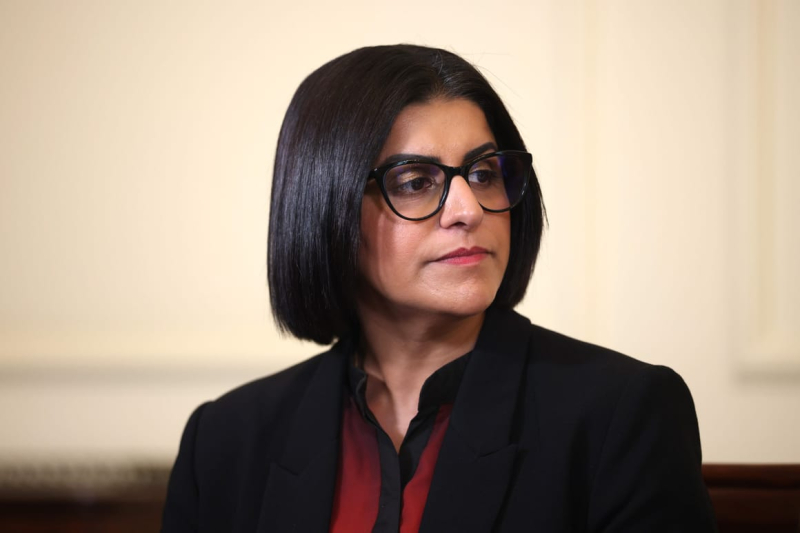

The woman widely tipped to become Andy Burnham’s chief finance minister held a hard line on immigration as home secretary, but her economic approach is still a mystery.
LONDON — The swirling speculation about Keir Starmer’s future landed on Shabana Mahmood, his home secretary, at a Westminster Christmas drinks party last December. “She won’t be leader,” whispered one admirer. “But she will be chancellor.”
Eight months after that risky prediction, Mahmood appears to be a frontrunner to run Britain’s finance ministry under Andy Burnham when he takes Starmer’s job on Monday.
While Burnham’s team insists he has not yet made up his mind, if he does choose Mahmood it would be striking given that she stands on Labour’s conservative right — the opposite of another leading contender, close Burnham ally Ed Miliband, and in apparent contrast to Burnham’s left-leaning pitch that he may have to ask for “a little more” tax.
Her hardline views on tightening migration policy meant she was never a serious prospect for prime minister. Allies in her center-left party believed she could not win the backing of 81 MPs to enter the ballot.
In public, how Mahmood might deal with Britain’s faltering economy is a mystery. She last served in an economic brief 11 years ago, as a shadow Treasury minister under Miliband’s leadership. She then went into the wilderness under Miliband’s successor Jeremy Corbyn before organizing privately to recapture the party from the hard left. She took the party’s campaign co-ordinator role when Starmer, with the help of his aide (then her ally) Morgan McSweeney, took power. She has refused to talk about the economy in the spirit of sticking to her brief.
In private, however, some of Mahmood’s close allies have long sought to argue that her economic views are more nuanced and less predictably right-wing than her critics may assume.
While the Blue Labour faction with which she has been associated is socially conservative, economically it backs old heavy industries and rails against the free-market right and globalization, appearing sympathetic to Burnham’s calls for greater state control over utilities.
Supporters also say Mahmood’s views are not simply those of Blue Labour. An MP for 16 years, she only left the shadow Treasury brief when Miliband lost the 2015 election — after which Burnham and his colleague Yvette Cooper lost a leadership election to Corbyn.
“People want to badge her as Blue Labour — it’s such a lazy stereotype,” one long-term ally of Mahmood, like others in this piece granted anonymity to speak frankly, said in late 2025. “If you ask Shabana her views on the economy, she was shadow chief secretary, she was in [former shadow chancellor] Ed Balls’ team. That had an impact on her.”
A former Labour adviser said this week: “She’s not an economic liberal … She’s less likely to say the state should get out the way of the market.”
A kind of engineer
Mahmood could well have had an economic brief if Labour had won in 2015, the same ally argued, or if Cooper or Burnham had won the leadership. Instead she channelled her energies into Labour’s internal machinations, before high-profile roles at justice and home affairs — which suited her socially conservative politics.
This does not mean her more recent views have been totally unknown. Mahmood spoke to MPs at a private dinner in late 2025 about the future of the left, which included setting out her views on the economy, said a person with knowledge of it. Josh Simons, an MP and another ally of Mahmood who later resigned his Makerfield seat to allow Burnham’s return to parliament, was among the attendees.
The same long-term ally quoted above said Mahmood believed a “fundamental reckoning” is needed with which sort of economy Britain needs.
They argued she wanted to build Britain’s manufacturing base and had a U.K.-first view of finding growth, while also being open to bilateral trade deals. They added: “She’s not a protectionist but there is a post-globalization bent to her view of the economy.”
A second supporter of Mahmood, also speaking in late 2025, argued that she starts from the position that voters are angry and 90 percent of the time, they are right to be so. She believes her job as a politician is to be a kind of “engineer,” this person said — to “look at where they’re right to be angry about what’s not working inside an institution.”
Her view is that “elites run things,” the first ally agreed. The problem with Starmer’s ambition of a politics that would “tread lightly” on voters’ lives, they argued, was that it essentially left the elites to get on with the job.“Shabana’s view is we sort of broke that with the financial crash of 2008, and we broke it again with austerity,” they added.
This raises the question of whether Mahmood would cozy up to big business and the City like outgoing Chancellor Rachel Reeves, who launched a “smoked salmon offensive” of breakfasts ahead of taking power in 2024.
Mahmood’s views also extend to a skepticism about the EU, the first ally quoted above added — despite Starmer and Burnham both pushing for closer ties with the bloc.
Hard questions ahead
None of these assessments answer the hard questions that Burnham’s chancellor will have to grapple with this summer — whether to tweak fiscal rules to allow more infrastructure investment, and whether to raise taxes in their first budget, likely in October.
Nor do they show for certain how far Mahmood in No. 11 Downing Street would be in lockstep with the prime minister living next door, or in conflict like Chancellor Gordon Brown was with Tony Blair in the New Labour government.
A close ally of Burnham said last month that he would seek a chancellor with whom he was closely aligned, and noted that did not rule out Mahmood. Another close ally of Burnham on the party’s left flank talked up her chances.
But Mahmood’s record suggests she would not be a pushover either. She spent her time before parliament working as a barrister and has long been known for being forthright in private; her supporters have long argued that her appeal is a tendency to form firm, principled views on policy and to fight hard to see them through.
One person who has worked with Mahmood said she acts out of character in the period when she is figuring out what to do about a policy problem. She devotes enormous energy to it, goes to bed late and wakes early — before settling on a view. They said: “When she’s clear about the ‘why,’ she will break any bone she has to.” In this, she has something in common with Miliband.
Mahmood, interviewed by Blair at a reception hosted by the Tony Blair Institute in December, said: “I think the point of politics is to make an argument and try to persuade people of your position. And I think that modern politics, in this frenzied 24/7 world that we live in, sort of drives you towards becoming a commentator, not feeling in control of events.
“Going out and making the argument is, in and of itself, almost a fresh thing to do.”
Describing Mahmood’s approach in late 2025, one Labour official said: “It’s like how Tony Blair used to be — he would go to party conference and say ‘I know you’re all going to disagree with me, but you’re wrong.’”
‘Life is a test’
Mahmood is one of the most prominent Muslims in British public life and her faith informs the way she has seen out her career. She told Blair last year: “I genuinely believe life is a test, and you are accountable to God for how you use the privilege you were gifted at birth by God, and that really motivates me.”
While forthright on her policy views, she is said to be more introverted than many other Labour power players, and — although she met many new MPs in small groups after the 2024 election — avoids plotting over drinks and at receptions. Her group of friends in the party does not follow one clear faction, though people who supporters have named as being close to her include Deputy Leader Lucy Powell, Burnham ally Louise Haigh and Miliband himself.
Unlike some MPs in constituencies far away from home, Mahmood also represents the economically and culturally diverse part of Birmingham where she was brought up, and the conversations she has there inform her views on national policy.
In other words, she might not be so different to Andy Burnham — the Catholic boy with political ideology who casts himself as an outsider and wants a “Makerfield test” to ensure national policy benefits constituencies like his.
If he does choose Mahmood as his chancellor, that theory will be put to the ultimate test.
Hannah Brenton contributed reporting.