
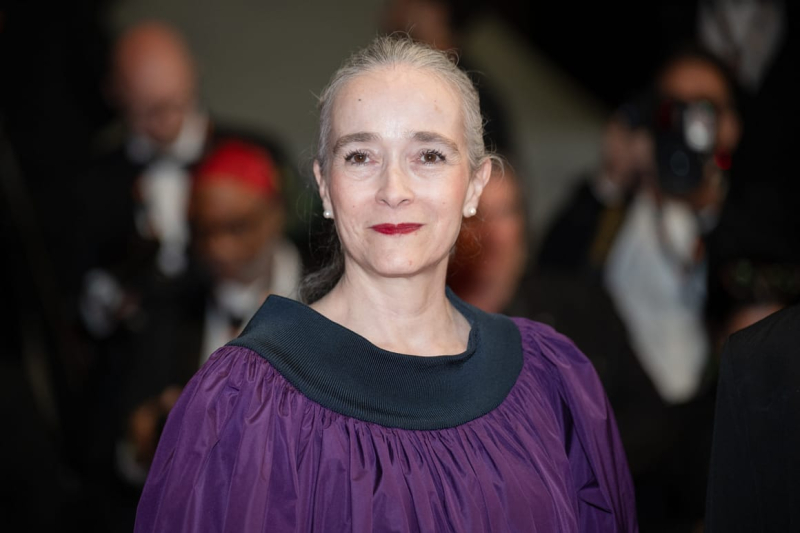

The National Rally’s push to privatize French public broadcasters would destroy them, Delphine Ernotte said.
PARIS — French public media will cease to exist if the far-right National Rally follows through on its pledge to privatize it, warned the head of France Télévisions as Marine Le Pen edges closer to power.
“In France there is a political party that has clearly said what it plans to do with public broadcasting: privatize it, which in reality means eliminating it,” said France TV CEO Delphine Ernotte in an exclusive interview.
Le Pen and her allies have long accused the French state of using taxpayer money to fund news coverage and cultural content that promotes a progressive agenda. And with polls showing her well-placed to win next year’s presidential election, the National Rally’s pledge to privatize or dismantle state-funded media has never been closer to becoming reality.
“In populist regimes, freedom [of the press] is a threat. So they try to get hold of public services in different ways. In Italy, they appoint managers […] In the Czech Republic, they cut funding,” said Ernotte, referring to allegations of political interference at Italian state broadcaster RAI and Prague’s effort to scrap public broadcasting license fees.
But while speaking to POLITICO from a pristine, all-glass meeting room overlooking the Seine at her network’s headquarters, Ernotte said her focus is on positioning France TV for future success regardless of who occupies the Elysée Palace when President Emmanuel Macron’s term expires next year.
“My job isn’t political. It’s to get this independent firm up and running while respecting all political views, from the far right to the far left,” said Ernotte.
The veteran telecommunications executive took the reins of France TV in 2015, turning the state-controlled broadcaster into a multi-platform behemoth boasting 45 million monthly unique visitors across television and streaming. The media giant has a good track record of developing hits like “Dix pour cent” (known as “Call My Agent” in English), and Ernotte boasts that its legacy evening news broadcast is the most trusted of its kind.
But France TV is locked in an increasingly difficult fight for eyeballs with both private legacy media companies and a new generation of streamers.
And, like many of its audiovisual peers, France TV has struggled to keep its finances in check while navigating a rapidly changing media landscape. A report by France’s top public auditors last year said the company’s economic model was “unsustainable in the long term.”
Building back credibility
Ernotte said she was in favor of the long-running proposal to merge France TV with Radio France — the country’s public radio broadcaster — as a way to jump-start both businesses.
But with France sitting on a massive budget deficit and desperate for cash to invest in other priorities like defense and the green transition, public media’s inability to turn a profit has made it a target for the chopping block.
Ernotte was one of many media executives and journalists who testified before a parliamentary probe this year examining public media neutrality and finances, which turned into a political lightning rod when the committee’s far-right rapporteur recommended slashing budgets and consolidating multiple TV stations in April. One French copyright and authors group said such moves would “ruin” French public media.
Ernotte said she disagreed with the probe’s findings. She believes their extensive coverage in outlets that belong to right-wing billionaire Vincent Bolloré’s media empire “created a lot of bad buzz” and hurt France TV’s credibility.
“The goal was to undermine the credibility of public broadcasting in order to push through privatization. That’s how I understood it,” said Ernotte.
Three of the Bolloré-owned outlets she cited — Le Journal du Dimanche, Europe 1 and CNews — said in a joint statement to POLITICO that “the activities of a parliamentary inquiry committee on public broadcasting are, by their very nature, a matter of significant public interest.”
“Diffusing and covering them is part of the fundamental mission of any newsroom: to inform the French public,” read the statement.
Ernotte was recently confirmed for her fourth term leading the European Broadcasting Union (EBU), an alliance of public media from across the continent. She hopes she can use her role to get Europe to start considering the news as “critical infrastructure” that must be protected from domestic and overseas threats.
She said that one of her main focuses as EBU president will be the review of the Audiovisual Media Services Directive, which is expected by the end of the year.
Her priorities for the text include ensuring that French and European content is prominently displayed on platforms, and that broadcasters are fairly remunerated when their programming is used by platforms and by artificial intelligence.
Heading into the presidential election next year, Ernotte also wants authorities to endow public broadcasters with more tools to fight foreign interference. France TV already has a partnership with Viginum — the French government’s foreign interference watchdog — but Ernotte is asking regulators for permission to break the rules on pre-election reporting restrictions on voting weekends to reveal any instances or attempts of foreign interference.
“We need to find a way to do this. Because it would be unthinkable for us to let ourselves be manipulated,” she said.