

Contents
European tech funding rebounded in June with more deals but lower investment, as Germany led funding, robotics topped sectors, and exit activity remained stable.
European tech activity in June 2026 was characterised by a recovery in deal volume but a decline in total capital raised compared to May.
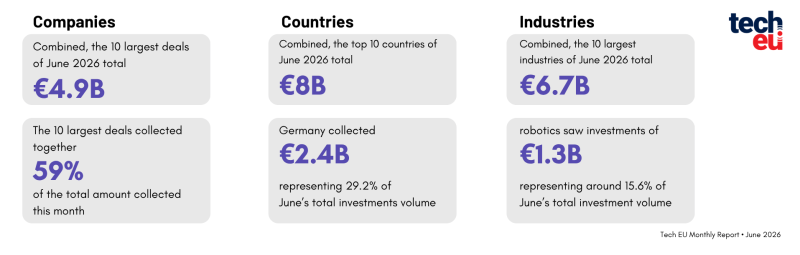
The ecosystem recorded 293 funding deals and €8.3 billion raised, compared to 258 deals and €10.5 billion in May, representing a 14 per cent increase in deal activity and a 21 per cent decline in total capital invested.
At the country level, Germany emerged as Europe’s leading funding hub, attracting €2.4 billion in investment and replacing the UK, which led in May with €7.9 billion, reflecting a more geographically balanced month for European funding.
Sector dynamics also shifted, with robotics becoming the leading sector after attracting €1.3 billion, replacing cloud as the strongest-performing sector in May.
Exit activity remained stable in June, with 39 exits recorded, unchanged from May, suggesting liquidity conditions held steady despite the softer funding environment.
Our Cate Lawrence, Senior Journalist at Tech.eu, commented on the June numbers within the European tech investment landscape in our monthly report:
“While headline investment volumes softened compared with the previous month, the underlying picture remains encouraging.
The month’s largest financings were concentrated in companies developing robotics, AI, security, space and quantum technologies – areas increasingly linked to Europe’s ambitions around industrial resilience, digital sovereignty and strategic autonomy.”
For her more detailed review and more in-depth analyses of the European tech ecosystem, including industry and country performance, exit activities, and more, check out our June report.

Here are the 10 largest tech deals in Europe from June, accounting for 59 per cent of the month’s total funding.
1

Neura Robotics (Germany)
Amount raised: $1.4B
NEURA Robotics is a German robotics company developing cognitive robots designed to work safely and collaboratively alongside humans. Its portfolio includes collaborative robots, mobile manipulators and humanoid robots equipped with AI capabilities that enable them to see, hear, feel and learn from their environment.
Alongside its hardware, the company is building a software and data ecosystem for physical AI, aiming to make intelligent automation more accessible across manufacturing, logistics, healthcare and other industries.
NEURA Robotics raised up to $1.4 billion in a Series C round to scale its Physical AI and cognitive robotics platform, expand manufacturing, accelerate commercial deployment, and grow its global robotics ecosystem.
2

Kpler (Belgium)
Amount raised: $1B
Kpler is a global provider of trade intelligence and analytics for commodity and maritime markets. Its platform combines artificial intelligence with proprietary data collection to deliver real-time insights into global trade flows, shipping activity, energy markets and supply chains.
Covering dozens of commodities, including oil, gas, agriculture and metals, Kpler serves traders, financial institutions, governments and industrial companies seeking greater market transparency and operational intelligence.
Kpler secured a strategic growth equity investment of over $1 billion to support expansion into adjacent markets and the development of new products.
3

Stark (Germany)
Amount raised: €500M
Stark is a defence technology company specialising in AI-enabled, software-defined unmanned systems for modern military operations.
The company develops loitering munitions, autonomous maritime systems and command-and-control software designed to support multi-domain missions while strengthening European defence capabilities and technological sovereignty.
STARK focuses on rapidly developed, scalable systems intended for deployment by European armed forces and NATO partners, with an emphasis on affordability, adaptability and operational effectiveness in evolving defence environments.
Stark raised €500 million to scale production, expand R&D, and strengthen sovereign defence capabilities.
4

Alan (France)
Amount raised: €480M
Alan is a healthtech company that combines digital health insurance, healthcare services and preventive care within a single platform.
Its offering integrates insurance coverage with medical consultations, AI-powered health tools and personalised wellbeing programmes, aiming to simplify access to healthcare for individuals, employers and public organisations.
Alan raised €480 million in a Series G round to expand into new international markets, strengthen its presence in existing markets, pursue acquisitions, and invest in AI-powered healthcare services and product innovation.
5

Iceye (Finland)
Amount raised: €450M
ICEYE is a space technology company operating the world’s largest constellation of synthetic aperture radar (SAR) satellites.
ICEYE operates satellites that provide round-the-clock, all-weather Earth observation data, supporting defence, disaster response, environmental monitoring, maritime surveillance, and other government and commercial applications.
ICEYE raised €450 million in a Series F round to expand its global footprint, deepen its space intelligence capabilities, and accelerate delivery of sovereign intelligence systems and data to governments and commercial customers.
6

Nearfield Instruments (Netherlands)
Amount raised: $380M
Nearfield Instruments is a semiconductor equipment company developing advanced metrology systems for the global chip manufacturing industry.
Founded as a spin-off from TNO, the company specialises in high-throughput atomic force microscopy (AFM) technology that enables three-dimensional, atom-scale measurements during semiconductor production.
Nearfield Instruments raised $380 million in a Series D round to scale manufacturing, expand customer support, and meet growing semiconductor demand.
7

Oxford Quantum Circuits (UK)
Amount raised: £260M
Oxford Quantum Circuits (OQC) is a UK quantum computing company developing superconducting quantum computers for commercial applications.
Founded in 2017, the company designs and builds its own hardware using proprietary Coaxmon architecture and Dimon qubit technology, with the goal of delivering fault-tolerant quantum computing. OQC provides Quantum Computing as a Service (QCaaS), enabling enterprises, researchers and public-sector organisations to access its systems through secure cloud infrastructure.
Oxford Quantum Circuits raised £260 million in a Series C round to expand its international footprint, scale quantum infrastructure, and develop next-generation quantum systems.
8

Isar Aerospace (Germany)
Amount raised: €270M
Isar Aerospace is a German space company developing launch vehicles for small and medium-sized satellites and satellite constellations.
The company designs, manufactures and tests most of its rocket systems in-house, aiming to provide reliable and scalable access to space for commercial and institutional customers. Its flagship launch vehicle, Spectrum, is designed to support
Isar Aerospace raised €270 million in a Series D round to expand globally, scale production of its Spectrum launch vehicle, and grow its launch infrastructure.
9

Perk (Spain)
Amount raised: $300M
Perk, formerly TravelPerk, is a business travel and spend management platform that combines travel booking, expense management and financial controls in a single AI-powered solution.
The platform enables organisations to manage travel policies, approvals, expenses, invoices and company spending through integrated workflows and real-time reporting. Designed for finance, operations and travel teams, Perk aims to reduce administrative work while giving businesses greater visibility and control over corporate travel and spending.
Perk secured a $300 million private credit facility to accelerate investment in product, technology and AI, and support global expansion, including the launch of its expense management product in the US.
10

PhysicsX (UK)
Amount raised: $300M
PhysicsX is a UK software company that develops AI-powered engineering software combining artificial intelligence with physics-based modelling.
Its platform supports product design, simulation and optimisation across industries including aerospace, automotive, semiconductors, energy and advanced manufacturing. The technology is designed to help engineers improve development processes and industrial performance.
PhysicsX raised $300 million in a Series C round to expand its AI engineering platform, advance physics AI research, and support international expansion.
1/10