
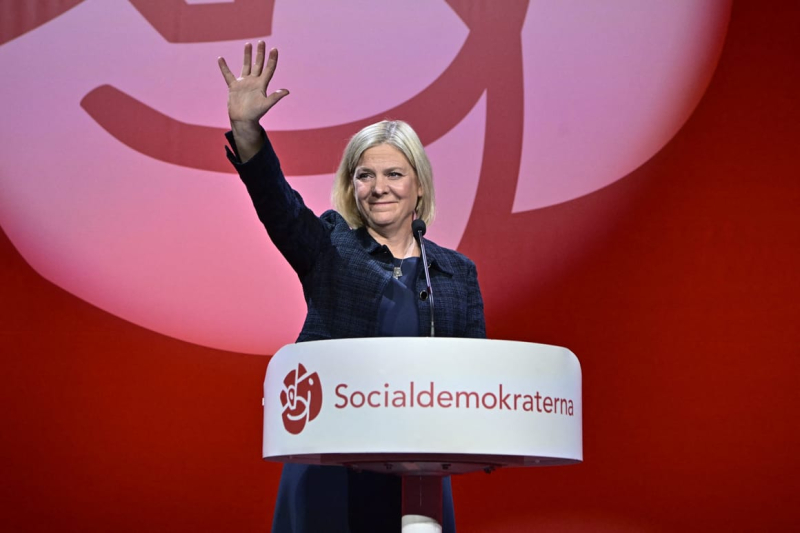

Social Democrat Magdalena Andersson set to become new prime minister but needs to finalize a deal with other parties first.
Sweden’s Prime Minister Ulf Kristersson resigned after narrowly losing a closely fought election, paving the way for a new center-left government to take over.
Social Democrat leader Magdalena Andersson is now expected to begin formal negotiations with other parties in her bloc and, if she can get a deal, she will become Sweden’s new prime minister in the weeks ahead.
“The Swedish people have voted for a new direction for our country,” Andersson said in a video posted on social media. She said the election showed voters wanted “cohesion” and not “division” and promised to work for unity as prime minister.
Anderson said she would seek to prioritize a fair migration system that stops unfair deportations, a climate policy that sees green transition as an opportunity for Sweden, better elderly care and healthcare, and a revitalized economy to boost growth and reduce unemployment.
The contest offered voters a choice between Andersson’s center-left and socialist alliance of four parties, and Kristersson’s rightwing grouping of four parties, which included the far-right anti-immigration Sweden Democrats.
During the campaign, Andersson, who previously served as prime minister until the 2022 election, warned voters against handing power to the Sweden Democrats after Kristersson said he would offer the far-right party ministerial jobs in his next government.
But the result capped a bad election for the Sweden Democrats who were hoping to enter power as for the first time but lost votes, seats and influence instead.
The Swedish Election Authority’s final tally of the preliminary vote count gives Andersson’s left bloc 176 seats to Kristersson’s 173.
Despite winning the most seats, Andersson still needs the support of the three other parties in her leftwing bloc to achieve a majority.
That may not be easy as two of these potential allies are at odds: The Left Party has named its price as having ministers in the government — and that’s something the liberal Center Party says it cannot accept.
Andersson said “a new era of cooperation between the political parties” would be needed.
In his resignation letter to the speaker of parliament, Kristersson, the conservative center-right leader, appealed for talks between “all parties” because pre-existing red lines would make finding a coalition hard. Although he didn’t name Andersson or the dispute between the Green and Left parties, it’s likely that he had these issues in mind.
“A constructive openness will now be needed from the parties in the Riksdag for a prime minister to be tolerated — and for a new government to gain support for its state budget,” Kristersson wrote. “Talks will need to be held with all parties to find ways around these deadlocks and create the conditions for a stable and effective government.”
One option sometimes discussed by commentators in Sweden is for the main center left and center right parties — Andersson’s Social Democrats and Kristersson’s Moderates — to come together to form a grand coalition, removing the need for support from either end of the political spectrum.
But even if they did agree to work together, these two parties would still need backing from a third to get a majority, and collaboration between the two rival camps is seen as highly unlikely by political insiders.
Negotiations could last weeks. The earliest a new prime minister can be sworn in is Sept. 29. Barring an unlikely unravelling of those negotiations, the result heralds the end of conservative Kristersson’s hopes of holding onto his job. He is expected to take a caretaker role until a new government is formed.
This article was updated.