
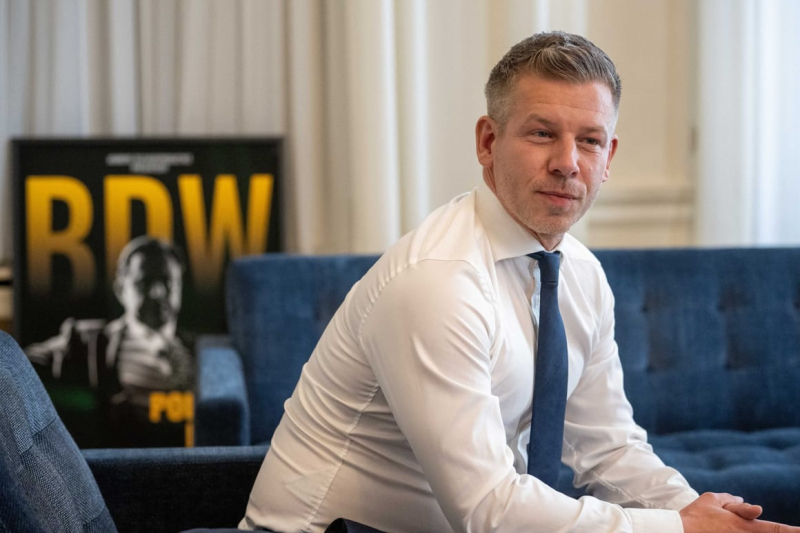

The Hungarian leader has made the release of EU money central to his post-Orbán reset, but the Commission wants him to deliver on reforms first.
BRUSSELS — The European Commission is approaching Péter Magyar’s push to unlock frozen EU funds with caution, even as Hungary’s new prime minister arrived in Brussels insisting a deal is “very close.”
Magyar will meet Commission President Ursula von der Leyen on Friday seeking a breakthrough on releasing billions of euros blocked over breaches of EU law during former leader Viktor Orbán’s years in power. But EU officials warn privately that the process is nowhere near as straightforward as Magyar’s bullish public messaging suggests.
While agreement on some elements is likely on Friday, a Commission official told POLITICO, they cautioned work will remain on the more complex issues.
“Of course you can’t ask to reform a country overnight so we don’t expect an agreement on everything, something will be agreed and some other things we will continue to work on,” said the official, granted anonymity to discuss the confidential talks.
Brussels has three main concerns: a looming court ruling over a previous Commission release of Hungarian funds; whether Magyar can deliver reforms quickly without triggering a constitutional crisis; and the example of Poland, where EU money was released after a change of government only for key reforms to stall.
The immediate risk is at the European Court of Justice, which is expected to rule in the coming weeks on the Commission’s 2023 decision to release about €10 billion in frozen funds to Hungary when Orbán was prime minister. The European Parliament challenged that move, arguing the Commission overlooked continuing democratic and judicial problems. The court’s advocate general has already sided with Parliament in a non-binding opinion.
A loss could leave the Commission accused of moving too quickly on money for Hungary once again. Wary of doing so again, it is demanding reforms be completed — not just promised — before releasing the cash.
The uneasy choreography around Magyar’s visit has underlined the disconnect. Hungary’s Foreign Minister Anita Orbán told POLITICO last weekend that Magyar would meet von der Leyen on Thursday. Budapest then publicly trailed the encounter for days while the Commission refused to confirm it. Only late Wednesday — after Magyar posted that the meeting would take place Friday — did a Commission spokesperson acknowledge it publicly.
There was another awkward moment Thursday when NATO canceled a planned press conference that had been due to feature Magyar and Secretary-General Mark Rutte. The press conference was called off “due to scheduling issues,” a NATO official speaking on behalf of the organization said. A Hungarian government spokesperson declined to comment.
Magyar has made the release of EU money central to his post-Orbán reset. Hungary’s Finance Minister András Kármán, Transport and Investment Minister Dávid Vitézy and Foreign Minister Anita Orbán are also in Brussels for preparatory talks ahead of his von der Leyen meeting, he said in a video.
“One of our most important campaign promises was to secure EU funds for Hungary,” Magyar said. “We are talking about many hundreds of billions of forints. Every EU member state has already received these funds, except for Hungary.”
“There are still open questions, but we have basically struck a deal on a lot of important issues. We’re very close to an agreement now,” he added.
Commission spokesperson Paula Pinho confirmed Thursday that “a series of meetings has been taking place … between the teams on both sides to make as much progress as possible.”
The main pot of money at stake is €10.4 billion in EU post-pandemic recovery funds. A deal to unlock the funds hinges on Magyar’s government submitting a revised plan for spending the cash, two Commission officials granted anonymity to speak freely told POLITICO.
To access the full amount, Hungary must complete so-called super milestones covering the judiciary, anti-corruption safeguards and public procurement. Budapest must formally request access to the money by Aug. 31, with final disbursements due before the end of the year.
Magyar has a parliamentary supermajority. But the reforms must be drafted, enacted and survive legal challenges. Key posts — including the presidency, the head of the constitutional court and the prosecutor general — remain occupied by Orbán loyalists who could obstruct reforms.
Trying to remove them could trigger a constitutional crisis, said John Morijn, professor of law and politics in international relations at the University of Groningen.
“It’s extremely difficult to restore the rule of law without breaking the law,” Morijn said. Removing court leaders would be “a very draconian thing to do,” he added. “He would be breaking the constitution as well, and the Commission does not want to be associated with that. You would face a constitutional crisis.”
Magyar has acknowledged some limits. After saying he would submit Hungary’s intention to join the European Public Prosecutor’s Office to von der Leyen and European Council President António Costa, he added: “We cannot accept proposals for amendments that might conflict with the Hungarian constitutional system. I think that the European Commission will understand this.”
Poland is also weighing on Brussels.
After Donald Tusk came to power in Poland’s 2023 election, the Commission unfroze more than €100 billion after Warsaw submitted a judicial reform plan and took initial steps to rebuild trust. But President Karol Nawrocki, loyal to the Law and Justice party, later blocked key reforms, fueling criticism that the Commission had released funds on promises rather than actual changes.
Nonetheless, EU officials are keen to encourage Magyar’s break with Orbán after years of confrontation with Brussels. Ireland’s Europe Minister Thomas Byrne said Hungary’s new tone was “a complete reversal” and “wonderful to hear.”
Yet some European capitals are taking a cautious approach to Magyar — and prefer to wait to see what changes he brings before fully embracing Hungary on issues such as closer intelligence sharing.
“It’s not a panacea — it’s not a new dawn,” said one senior European defense official, adding: “but it’s very significant.”
Victor Jack and Gerardo Fortuna contributed reporting.