
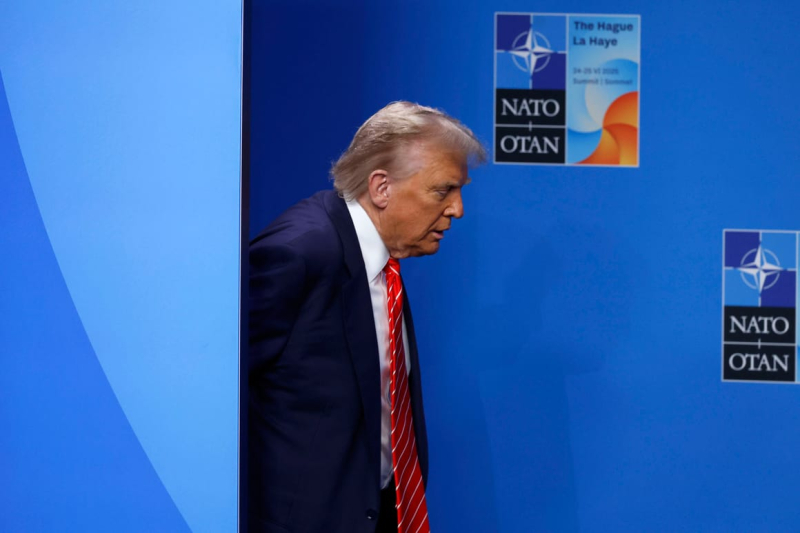

European leaders tested solutions to NATO’s new problem: how to handle an America that can both anchor the alliance and shake it.
PRAGUE — Europe is trying to Trump-proof itself.
Donald Trump’s whiplash over U.S. troop deployments in Poland turned this week’s GLOBSEC Forum in Prague into a preview of how Europe is working to keep NATO functioning even when Washington becomes a source of uncertainty.
“Think of how confused the Russians are,” Polish Foreign Minister Radosław Sikorski joked at the POLITICO Speakeasy, after being asked how Warsaw could plan around Washington’s shifts.
Sikorski called the troop episode “some miscommunications,” said “all’s well that ends well,” and dismissed damage to relations with Washington as “just a hiccup.”
But the back-and-forth from Washington — from Defense Secretary Pete Hegseth’s unexpected decision to cancel a planned deployment of 4,000 troops to Poland followed by this week’s U-turn by Trump in a Truth Social post — left a lot of bruised feelings in Warsaw.
Conflicting U.S. messaging helped cause “major political and psychological shock” in Poland, according to a U.S. diplomatic cable obtained by POLITICO.
The lesson across Europe is that America is still crucial to the continent’s defense but that it is now unpredictable.
Czech President Petr Pavel complained the problem was “not so much the withdrawals as the lack of information.”
Allies “used to be informed” about changes in U.S. troop numbers and presence, he said, while the dramatic shifts in deployment to Poland appeared to have been announced “without any coordination with NATO.”
Even aides to Poland’s MAGA-aligned President Karol Nawrocki were befuddled by the quick shifts.
Marcin Przydacz, secretary of state to the Polish president, called the communication out of Washington “chaotic,” and underlined that Poland is “those guys who fulfill 5 percent GDP,” referring to NATO’s defense spending target.
Poland has followed the model of keeping American onside by being a top alliance defense spender, refraining from criticizing the war Trump unleashed against Iran, and buying tens of billions of dollars of U.S. weapons. But even that isn’t buying Washington’s loyalty and stability.
That previews a central question for July’s NATO leaders’ summit in Ankara: whether Europe should fall in line with demands from alliance chief Mark Rutte to continue to rely on crucial American weapons systems, or to turn more to their own capabilities.
Germany is working with partners to build “a new, strong defense capability for Europe,” while recognizing that Washington is increasingly focused on China and the Indo-Pacific, said Foreign Minister Johann Wadephul.
But that also creates tensions within Europe as many countries favor quick purchases of U.S. weapons to deter the Russian threat.
Swedish Defense Minister Pål Jonson warned against inserting a “European preference” into EU defense procurement rules.
“My responsibility, first and foremost, is to get weapons in the hands of these warfighters,” Jonson said on Saturday. “Sometimes that can be from Europeans, sometimes it can be from the Americans or somewhere it can be from Asia.”
Jonson’s warning landed weeks after Thomas DiNanno, the U.S. under secretary of state for arms control, traveled to Poland, Romania and Estonia. The State Department said his Warsaw meetings with U.S. industry representatives included discussions on “EU defense protectionism” and the “America First Arms Transfer Strategy.”
Romanian Foreign Minister Oana Țoiu also framed the balance between equipping troops and building up local defense industries. “Localization was very important, investment in jobs at home was very important,” she said on Saturday.
But Bucharest also wants to “create the space to advance in the engagement with the United States,” she said, adding that Romania’s procurement plan included “more than $2 billion” of U.S. kit.
That need to calibrate domestic interests against keeping an unpredictable Trump-led U.S. committed to the alliance is likely to be a key theme in Ankara.