
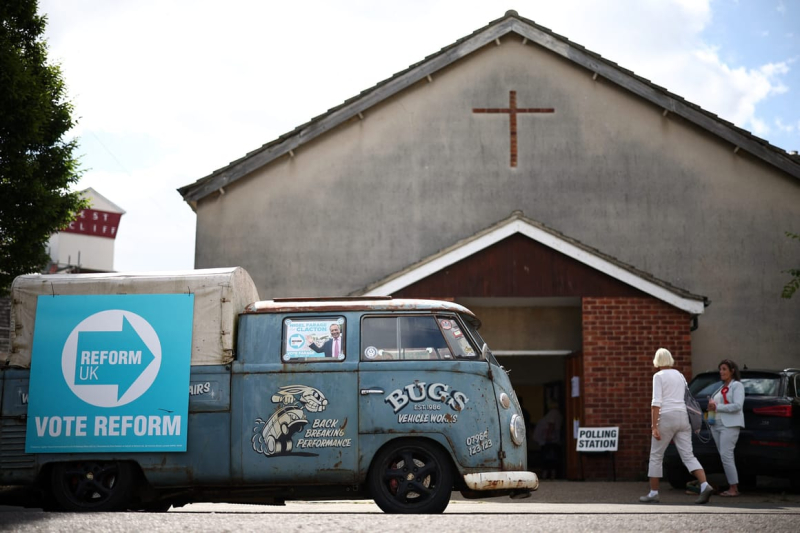

Zia Yusuf said his party wants to “protect the Christian heritage of Britain.”
LONDON —New Labour spin doctor Alastair Campbell famously said “we don’t do God.” Reform UK is taking a different approach.
Nigel Farage’s populist right-wing force, which leads in the opinion polls, put religion at the heart of its political agenda on Monday, promising to “protect the Christian heritage of Britain.”
In a speech on the south coast of England, Zia Yusuf, the party’s home affairs spokesperson, said: “A nation without a culture is not a nation at all. It’s just an economic zone, a shopping mall with a flag waiting to be exploited.”
Yusuf earlier told the Times newspaper that Christianity is “core to the history and the DNA of the country,” and renewing the nation’s religious faith is essential for tackling the “crisis of meaning culturally.”
He told the paper Britain is losing its Christian values because of the “sheer quantities of people that came to the country in a short period of time.”
If it wins power, Reform UK would grant immediate and automatic listed status to churches, meaning their character could not be altered. The buildings would also be prevented from being converted into places of worship for other religions, like mosques, Yusuf said.
Not doing God
Religious faith is a topic U.K. politicians usually try to avoid. Prime Minister Keir Starmer is an atheist, while Tory leader Kemi Badenoch is agnostic — though she said she still feels like a “cultural Christian.”
Tim Farron resigned as Lib Dem leader after the 2017 general election because he felt unable to square “being a good leader and a good Christian”.
Speaking in Dover on Monday, Yusuf, a Muslim, said: “I can see that so much of what makes Britain such a great country is associated and irrevocably derived from Britain’s Christian heritage. I think that’s a very popular view. I hear that all the time from people.”
Sunder Katwala, director of the British Future think tank, challenged Reform’s claim that migrants are undermining Christianity. “There’s an irony that it is Britain’s new migrant populations that are slowing the decline of church-going in Britain,” he said in a statement to POLITICO.
Less than half (46.2 percent) of the U.K. population described themselves as Christian in the 2021 England and Wales census, down from 59.3 percent in 2011.
More than a third (37.2 percent) said they had no religion, up from 25.2 percent 10 years earlier.
Humanists UK Chief Executive Andrew Copson criticized Reform for failing to recognize the growing number of non-Christians in Britain.
“Most of us in Britain aren’t Christian in our beliefs, practices, or identity. Although Christianity has contributed to our heritage, pre-Christian, non-Christian, and post-Christian influences have been just as important,” he said in a statement.
Reform UK also announced Monday it would proscribe the Muslim Brotherhood and Islamic Revolutionary Guard Corps as terrorist organizations. It will also overhaul the Prevent program, which aims to stop people from becoming terrorists.
A new group linking the church and Reform UK called the Christian Fellowship for Reform was launched last year. Earlier this month, James Orr, a Christian and associate professor of philosophy of religion at the University of Cambridge, was appointed Reform UK’s head of policy.
Sam Blewett contributed reporting