

Contents
As Europe pursues AI sovereignty, the PyTorch Foundation believes the continent's greatest strength lies not just in building models, but in maintaining the open infrastructure that powers them.
Europe has emerged as one of the world’s leading centres for open-weight AI, with companies including Mistral, Black Forest Labs and Helsing contributing to a growing ecosystem focused on open models and AI sovereignty.
Much of that ecosystem relies on PyTorch, the open source machine learning framework used by the vast majority of organisations training frontier AI models.
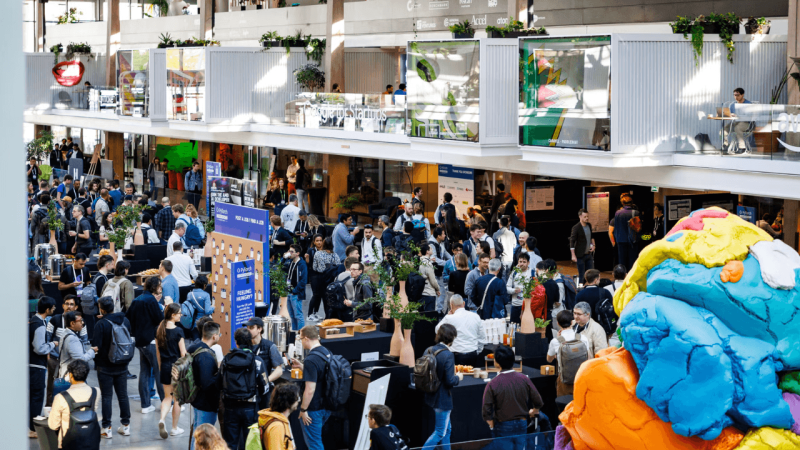
Earlier this year, I spoke with Mark Collier, Executive Director, PyTorch Foundation, at the PyTorch Paris conference.
From Meta project to neutral foundation
PyTorch originated at Meta, back when it was still Facebook. It was created as an open source framework to help researchers train deep learning models. Even in its early days, the team recognised that this software was too fundamental to AI research to remain closed. They wanted researchers everywhere to use it, contribute to it and build an ecosystem around it.
Collier recalls:
“This was six or seven years ago, before generative AI became mainstream. But PyTorch became one of the core technologies used to train the models that eventually led to systems like ChatGPT.”
Around three years ago, Meta transferred PyTorch into an independent, non-profit foundation. Collier argues that simply making code open source is only the first step.
When a project moves into a neutral foundation, other companies are much more willing to invest in it, contribute code and build products around it because they know it isn’t controlled by a single vendor that could change direction or lose interest.
“The PyTorch Foundation gave the project a permanent home, and since then adoption has only accelerated. Today, more than 90 per cent of AI laboratories developing frontier models use PyTorch.”
How critical AI infrastructure becomes a public good
Through Linux Foundation Europe, launched in Brussels in 2022, the organisation has been encouraging more open collaborative projects to be governed on European soil.
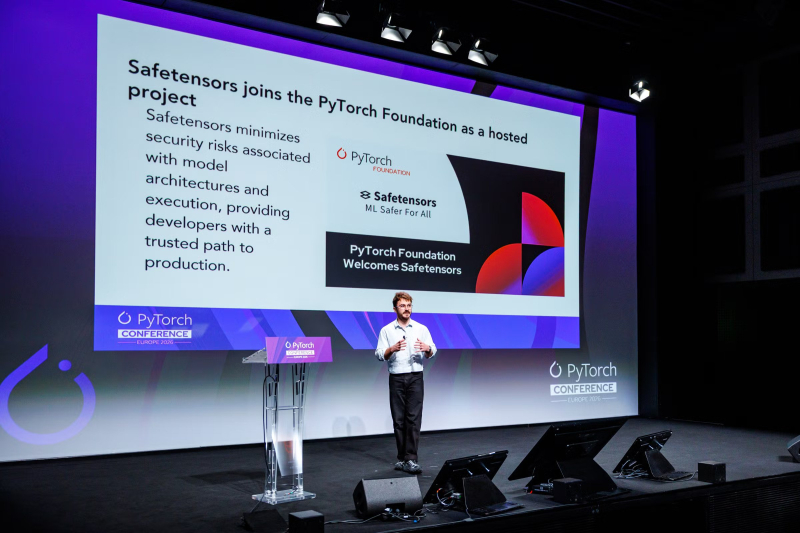
Collier points to Safe Tensors as an example of how critical AI infrastructure should be governed.
Originally developed by Hugging Face as a secure alternative to Python’ klo s pickle-based model format — which can execute arbitrary code during loading — SafeTensors is now being transitioned from company ownership to community stewardship.
Under the PyTorch Foundation, governance, trademarks and long-term stewardship will move to the Linux Foundation, while Hugging Face’s maintainers will continue to oversee day-to-day development.
An expanding home for open AI infrastructure
The Paris conference also reflected how the PyTorch Foundation is evolving.
Rather than acting solely as the steward of a machine learning framework, it is becoming a neutral home for an expanding open source AI stack. Alongside PyTorch, projects including vLLM, DeepSpeed, Ray, and Helion now sit under the Foundation, reflecting a broader shift towards community-governed infrastructure spanning training, inference, deployment and AI security.
According to Collier, “This follows a similar pattern to what happened with PyTorch itself. Moving an important technology into a neutral foundation signals to the market that it’s intended to become a long-term standard rather than remaining closely associated with a single company.”
SafeTensors is designed to improve the security of AI models by ensuring that downloaded models can be executed safely without introducing malicious code.
Collier argues that security standards are strengthened when the community joins forces on common implementations.
“The project was already successful, but joining the foundation should give it greater visibility, wider adoption and stronger long-term momentum.”
Why Europe matters
That said, while open source has become a central part of Europe’s AI strategy, policymakers continue to debate how it should sit alongside investment in proprietary frontier models and domestic compute infrastructure.
As Europe pushes for greater AI sovereignty, Collier argues that open source should form the foundation — not by creating separate European versions of software, but by ensuring globally maintained projects remain openly available for countries and companies to deploy locally.
“Europe has an extraordinary concentration of AI talent, particularly around open source AI,” says Collier.
Companies like Mistral have become global leaders in open-weight AI models, and Europe has built a strong culture around open source AI more generally. The region is also increasingly focused on AI sovereignty. Open source plays a crucial role here because it gives organisations access to the technologies they need without becoming dependent on a single vendor.
Collier cautioned:
“What we don’t want is separate regional versions of open source. Open source should remain global. Countries and regions can then use those shared technologies locally to meet their own sovereignty requirements. That’s the right balance.”
Where startups learn to scale AI
Collier argues that one of the greatest strengths of the PyTorch community is its access to companies that have successfully commercialised AI.
This means startups in Europe trying to bridge the gap between AI research and commercialisation can learn from others who have already made that transition.
“At conferences like this, startups can meet customers, partners and companies that have successfully taken research out of the lab and into production.
You can have very practical conversations about how someone turned a complex piece of AI software into a commercial product. There’s enormous value in learning directly from peers who are building businesses around these technologies.”
Collier shared:
“This is our first PyTorch Conference in Europe, and bringing everyone into the same room helps people work through competing ideas in ways that benefit the broader ecosystem. Ultimately, everyone here is betting on the same platform.”
Why open standards matter
For Collier, it is critical that AI remains open and accessible. The industry is investing enormous amounts in AI hardware and new accelerator architectures, but none of it matters without software capable of unlocking it. PyTorch provides a common layer. That’s why so many companies contribute to it.
“If we can maintain a shared, open standard that works across different hardware platforms, we’ll end up with a much healthier AI ecosystem than one dominated by only a handful of companies.”
Building the next generation of open AI
From here on, PyTorch aims to work much more closely with neighbouring open source communities.
“Modern AI depends on an entire stack covering training, inference, agents and deployment. No single project provides everything. Increasingly, these projects need to work together rather than exist in isolation.”
With PyTorch, anyone can contribute code to PyTorch regardless of their location. The Foundation also invests heavily in local communities, launching a local ambassadors programme in 2025, and organising PyTorch Meetups, PyTorch Days and regional events around the world
Those regional networks are an important way of keeping the community genuinely global.
For Collier, Europe’s competitive advantage isn’t simply producing more AI models — it’s helping build the open infrastructure that allows an entire ecosystem of companies to innovate.